people


Continuing from yesterday

“It is two a.m., as I leave this house and travel on until sunrise when I came in sight of Reno. At six o’clock I came to a good grass patch where I stopped for my companions to get a nibble. At seven, I journeyed on and entered the town of Reno at half-past eight o’clock, passing through and halting about eighty rods west of the town. Having secured my cattle, I went in search of a blacksmith to shoe my cow.

“I inquired of several but did not find the right one, but was told that such a man could shoe her; I went there and inquired for the proprietor, of whom I asked, ‘Can you shoe a cow for me? I am traveling east with a horse and carriage, leading a cow. I have traveled about seven hundred miles and have not been able to get her iron shoes; I have had her feet seared three times, which have worn very small.’ ‘I have never shod a cow, but have shod a great many oxen and think I can shoe her.’ ‘How much will you ask me to put iron shoes on her?’ ‘My price for oxen is four dollars; if you and I can do it, I will charge you but two dollars.’ ‘When will you shoe her?’ ‘After dinner. Where is she?’ ‘But a short distance from here.’ ‘Lead her down after dinner and I will see what we can do,’ said the blacksmith.

“About one o’clock, I drove down to the shop with my horse, carriage, and cow. I had not said a word to any one but the blacksmith, but on my arrival there were scores of people to see the cow shod. Many were the questions leveled at me, which I patiently answered with as little show as possible. ‘Stranger,’ said the blacksmith, ‘lead your cow around into the brake, we will see what can be done.’

“I untied the cow from the carriage and led her around the shop to the brake. The horse was very much troubled at seeing her led away, but on coming in sight of the horse she was all right again. I am in the habit of talking to my cattle and think they understand much more than we give them credit for. ‘Come, Bessie,’ I said, ‘get into that brake, it will not harm you.’ I went into the brake ahead of her and she followed me without any further trouble.

“A strap was put under her belly and she was raised from her feet; this was more than she would stand, so I asked the blacksmith to let her down again, which he did. I then went to my carriage and got some rope. Putting a rope around each hind leg, and bringing her feet back under her rear parts, I took up her forward foot, telling the blacksmith to make it fast, which he did. She tried to get loose but could not. In the meantime, I had taken the horse out of the carriage and fastened her beside the cow, telling the blacksmith to make a good job. He answered that he would do his best.”

to be continued …

When we last heard from Mr. Johnson, he had fallen in with some shepherds who were guarding a huge flock of sheep from wolves, on the road to Reno.

That same night …

“It was about midnight when I left my camp; I concluded it would be safer to move on than stay there with all those wolves around me. I filled my lantern with oil and moved on; after traveling about a half mile I found that I had a big hill to descend, it was very dark and could scarce see my way. I roped my wheels and descended the hill with bated breath, not knowing what might happen; I could see on my left a deep canyon, the road was apparently wide and good. Having made the descent safely I breathed more freely; on going some further distance I came to a house, which I approached and knocking at the door a voice answered, ‘Who is there?’ ‘Get up, friend, I would like to ask a few questions.’ ‘Go on, I can hear you without coming there,’ was answered. ‘I won’t harm you, I am traveling and from Eureka, three hundred miles from San Francisco.’ ‘You from Eureka?’ ‘I am, sir.’ ‘You talk as I used to do at home; I left Maine for Eureka in 1868. I am a Yankee, as evidently you are by your talk?’

“[I replied,] ‘You are right; I am. I came by way of Grass Valley, on the Henness trail, by Webber’s Lake. When I reached the turnpike I was in the rear of a herd of sheep and could not pass them and was obliged to travel in their rear until we came to the old saw mill on the hill where they turn into the canyon, while I camped opposite the mill. There seems to be any quantity of wild animals in that canyon; the herdsmen kept firing away all the first part of the night. I went to bed but dared not sleep, and became so much excited that I broke camp and came on here, running my chances of safely reaching Reno early in the day. How is the road thereto, is it safe to travel at night and is there much timber on the road?’ ‘From here to Reno is twelve miles and the road is both good and safe either night or day; there is no timber on the way.’ ‘How far am I from the railroad?’ ‘Not more than a half mile. This is Verdi, you will not pass the depot, as it is to your right a few rods. Stranger, you have been passing through the most dangerous part of California; no part being so dangerous as the last hundred miles you have come so far unharmed, and so far you are a very lucky man, I hope you will succeed as well on your longer journey, good morning.'” …

One of the ads I’m designing for the March issue of The Carriage Journal is a full-page advertisement our 2014 International Carriage Symposium (next February at Colonial Williamsburg). The focus of this fourth biennial symposium is carriage and wagon accessories, which includes lamps, livery, whips, etc.

In searching for an image to illustrate this particular ad, we went through Jill’s collection of Vanity Fair’s prints of famous coaching men. And we found this lovely print of Alfred G. Vanderbilt. You may remember him as the American coaching enthusiast who took his coach, the Venture, and eighty horses to England, in order to drive them on the London-to-Brighton road for several weeks during the summer of 1908. (You either already knew this or picked it up from yesterday’s tweets, right?).

He was a little too tall for my scanner, but I managed to scan him in two parts and stitch him back together quite nicely.

.

Alfred G. Vanderbilt, from Vanity Fair

.

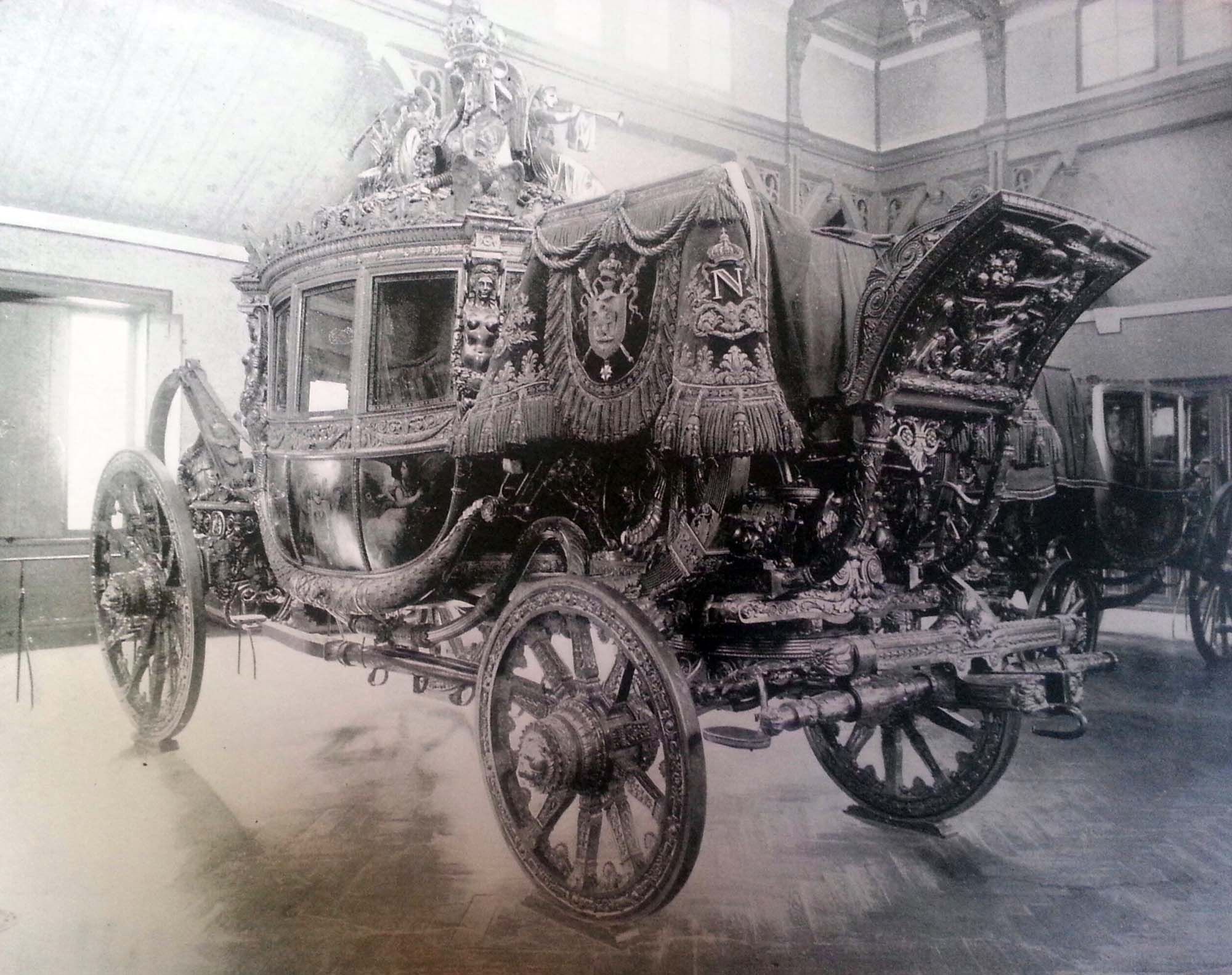
For our next Glimpses of the World photo, and the last from France, we have this magnificent coach:

.

from Glimpses of the World (1892) - page 55.

Here is the caption that accompanies the image in the book:

Among the relics of royalty and of the empire displayed at Versailles is this magnificent vehicle, the woodwork of which is one mass of gilding, while the interior decorations are of the most elegant description. This is said to be the carriage in which the Emperor Napoleon I went with the Empress Marie Louise to solemnize their [1810] marriage in the Cathedral of Notre Dame. [Their wedding actually took place at the Louvre.] All Paris was in the greatest excitement, and Napoleon’s future seemed then brilliant beyond all precedent in modern history. Yet in reality these gilded wheels were swiftly bearing him to what Napoleon himself subsequently called, “an abyss covered with flowers.” And such indeed proved to be this fatal marriage following his divorce from Josephine. No doubt Napoleon’s pride was gratified, as in this gorgeous vehicle he sat beside his Austrian bride, but it was certainly impossible for him to ever love her as he had once loved Josephine. The latter, slightly older than himself, had been his life-long confidant and friend. She had at first contributed much to his success. Her intuitions made her a most useful counselor. But what was Marie Louise? A simple, inexperienced girl, with whom the emperor always wore a mask, lest his designs should through her reach the court of Austria! The one possessed a character as weak and vacillating at her face would indicate. The other proved herself a heroine by sacrificing to the interests of France not only the most enviable throne in Europe, but also the most famous of earth’s sovereigns, and the man she loved. “It will not bring him fortune,” said the common people when the divorce had been proclaimed, and they were right.

.

Interestingly, even though our book was published only eighty-two years after the events of 1810, the caption is incorrect.

This coach was not used by Napoleon I. Rather, a whopping thirty-four ceremonial Berlins were ordered (from fourteen Paris coachbuilders) specifically for the wedding procession. The two known as “La Victoire” and “La Cornaline” were used by the imperial couple.

The ornate coach shown above was built in 1814 and was used in 1825 as Charles X’s coronation coach. In 1856, it was renovated — and the Napoleonic “N”s were added — and was used for the baptism of Napoleon III’s son.

It’s now in the collection at the Palace of Versailles and is, in fact, currently on display in the “Roulez carrosses!” exhibit (through November 10) at Le Musée des Beaux-Arts d’Arras in France.

You can see color photos of the coach and read more about it here.

(continued from yesterday) …

“This is a very good road, I have had none like it so far on my journey. I am traveling in the rear of a large flock of sheep and cannot get by them. On my left is a deep canyon, and on my right is a high bluff or mountain. I asked the herdsman where they intended to camp? He said, just this side of Silver Peak, but a short distance further.

“At six o’clock we came to a saw mill. At the left of this mill the herdsman turned in and drove down into the canyon. I was informed that there was good feeding, but did not go down to see. I pitched my camp opposite the mill, where there was a good feeding of wild oats, which my cattle readily devoured. They were the first wild oats on which they had fed. I made a fire, wood being around in abundance; made a dish of tea and ate my supper and laid down for a while.

“About nine o’clock I got up and after securing the cattle for the night I again laid down, but could not go to slepp, on account of the sheep bleating for their young, there being about six thousand of them in the canyon. About half-past ten o’clock I heard the report of a gun, then another, and another.

“I called out, ‘What is the matter down there?’ ‘Matter enough, the wolves are after our mutton, the canyon is full of them. We dare not set our dogs on them as they will be killed, so we blaze at them.’ ‘Come up here and get some milk, I have some and you can have all you wish.’

“The man was soon at my camp who said, ‘I have come for that milk, thinking it must be worth coming after.’ ‘But what have you to carry it in?’ ‘Oh, the devil. I did not think to bring anything. Can’t I take the can, I will bring it back; what is it worth?’ ‘I paid a dollar for it in Sacramento.’ ‘Will you sell it, I will give what it cost you and more if you say so.’ I let him have the can at cost and he gave me a dollar. He wished to pay me for the milk also but I declined to take it. ‘What is the matter among your sheep?’ I asked. ‘The wolves want mutton; they were as thick as rabbits when I came up, I could hear them in the brush after the sheep; they can smell a sheep a long way off. Our sheep are hungry, still we dare not let them feed at nights; they must wait till morning and then the dogs can take care of them,’ said the shepherd. ‘In what kind of a place are your sheep tonight?’ ‘They are in a kind of oblong square, and there are six thousand of them; they will cover about two acres. On one side we have three camp fires, on the other are six dogs and four men with guns.’ ‘Do you fear the coyote?’ ‘No, we do not, we set our dogs on them, but the wolf would kill a dog mighty quick. When the wolves show themselves we quickly blaze at them; we try not to kill but to wound them. If a wolf is wounded we are not troubled with others for some time.’ ‘You was not afraid to come for the milk?’ ‘I should not have dared to come had I not had this lantern, it is enough to keep any wolf away from me.’ ‘Do you think they will make an attack on me?’ ‘They will not trouble you as long as the sheep are there, if they were not around they might attack your cattle; but you need not fear.’

“Bang, bang, bang, went three guns. ‘I must go back, there may be something for me to do; they may have a strong army and if they attack us would make a clean sweep of the sheep. Stranger, you have been passing through a wild country; have you not been troubled by these infernals during the night? If not, you are remarkably lucky.’ ‘At Graniteville, I was told that I was entering a wild region and should be ready to meet them. Since then I have been on the lookout, and tonight the varmints are plentiful around and should be handled with firmness.'”

« Previous PageNext Page »