In celebration of tonight’s opening ceremonies for the 2010 Vancouver Winter Olympics, we bring you the following story and photos from our friends at Drive Canada.
The text and photos are from Gerard Paagman of Invermere in British Columbia, Canada.
In October 2009, we were contacted by the Olympic Torch Relay Committee with the question, “Are you willing to help us with your Friesian horses and a sleigh in bringing the Olympic Torch across a frozen lake for the first time in history?”
Of course we immediately said, “Yes.” What a great opportunity and privilege to have driving and the Friesian horses placed in the world spotlight!
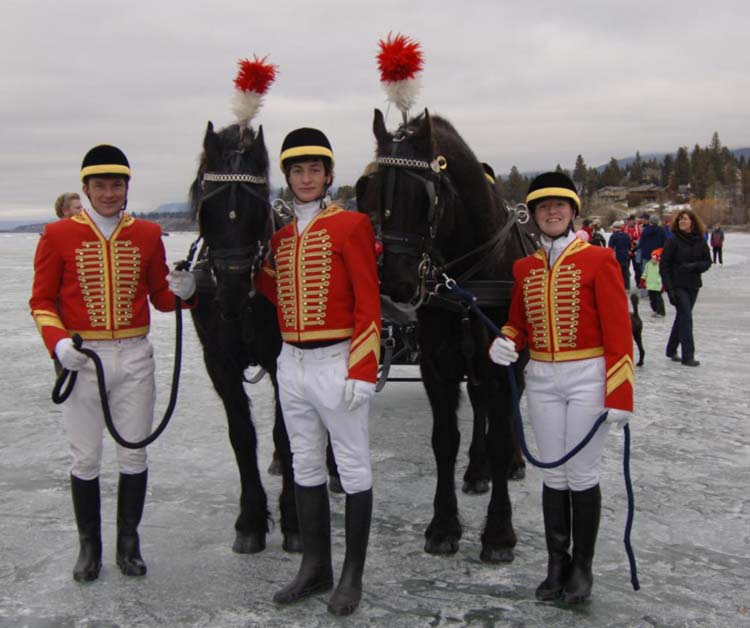
In December 2009, it turned really cold and Lake Windermere in British Columbia (the lake we would have to cross) froze. So, we started practicing with a four-in-hand team of our horses. At that time, we did not know how the ice would be when the Olympic torch would actually cross the lake. Would it be plain ice? Would the ice be covered with two or three feet of snow? Or would we be facing heavy snow banks? In order to make sure that we were well-prepared, we worked together with our farrier, Dan Higs from Cranbrook, and tested all the different shoes for all possible conditions that we could encounter.
And there were meetings; many meetings. And most of the topics discussed were about safety and protocol. How heavy are our horses? Will the ice be strong enough to hold four horses and a sleigh and six passengers (approximately 7,000 pounds)? Can the horses keep up to the requested speed of 10 miles per hour? Are the horses “bomb proof,” or will a helicopter above their heads scare them?
And then … January came and the weather changed! Instead of turning even colder, we noticed that it was turning really warm and that all the snow on top of the ice melted and a thick layer of water was on top of the ice. Normally, during the winter, there is an official road on the ice of Lake Windermere, but as it turned out to be so warm a week before the torch would cross Lake Windermere, the road was closed!
So, more meetings. Alternative plans were made.
And then we were lucky: it started freezing again!
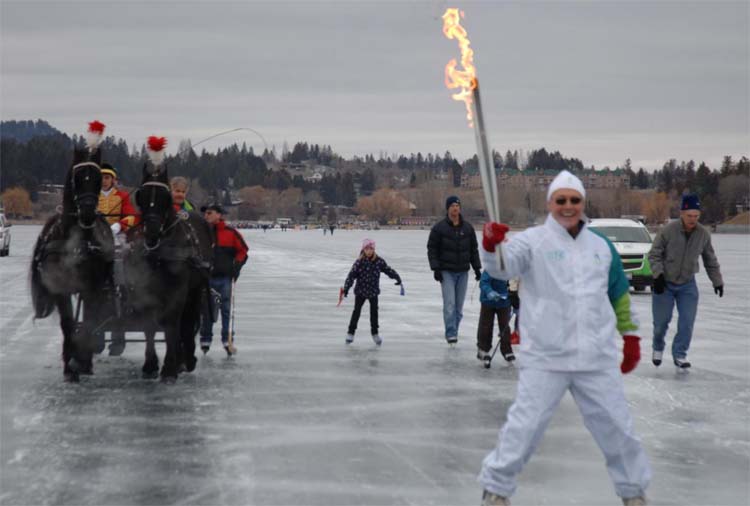
On Thursday night (the evening before the day on which the Olympic torch would cross Lake Windermere) we got the final YES; the Olympic torch would cross Lake Windermere for the very first time in history! We had planned to hitch up four horses to our sleigh, but the security people only gave us permission to hook up two horses (as a pair) because of the ice conditions on the lake.
The next morning (Friday), around 6:00 a.m., we arrived with our horses at Lake Windermere for the final testing. The cars that were escorting the Olympic Torch Relay Committee were driving next to us and providing us with enough light, by means of the high beams on their cars, as it was still dark. The ice was then tested again to make sure that we would also be able to keep up with the requested speed of 10 miles per hour. Security people were yelling through big speakers mounted on their trucks to test whether the horses were really bomb proof!
And then, at 8:00 a.m., we got the final approval from the security people; our horses, sleigh, harnesses, and driving skills were good enough and the show could start!
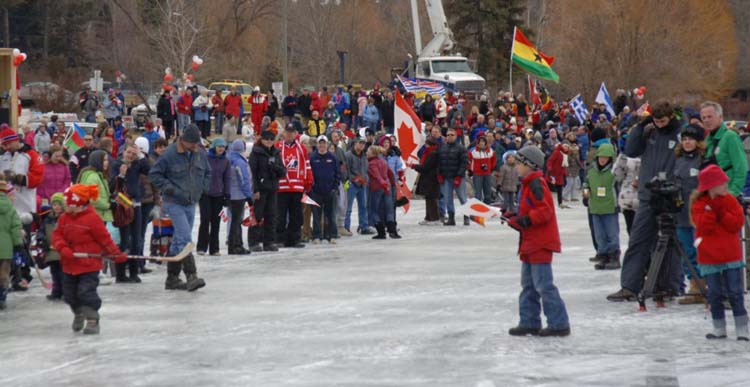
The torch was scheduled to leave the Invermere beach at 1:10 p.m. To make sure that we were on time, we arrived at the beach an hour early. Never in their entire lives have our horses had so much attention from the press, photographers, and spectators as during that unique hour!
We got our special passengers in our sleigh: two former Olympic gold medalists, meaning that we got even more attention from press and spectators! The director of the Torch Relay Committee arrived at the beach. When he saw the sleigh and the horses, he decided that he also wanted to sit in the sleigh! And so … the head of security also had to come with us in the sleigh.
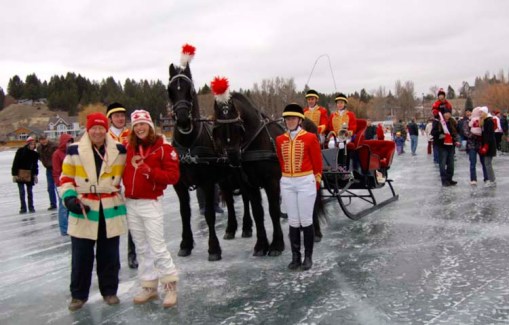
photo courtesy of Gerard Paagman
In just a few minutes, the security people filled our sleigh with a lot of communication and safety devices. At this point, we were constantly surrounded by at least four security people around the horses and the sleigh. In addition, they also made sure to put a number of spare torches in the bottom of the sleigh.
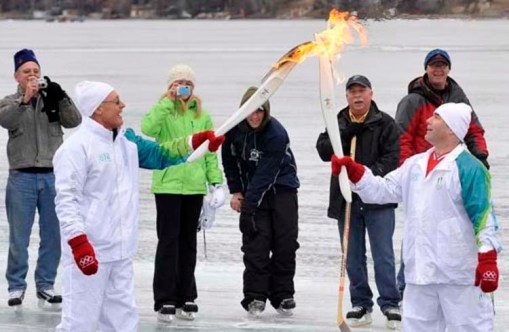
photo courtesy of Gerard Paagman
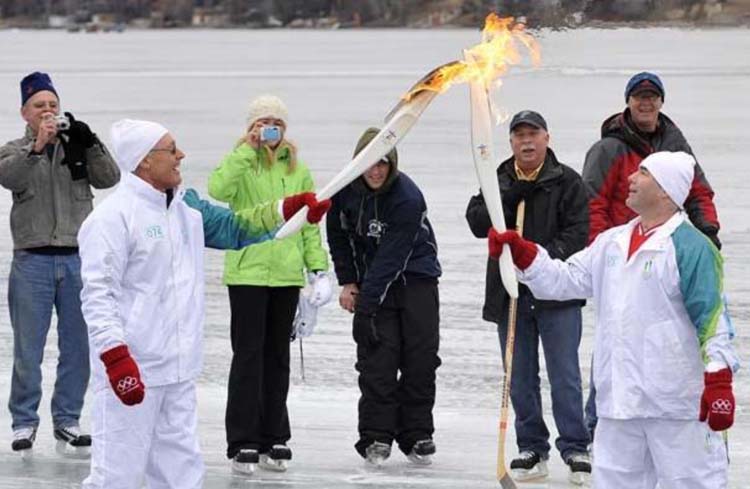
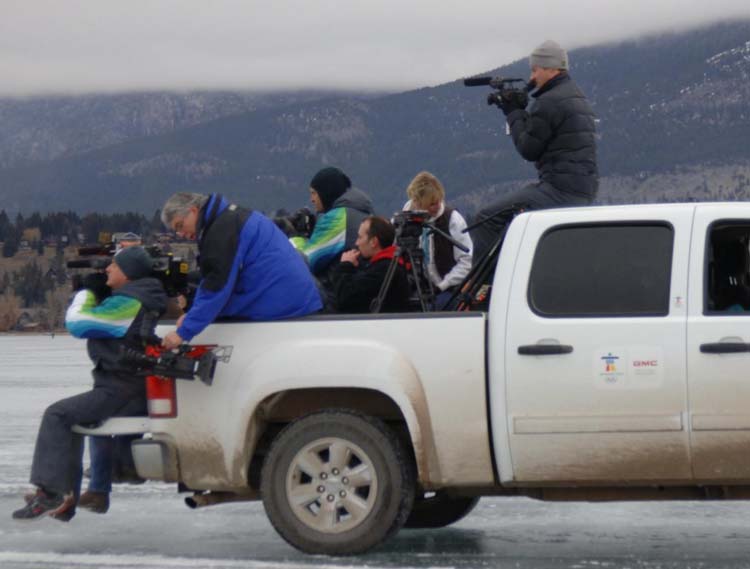
At 1:10 p.m. exactly, the torch arrived at the beach. What great energy and excitement was in the air! Our tour across the lake started. Trucks filled with media were all directed to drive next to us. We were live on television!
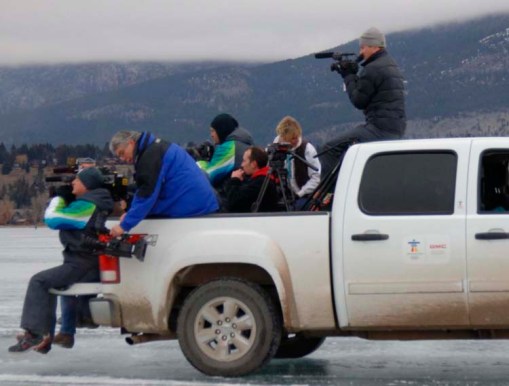
photo courtesy of Gerard Paagman
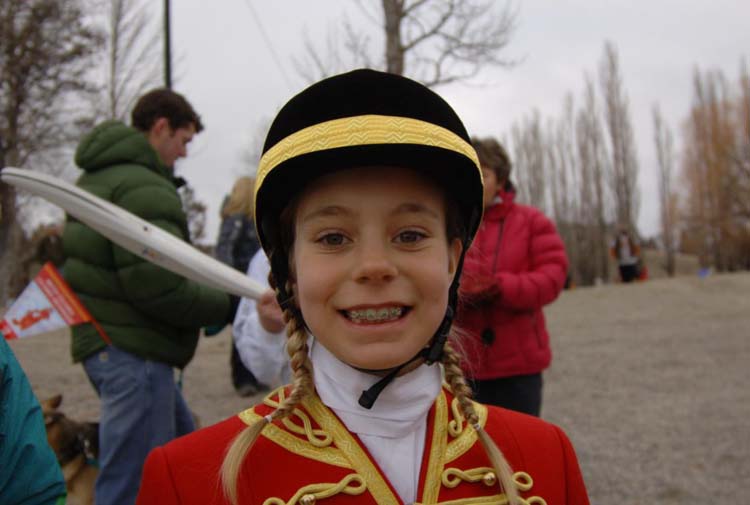
The horses were doing great. It was pretty easy for us to keep the requested speed and so we let Balance (a twelve-year-old girl) drive the horses.
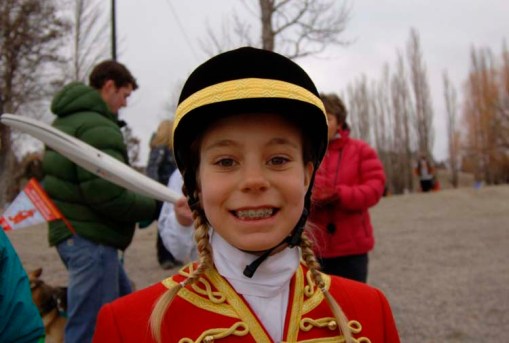
photo courtesy of Gerard Paagman
At one point, the head of the security said he had just been informed that 22 million people were watching the Olympic Torch Relay live! For the first time in history, the torch was going over a frozen lake, and for the first time in history accompanied by Friesian horses and a sleigh!
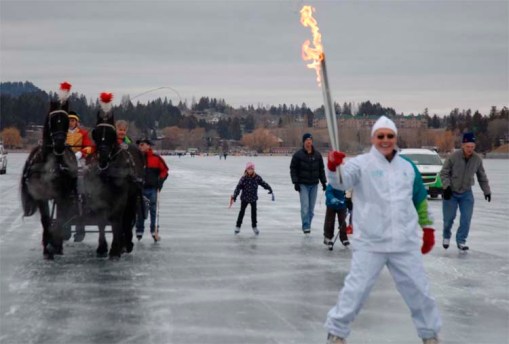
photo courtesy of Gerard Paagman
We got instructions from security to increase our speed to 11 miles per hour because we were a little bit behind schedule. Not a problem for us or for our horses. But the new speed was too fast for the torch: the flame went out! Our whole group stopped, and the television companies got instructions to switch to a commercial. A new torch was taken out of our sleigh, lighted, and given to the torch bearer. After this has been completed, we continued our journey of crossing the lake while keeping the original speed of 10 miles per hour.
In about forty minutes, we arrived at the Lake Windermere beach, where we were welcomed by a great and enthusiastic crowd. More security swarmed around the torch, and the torch immediately continued on its way to Vancouver.
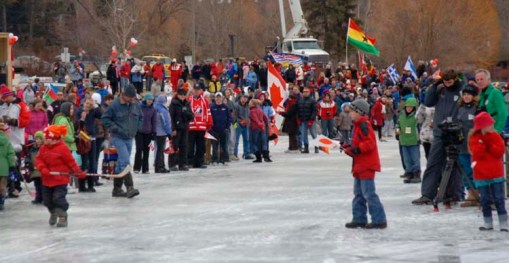
photo courtesy of Gerard Paagman
For the very first time in history, the Olympic torch had crossed a frozen lake. We felt so honored that we had been part of it, and we were so proud of our Friesian horses, our Ideal Harnesses, our sleigh, and our whole team of people!
The Friesian horse, again, had proven to be reliable and versatile and it was great that the 22 million people who had been watching in North America had now witnessed the Friesian horse showing her elegance and beauty.
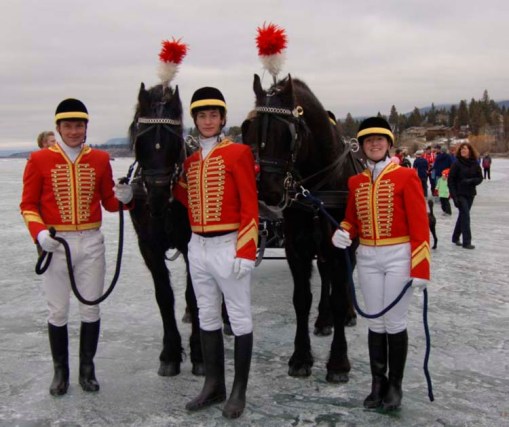
photo courtesy of Gerard Paagman
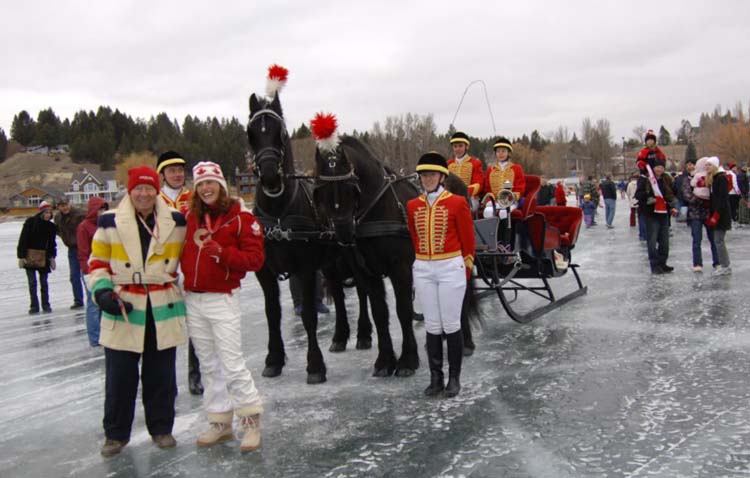
 The Slower Road