horses & driving


The CAA just received a wonderful donation of books from a member in Canada, and I admit that I (and several others) spent a good hour or so looking through the boxes when they arrived earlier this week.

One of the books is from a series called The Sports Library. This particular one: Riding, Driving, and Kindred Sports by T. F. Dale.

The book was published in London in 1899, and the Introduction says, “In preparing the Sports Library for the younger generation of sportsmen, the Publisher and the Editor had the following ideas in view:

“They intended that the books should be written by sportsmen of the younger generation in thorough sympathy with the needs of younger athletes and twentieth-century ideas. They hoped where necessary and practicable to deal with the cost of each sport, and also to show the public that many sports which are considered beyond the means of the ordinary man, are quite within the reach of all who are really interested. … Last, but not least, it was intended that the series should be a kind of cheap Badminton Library to the thousands of sportsmen who cannot command the price of that series.

“It is natural, perhaps, that the book on Riding, Driving, Hunting, &c., should come first. In no country is the interest in horses more widely felt than in England; it extends from the coster who drives his Russian pony to the Derby, and the City clerk on his hired hack enjoying Saturday afternoon, to the Earl of Lonsdale and the Duke of Westminster. It is anticipated that the motor cars and bicycles will so reduce the price of horses that the splendid exercise of riding will come within the reach of many who have hitherto regarded it as prohibitive.

“Mr. Dale needs no introduction to lovers of horse-flesh. Land and Water, the Field, and the Badminton Magazine have published his articles for many years, while he is well known as the author of Polo, editor of the book on Polo in the Badminton Library, “The History of the Belvoir Hunt,” &c., &c. Mr. Dale is, perhaps, the greatest authority on Polo in the United Kingdom; while in hunting and racing there are few other men who have seen so much sport at such a small expenditure of cash.

“The second volume of the Sports Library is a thoroughly up-to-date work on Football — Association and Rugby — Hockey and Lacrosse. …

“The Editor hopes to include in the third volume of this Library treatises on boxing, fencing, gymnastics, wrestling, and physical culture — each sport to be described by well-known men. Volume IV will include running, athletics, swimming, and water polo. … It is hoped that its readers, the younger generation of sportsmen, will show their appreciation of these efforts by encouraging the Publisher and Editor to produce a library of ten volumes covering every known sport.”

Mr. Dale may have been an expert on polo, but his book includes chapters on horsemanship, riding to hounds, ladies on horseback, polo (naturally), sport and health, dress and equipment, driving, tandem driving, four-in-hand driving, hog hunting, racing, and more.

Starting tomorrow, and continuing for several Saturdays, we’ll take a look at his amusing chapter on tandem driving. Stay tuned!
This is another one of my (very) occasional blog posts that’s not really about much of anything other than being able to say I posted something today.

I and a whole bunch of other volunteers are at the KY Horse Park today (in the CAA office as I write this, eating lunch) having a volunteer “work day” for next week’s KY Classic CDE.

I was hoping to get photos of the work day to post here, but I’m on sign and “rope barrier” detail, and I didn’t think it would be terribly exciting to post photos of us pounding stakes in the ground and running rope between them.

And … I want today’s post to be short so that everyone gets a chance to see the wonderful videos in yesterday’s post.

Back to work, then.

If you’ve just stumbled onto this carriage- and driving-related blog, or if you’re a regular reader who doesn’t actually drive, or even if you’re an experienced driver but would like a pleasant refresher course, you may find these (old) videos rather interesting:

.

.

.

.

.

from the March 5, 1898, issue of  The Rider and Driver:

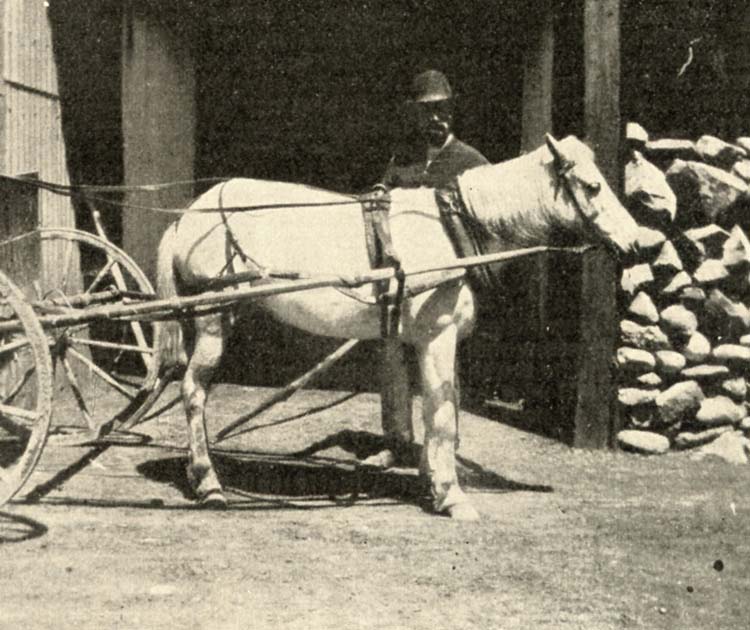
The Torbay Nag

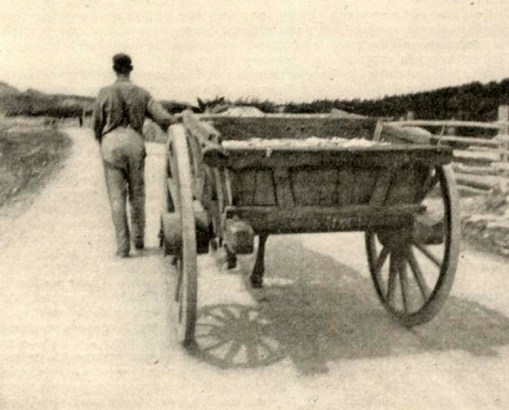
The horseless carriage attracts the attention of the visitor to New York. In Newfoundland he is struck by the sight of the almost horseless carriage.

.

.

The gentle Torbay nags, which peck away at the hard roadway with their little hooves, seem to have such a small part in the motor arrangements of the outfit that one can hardly realize that they are doing all of the pulling. I wanted to go downhill all of the time when riding behind one them, just out of sympathy for the little beastlet, but I was assured that they preferred to go uphill. Probably on the theory that it felt so good when they got to the top.

In the cold northern climate the horses seem to contract in order to expose the smallest area of surface to the bleak winds, but all of the goodness of the big horse remains within the little one and the nags represent the peaceful ways of the hardy and hospitable inhabitants of the “Isle where sailors gang to fish for cod.”

I have often thought that these Torbay nags of Newfoundland would make interesting pets for children because they will keep good-natured under the inflictions that our dear barbarous progeny impose upon the things that they love most, and if anyone forgets to feed a nag it is of little consequence, because one such small meal as he would eat is a trifling affair. It is said that in winter they will dig down through the snow with their hooves and get a good living on the moss and dried grasses. I have also heard that in times of short rations they will eat dried cod fish, but I will not vouch for the truth of this statement.

.

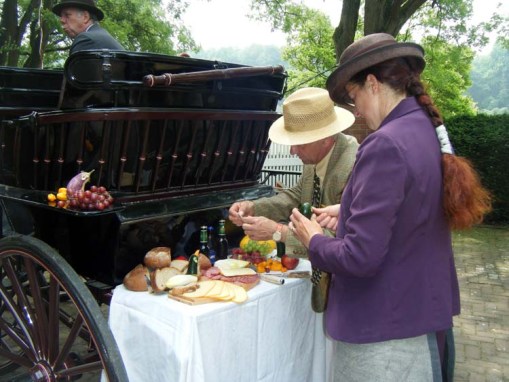
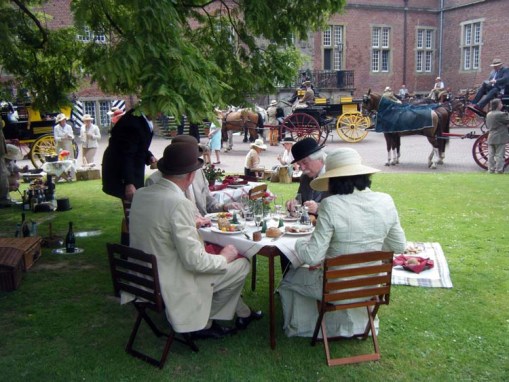
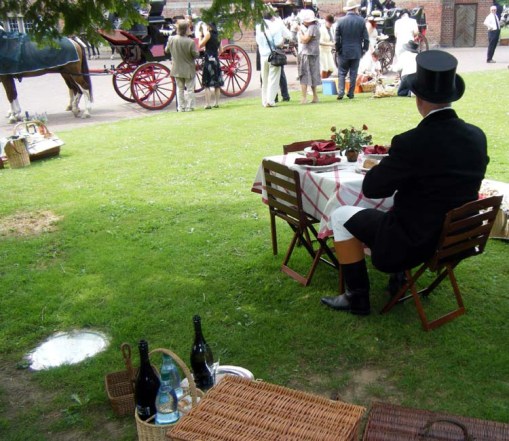
Every two years, members of Europe’s Private Driving Club gather for a two-day drive through the countryside, punctuated by sherry stops, elegant picnics, visits to private castles and estates, and festive dinners. The club’s goal is to celebrate their common love of horses and fine antique vehicles.

The drives are typically held in Belgium, but this year’s (back in June) took place in the lower-Rhine countryside of far western Germany. CAA members Penny and John Hunt were invited to join the drive and rode as guests of Consuelo de Grunne, on her Siamese Phaeton, hitched to a team made up of two Halflingers and two Highland Ponies. For Penny’s account of the two-day drive, watch for the October issue of The Carriage Journal.

In the meantime, we hope you’ll enjoy these photos of PDC members and guests enjoying their picnic lunches.

Penny & John Hunt's hostess, Consuelo de Grunne, setting up a picnic suitable for her Siamese Phaeton (photo by Penny Hunt)

Penny & John Hunt’s hostess, Consuelo de Grunne, setting up a picnic suitable for her Siamese Phaeton

one of the many lovely picnics at Kalbeck Castle (photo by Penny Hunt)

one of the many lovely picnics at Kalbeck Castle

... and another (photo by Penny Hunt)

… and another

... and one more (photo by Penny Hunt)

… and one more

« Previous PageNext Page »