horses & driving


A little over two months ago, we began a read-along of sorts: small weekly morsels comprising the chapter on tandem driving in the first volume of  The Sports Library (by Mr. T. F. Dale), published in 1899.

If you didn’t start reading along with us from the beginning, you can catch up by reading part of the book’s introduction (and the introduction to our look back at this nineteenth-century book) and parts one, two, three, four, five, six, seven, eight, and nine of Chapter 10.

Today, the tenth part:

I have spoken about being run away with in a tandem. My experience suggests that this is a rare occurrence, but it has happened to me, and, as it illustrates the usefulness of being handy with the whip, I may relate my experience here. I had driven out a twenty-mile stage from Dera Ghazi Khan to meet a local dignitary on a tour of inspection, and I had to take him back to the station.

Now I had fever at the time, and was weak, and had, too, a leader which had only been at work in harness a short time. Almost as soon as we got into the cart, the leader, a powerful, rather nasty-tempered, but very useful animal, shied at a loaded camel and bolted. Unluckily the wheeler was fresh, and joined in the game. I took a pull, but found that I was powerless, and, moreover, I recognized that, being weakened by fever, I might easily exhaust my strength and roll off my seat.

The road was clear and rather sandy, so I devoted my attention to keeping the team straight. All was going well if rather fast, and I felt I should soon get a pull at my rebellious team, when I recollected that a short distance ahead was an Irish bridge across a mullah. An Irish bridge is so called because it goes under instead of over the water, and is a favorite frontier method of preserving roads which are liable to sudden floods. The dry watercourse is bricked where the road crosses it, which preserves the road and gives a sound bottom in times of flood. The descents are, however, often steep, and generally, as you approach these bridges the brickwork stands above the road by four or five inches. Knowing the tendency of country-breds in general and my black in particular to shy, I pictured to myself a sudden swerve, the wheeler’s legs caught in the trace, and a general smash up.

I tried a pull, but found they were still full of go. Then the best thing to do was to keep them going, and as we approached the critical point, I hit the leader and wheeler, drawing the whip, as it were, the length of the team, and sat tight. Up jumped the cart, down flew the ponies, their feet rattling on the bricks, and up the further side with the traces as tight as possible. I think the sudden change in the road and the swift descent and the weight of the cart as we scrambled up the far side steadied them, for I found I had got hold of them directly we were once more in the road, and the rest of the drive passed without incident. …
About two months ago, we began a read-along of sorts: small weekly morsels comprising the chapter on tandem driving in the first volume of  The Sports Library (by Mr. T. F. Dale), published in 1899. We missed last Saturday’s installment because I was out of town and reporting on our CAA International Carriage Symposium at Colonial Williamsburg, but Mr. Dale is back this week!

If you didn’t start reading along with us from the beginning, you can catch up by reading part of the book’s introduction (and the introduction to our look back at this nineteenth-century book) and parts one, two, three, four, five, six, seven, and eight of Chapter 10.

Today, the ninth part:

… Many amusing little incidents I recollect, but only two adventures.

On one stage the evening journey ended at a little police-station. There was no regular rest house, but there were a couple of rooms for the use of European or superior native officers when traveling. This stood in the middle of a wide and treeless plain. One day I was driving along quietly as usual when my attention was attracted by thunder growling on the horizon. I looked up, for rain is rare in those parts, but there on three sides were three separate storms creeping along towards us. Tropical thunderstorms and rain are not pleasant to be out in on a bare plain, besides I had my bedding strapped on under the driving-seat and the nights were chill, so I decided to race the storm. I think the ponies were a bit frightened, for they laid themselves out to gallop well, and soon I had them at full stretch. The thunder growled, the crimson lightning ran along the ground, the darkness swept down over us till I could barely see my leader’s ears, and it was all I could do to keep the team on the road. Soon I did not know where I was, when I saw the dark square of the little police post loom up, pulled up, unstrapped the bedding, and bolted for shelter just as the rain came down in sheets. As it happened the little post was the very center of the disturbance and we were lucky to get the horses and ourselves into shelter. …

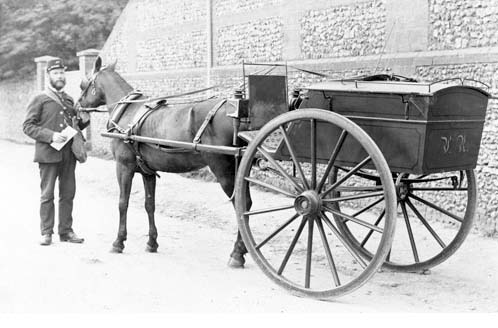
A member sent this photo, from 1894, showing a British postman with his horse and mail cart.

.

.

The photo’s caption reads as follows:

“The last London-based mail coach, between London and Norwich, ceased running in April 1846. However, the use of horses by the Post Office continued for another hundred years. The photograph shows a postman, horse, and cart used on a rural delivery route in 1894. From the 1840s, railways carried the mail across the country. But local delivery needed an efficient road service, still driven by the efforts of horses. The Post Office preferred not to run its own service; instead, the individual routes were contracted out. Successful applicants provided horses, vans (to Post Office specifications), and driver, who were provided with a Post Office uniform.”

Bob (who sent us the photo) also reports that, according to Post office specifications, the horses should be “… from 15 to 16 hands, … clean-limbed trotters, rising five …”

Several weeks ago, we began a read-along of sorts: small weekly morsels comprising the chapter on tandem driving in the first volume of  The Sports Library (by Mr. T. F. Dale), published in 1899.

If you didn’t start reading along with us from the beginning, you can catch up by reading part of the book’s introduction (and the introduction to our look back at this nineteenth-century book) and parts one, two, three, four, five, six, and seven of Chapter 10.

Today, the eighth part:

… As you glance over your team before starting, see that everything is in its place, the back-band is sufficiently loose, and the cart so balanced that the wheeler trots comfortably; the tongues of the buckles standing up from time to time. A glance shows you that the wheeler is drawing from his traces and not from the shafts, while the leader is just barely carrying his bar. Then as you come to a rise in the ground, the thong flies lightly off the crop, touching the leader under the bar and making him spring forward into his collar. As you reach the crown of the hill or just before it, you loop back the leader’s reins. The clink of the bar and chains tell you the leader is no longer drawing, and you go steadily down the descent.

It is evident that one of the dangers of tandem-driving is that a too-free leader will pull the wheeler on to his nose. The leader ought never to be really at work save up a rise or in very deep ground. The wheeler of course does most of the work, but it is wonderful what a great difference to his power of work the leader makes. At the hardest points of the road there are two instead of one. Besides horses go much more gaily when there are two than when there is only one.

My last stage in, on one of my frontier journeys, was about ten miles, part of which was over a deep and sandy road. On one occasion after the change the syce let the leader from the last stage go, and she came galloping up and ranged alongside the leader with a whinny. She trotted beside him all the way, having of course not a stitch of harness on. Never had my team gone so pleasantly or easily. Always after that the mare was let loose over that last stage and always trotted home with the team, seeming to encourage and cheer those at work. I found in practice that I averaged with a tandem, with a heavy load and rough roads, about seven and a half to eight miles an hour, which must be considered fair going, and I did about thirty miles a day with the teams. Thus in the morning, one team was sent out seven or eight miles. When I overtook it I changed, going on to the place where I halted for breakfast. The pair that came in first went out first in the afternoon, and the change was effected in the same way: all thus, of course, traveled thirty miles, but were in harness for only fifteen. The ponies — ordinary country-bred polo ponies — were never sick or sorry. …

Several weeks ago, we began a read-along of sorts: small weekly morsels comprising the chapter on tandem driving in the first volume of  The Sports Library (by Mr. T. F. Dale), published in 1899.

If you didn’t start reading along with us from the beginning, you can catch up by reading part of the book’s introduction (and the introduction to our look back at this nineteenth-century book) and parts one, two, three, four, five, and six of Chapter 10.

Today, the seventh part:

… One of the great secrets of tandem-driving is a light hand, another is to keep your hands still. I have found in practice that many animals which pull hard in the saddle or in the wheel, will not pull an ounce as leaders in a tandem. Then if you want your team to go well and look well, keep your hands still, for when once you have the team straight the reins should need little or no changing. A tandem team can be turned with the slightest movement of the wrist, for when once the horses are going it is the very lightest and handiest of teams.

Half the trouble and embarrassment in driving comes from pulling too hard, and in driving tandem it is well to recollect how slight a touch is needed. Women, few if any of whom have the strength requisite to drive four horses, can and do drive a tandem beautifully. And it is most delightful to drive a free-going tandem, with horses in a straight line trotting out freely, their hooves rattling gaily on the road.

« Previous PageNext Page »