horses & driving


It’s been a while since we caught up with Mr. Johnson on his travels across the continent. Let’s see what he’s up to …

On the morning of August 14, 1882, he “left Grass Valley for Reno, traveling the old trail known as Henness Pass, which passes through Nevada City, North Bloomfield, Graniteville, Jackson’s Ranche, Webbers Lake, Sardinian Village, and comes out on the old turnpike, by Silver Peak Mountain to Reno.”

After passing through Nevada City in the early morning, he stopped to give his horse and cow some water and grain. While stopped, he met and struck up a conversation with a couple who lived there but who were originally from Connecticut. Being from (and on his way back to) Massachusetts, Mr. Johnson chatted with them for a while.

Finally, he said, “‘I must go on, I am making too long a stop, I have so many miles to make per day.’ ‘How many miles a day do you travel?’ ‘When I travel ten hours, I make twenty-five miles; when but eight hours, only twenty miles; in this way I know the number of miles.’

“‘Stop and have some dinner with us,’ [said his new friends.] ‘Thank you; it will make a small day’s journey, I dare not travel in the night it is so hilly, [and] I have no brake on my carriage. When I have a hill to descend, I block the wheels with a rope.’ ‘You have one hill to go down, about six miles from here, that will make you shake. You have to get down into a canyon; don’t miss tying both wheels, should your harness break you would go where we don’t know; going down is worse than coming up.’

“‘Our dinner is ready, it is early, but some hot coffee will do you good,’ said the wife. I sat down and ate with these good people of Connecticut. It was eleven o’clock when goodbye was said on both sides.

“About three in the afternoon I met the stage, with six horses; it was a strong double-brake Concord coach. The driver stopped and said, ‘Stranger, chain your wheels before you go down the mountain, and be careful, you are a stranger to these parts, I think.’ ‘I am, sir.’

“In descending the hill to the first turn, I did not chain my wheels; at the turn I chained both and continued down to the bridge. I paid my toll and went on, up the opposite side of the canyon, which has but one turn.”
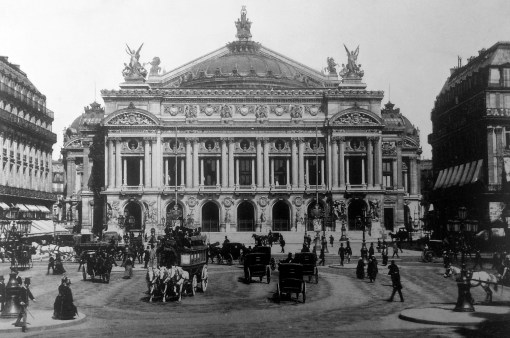
Here’s the first of several carriage- or driving-related (or otherwise interesting) photos that I found in our Glimpses of the World book. The photo captions, naturally, describe the man-made or natural wonders shown but make no mention of any horse-drawn vehicles in the photos.

I’m sure we wouldn’t say anything about the automobiles that “interfere” with our modern photos of landscapes or buildings, either. I know I wouldn’t mention them and would usually rather they weren’t in my photos at all. Likewise, most of the photos in our old book don’t have any vehicles in them, but some of the streets were just too busy to leave the pedestrians, horses, and vehicles out of their portraits.

In front of the Paris Opera House, we can see a number of Broughams (serving as taxicabs, no doubt) and a three-abreast of gray horses hitched to a crowded Omnibus.

(To see a larger version of the photo, click on the photo once and then, when a new version comes up, click on it again.)

.

.

This is the photo caption from the book:

“This is not merely one of the most magnificent structures of the French metropolis, but is the largest theatre in the world; not strictly so in regard to its seating capacity, which accommodates about 2,200 people, but in the area of three acres which it occupies in the very heart of the city. The first view of it as one approaches it along the boulevards can never be forgotten. Broad marble steps lead up to a facade adorned with groups of statuary representing Lyric Poetry, Idyllic Poetry, Music, Declamation, Song, and Dance. Above these are medallions of four great composers, and over these extends along the full width of the structure a loggia or gallery embellished with beautiful Corinthian monolithic columns and a marble parapet. Above the windows of this loggia, the eye beholds with pleasure medallion busts, in gilded bronze, of Mozart, Beethoven, Auber, Rossini, Meyerbeer, and Halevy, whose noble works are heard so frequently within the Temple of Music which they thus adorn. To right and left upon the roof colossal groups in gilded bronze stand radiantly forth against the sky, portraying the divinities of Poetry and Music with the muses in their train. While to complete the charm of this extraordinary building, there rises in the center a majestic dome above the crown of which we see, triumphant over all, the statue of Apollo holding aloft a golden lyre, which still reflects the splendor of the setting sun long after evening has begun to spread its shadows over the adjacent streets, which soon will burst forth from that temporary twilight into a blaze of artificial brilliancy almost as light as day, which makes the place of the Grand Opera seem like the diamond-clasp in that long belt of gaity, display, and fashion known as the Parisian boulevards.”

Quite a while ago, A.J. and I found a wonderful book in one of our local antique stores …
.

image

.
It’s Glimpses of the World: A Portfolio of Photograghs of the Marvelous Works of God and Man, and it was “prepared under the supervision of the distinguished lecturer and traveler John L. Stoddard, containing a rare and elaborate collection of photographic views of the entire world of nature and art.” The photos were taken in the late nineteenth century, and the book was published in 1892.

Needless to say, there are a few old street scenes included in the book, which I’ll share with you here. Stay tuned.

These and other hard-working horses in the nation’s capital received a bit of a treat in 1919, when they were presented with a Christmas tree covered in edible decorations.

.

One of our CAA members sent this to Jill, and she forwarded it to me, and I thought y’all might enjoy it, too. It’s an excerpt from Time and Again (by Jack Finney, 1995), and this scene takes place in New York City, in 1882.

Doesn’t this sound like fun? …

“Welcome home! Just in time for the sleighing party! Mr. Pickering’s rented two sleighs!” … “Ready?” Felix yelled over his shoulder, and Jake exuberantly shouted back that he was. Their reins snapped simultaneously, both teams dug in, and the harness bells came to life. The runners sliding easily, the horses eased back; then at a second snap of the reins as we rounded the corner onto Twenty-first Street, they tossed their heads, snorting jets of warm breath, and began to trot, obviously enjoying themselves, and now the harness bells sang.

All I can really tell you about the rest of that day and the evening is that it was magical. A dream. The white streets of Manhattan were filled with sleighs; the air everywhere was alive with the music of their bells. … On the walks they were pulling kids on sleds, throwing snowballs, making snowmen; children, adults, old men and women, laughing, calling to each other. And in the streets we passed every kind of sleigh, and we called to them and they to us. We raced them sometimes; once, going up Fifth Avenue, we raced three teams abreast, drivers on their feet, whips cracking, girls shrieking, for nearly two blocks before – sleighs coming the other way – we had to fall into single file cheering and shouting. …

Jake turned impulsively into a cross street just as a sleigh coming south swung in, too. Bells jingling, we trotted along side by side, grinning at each other. It was a big, green-enameled swan’s-neck affair, a beautiful sleigh. They were five kids in their late teens and early twenties, and one of the girls began singing: Dashing through the snow! In a one-horse open sleigh! O’er the field we go! And then all ten of us… Laughing all the way! To the exact rhythm of our horses’ hooves and the jounce of our bells, we lined it out: Bells on bobtail ring! Making spirits bright! What fun it is to ride and sing and it was; oh, Lord, it was – a sleighing song tonight! Then we roared it: Jingle bells, jingle bells! Jingle all the way! Oh, what fun it is to ride in a one-horse open sleigh! For two blocks – people on the walks calling out to us, kids throwing snowballs at us – we sang. Beside me Julia’s voice was high, a soprano, very clear, very sweet and lovely. At the corner the kids swung south. Waving and yelling at each other, we headed north toward Central Park, both sleighs continuing to sing as long as each could hear the other.

We all flew along the curving roads with hundreds of other sleighs. Fast as we moved, sleighs raced past us, hooves drumming, the runners on one side sometimes actually lifting from the snow on the curves. Some of the drivers carried brass horns they occasionally raised and blew into, producing a single mournful yet somehow exciting blast of brassy sound that hung in the air for a moment afterward.

On through the park then, and out, and far up past it out into actual open countryside – astoundingly, still on Manhattan Island – until finally we stopped at a big wooden inn brilliant with light, shining out on the snow in long quartered rectangles, and the place was filled; there were surely fifty sleighs in a great outside shed, the horses tethered and blanketed. Inside, every table was occupied, the place jammed, the roar of voices and laughter so loud it was almost impossible to talk. Felix had called to me, and I worked my way over to his group. We had sandwiches and hot wine, standing up – there wasn’t a table empty – talking a little over the roar, but mostly just grinning at each other out of sheer sparkling excitement and joy.

« Previous PageNext Page »