Here’s another street scene … this one from North Adams, Massachusetts, c. 1908. A few of the vehicles of interest in this photo: a horse-drawn water tank being filled at streetside; two carriages with fringed tops, one of which has wire wheels; and a wagon with an enormous load of hay. Again, enjoy studying this glimpse of the past!
horses & driving
Archived Posts from this Category
April 20, 2013
and an even wider variety
Posted by Jennifer under carriages / carriage types, history, horses & driving, referenceLeave a Comment
April 19, 2013
a wide variety of things
Posted by Jennifer under carriages / carriage types, history, horses & driving, referenceLeave a Comment
This street scene from Laconia, New Hampshire, c. 1907, features several horse-drawn vehicles. There’s a laundry van, a man in a boater driving a single horse to a four-wheeled carriage, a work wagon, a lady driving a four-wheeled carriage, a butcher, a couple of vehicles parked along the side of the street, and several more in the background. Enjoy studying this one!
April 15, 2013
I’m stuck today (and probably tomorrow as well) in must-get-this-issue-of-the-magazine-finished! mode, so blog posts for the next couple of days will be short and sweet.
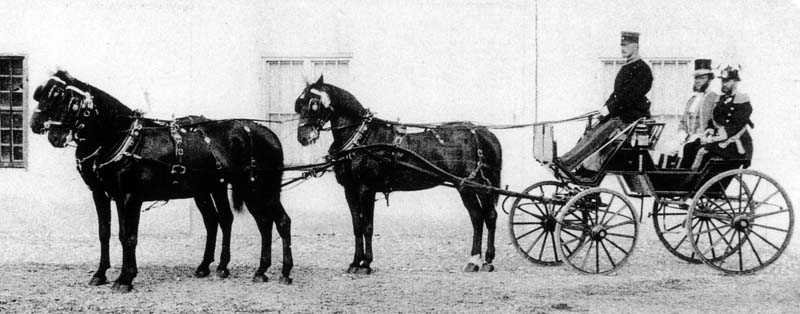
Here’s the complete version of the photo I posted on Saturday …
.
.
The handwritten (in German) caption on the photo describes this unusual arrangement as a “backwards unicorn.”
April 13, 2013
whoa, that’s some serious facial hair
Posted by Jennifer under Carriage Journal magazine, history, horses & driving, upcoming articlesLeave a Comment
Through the efforts of three CAA members, in three different countries, we now have a stack of (copies of) amazing old photos, more than thirty in all. We believe they’re all from Germany, and they appear to date from the late nineteenth or early twentieth century. I’m working on finding out (I hope) whose turnouts these actually were.
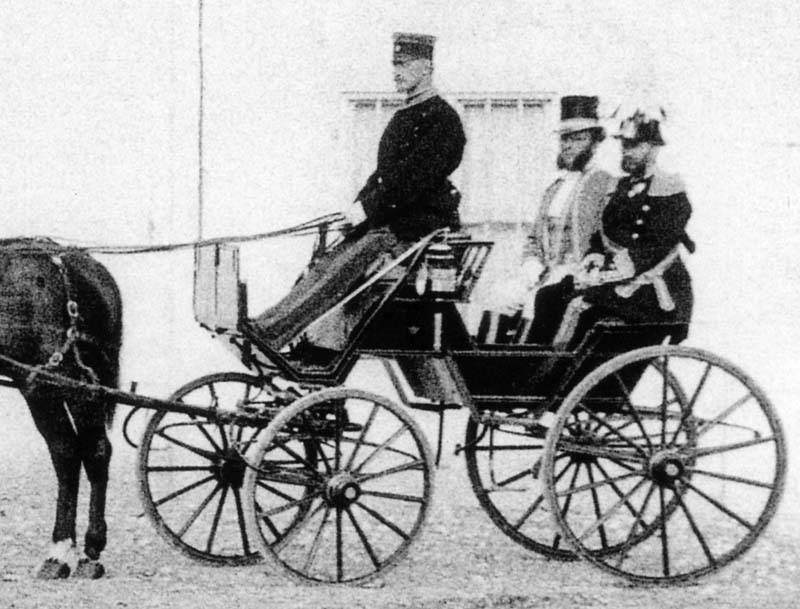
We’ll be reproducing a number of these in the May issue of The Carriage Journal, and I’ll be posting a few others here. But I thought I’d start with just a tidbit of one photo. See the off-side passenger, in the top hat? Check out his magnificent sideburns!
.
.
April 11, 2013
Bessie and Fanny enjoy some lush grass and hay
Posted by Jennifer under early roads, history, horses & driving, Mr. Johnson's trekLeave a Comment
On the morning of August 29, 1882, Mr. Johnson left Rye Patch …
“I was directed to cross the railroad above the water tank and follow the river to the second right-hand trail, as it was the harder and better road to Humboldt station, and no sand for nine miles. I left this morning in high glee, everything bright and cheerful.” …
“It was midnight of the morning of September first, as I left Humboldt station and at six I reached Mills City station, a journey of thirteen miles by railroad and fourteen by trail. This morning’s walk was very invigorating, a good road and fine weather, even the coyotes’ call was melodious.” …
“Mills City is a station on the Central Pacific Railroad, and consists of a hotel and store in one, house for the boss of repairs, and one for his Chinamen — in all, four buildings making the city. My stop was short, just one hour in feeding the cattle and myself. As I was leaving, the morning’s freight and emigrant train passed me. At this place, I was advised to take the left-hand trail to the river, as it was the better road and more traveled, and freer from sand, which I did. I was still but a short distance from the railroad; on the left the river and on each bank an abundance of grass, but now, nearly all were fenced with barbed wire. About eleven o’clock I came near the river, and at this place there was a break in the fence; I went in and gave my cattle water from the river and fed them with grain and the grass. I detached the horse from my carriage, giving her liberty, which she enjoyed by a series of rollings; she did enjoy it. The cow luxuriated on the grass.
“About half past one o’clock, I resumed my journey, returning to the road through the break in the fence. During the afternoon the expresses from the east and west passed me. About five o’clock I saw some men hauling hay. I spoke to my horse, as I frequently do, saying, ‘Fanny, we will soon turn in for the night.’ I traveled on until we came around a knoll of land on which was a stack of hay, along side of which I drove, giving my cattle a chance to eat as much as they wished.
“Presently, some men came with another load, when I said to them, ‘Gentlemen, excuse me, and I think you will when you know my story.’ There were four of them, and the elder, a man about sixty-five, who replied: ‘Stranger, what is your story, you look as if you had one?’ ‘Well, sir; we are both strangers, I am a traveler and have come a long distance, three hundred miles north of San Francisco.’ ‘What place, so far north?’ ‘Eureka city, Humboldt Bay.’ ‘What, with that cow?’ ‘Yes, just as you see.’ ‘Well, stranger, where do you intend to fetch up?’ ‘I intend to fetch up in Massachusetts; I may fail, there is abundance of room for that.’ ‘Yes, I think your chances of slipping up are very good, but you look the man to perform the journey if it can be done by any one, and you are about the right age too. Will you allow me to ask your age?’ ‘Sir, I was sixty-three years of age on the eleventh of July.’ ‘I was sixty-eight on the fourth of May last.’
“[I replied,] ‘I came from Humboldt station this morning, and I want to stay overnight here, as it looks a fine place for my cattle. I have to look well after them, so that I can have a chance to accomplish my great undertaking. I carry grain and feed them three times a day; hay is something I cannot always get.’ ‘You can stay here and welcome.’ … I gave the cattle water and grain, greased my carriage, and got everything ready to start in the morning.”
 The Slower Road