One of our members sent this link to an online collection of old photos of the Western U.S.
The first six or so, especially, plus a few near the end of the collection, are wonderful images of late-nineteenth-century vehicles, horses, and oxen.
March 31, 2011
One of our members sent this link to an online collection of old photos of the Western U.S.
The first six or so, especially, plus a few near the end of the collection, are wonderful images of late-nineteenth-century vehicles, horses, and oxen.
March 30, 2011
If you’ve read some of the recent posts in the “history” and “early roads” categories, you may remember a description of Stagecoach travel in the eighteenth-century America.
And then, late last week, I posted two stories of Stagecoach travel in New York in 1898 (the first part is here, and the second part here).
You’ve probably already guessed that these two types and styles of “coaching” — about a hundred years apart — were not the same.
From the earliest days of long-distance horse-drawn travel (around the middle of the seventeenth century in Europe, and about a century later than that here in the U.S.), Stagecoaches were a primary means of transporting mail, parcels, and travelers.
With the advent of railroads in the early nineteenth century, however, Stagecoaches started to become obsolete as a basic method of (long-distance) transportation in some parts of Great Britain and the United States.
By the late nineteenth century — in England, especially, and on the east coast of the United States — the art of driving a four-in-hand team to a coach had been handed down from the earlier generation of professional coachmen to a new set of wealthy sportsmen. So the two posts about coaching in 1898 were from this later era — known as the “coaching revival.” During these years, horsemen began driving Stagecoaches as sport. Their routes were not entirely practical; instead, they had “social” destinations such as parks, casinos, country clubs, and the like. Sometimes, the fares they collected were given to charities.
.
In a book titled The railway journey: The industrialization of time and space in the 19th century (Munich: 1977), Wolfgang Schivelbusch wrote:
As the new technology terminated the original relationship between the pre-industrial traveler and his vehicle and its journey, the old technology was seen, nostalgically, as having more “soul.”
W.B. Adams’ Pleasure Carriages, published in 1837, was the precursor of a literature of leisure and sports whose ever-increasing growth the century was to witness.* In this book, the use of horse-power was no longer treated nostalgically, but from a point of view that regarded the use of steam as merely unsportsmanlike: “Steam is a mere labourer –- a drudge who performs his work without speech or sign, with dogged perseverance but without emotion. … He may be personified when speaking of him; but no one pats his neck or speaks to him in a voice of encouragement. It is not so with a horse or horses.”
* In the manual on the art of driving published by the president of the Four-in-Hand Driving and Coaching Club, which was revived in 1870 by the Duke of Beaufort, there is a chapter titled “The coaching revival” that deals exclusively with the club members’ new practice of driving coaches on busy routes (e.g., to Brighton, Dover, Tunbridge Wells) and racing the railway trains to those destinations; this activity made the long-abandoned inns of the coaching era come alive again with the neighing of horses and the cracking of whips.” (P. D. Fischer, Betrachtungen eines in Deutschland reisenden Deutschen[Berlin, 1895], pp. 43-44. Fischer also mentions the following coaching titles published in the 1880s: Stanley Harris, Old Coaching Days; W. Ourtram Tristram, Coaching Days and Coaching Ways.)
March 28, 2011
For today: a beautiful (undated) French drawing of a design for a Vis-a-Vis du Prince Imperial.
.
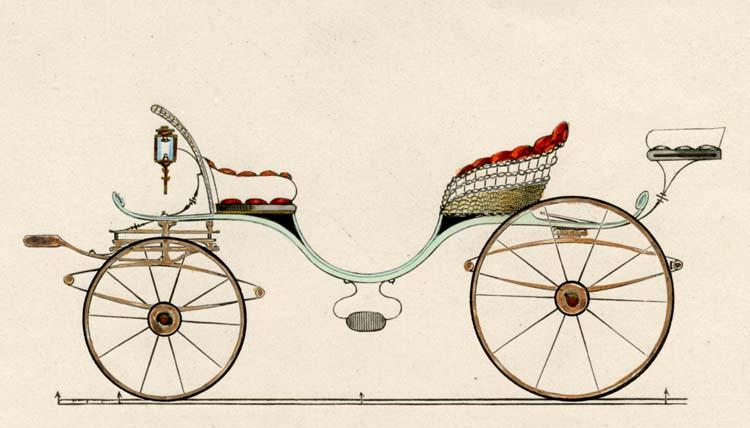
.
UPDATED to say that according to one of our CAA members in the Netherlands, this drawing is probably from about 1860 to 1865 (see Bart’s note in the comments).
March 27, 2011
March 25, 2011
Here’s the rest of the Rider & Driver news bit (from the March 19, 1898 issue) on coaching, continued from yesterday’s post:
Out Grafton way, near Worcester, Mass., the members of the Country Club are joining George Inches in a plan to run a coach this summer from the clubhouse along the glorious rolling roads of that district and into Worcester daily. If this becomes a fact, it will do much to revive interest in the sport of coaching throughout that region, the residents of which won’t need much encouraging to bring out their teams and make the hillsides ring with the sound of the tootling throughout the entire season. Beverley Farms, of course, is to have its coaching parties as of yore, and so will Dedham and Myopia, so that not counting other routes already being laid out, Massachusetts will be well taken care of by those who delight in “tooling” four horses to a smart drag. — Commercial Advertiser
The Rider & Driver is inclined to believe the foregoing rather speculative and premature. We should be most pleased, however, to hear of its realization.
Mr. Guy Ward, formerly of Troop A, now Squadron A, one of the best of all-around horsemen, will put a coach on the road between the South Side Club and Babylon, L.I., beginning the first day of May. The distance will be about 15 miles. Residents near the Club and along the route will be picked up in time for the morning express train for town and met and set down again on their return in the evening. Mr. Ward says: “The coach will run rain or shine, hail or blizzard, and anybody who has the fare will be welcome to ride. And I’m going to have on the placards,” continued he, with characteristic good humor, “a notice to passengers not to forget to tip the coachman. I’ll take anything they gim’me.” Mr. Ward stands about six feet one, in his stockings, tips the scales at 220 pounds, has a back as broad as a barn, a hand like the Hand of Providence, and being young and agile, might well tackle a bull and come out the victor. Although not exactly pertinent to coaching, it may be of interest to mention that when Attila, the professional strong man, was giving one of his exhibitions at Bay Shore last summer, Mr. Ward, on a wager made by a friend, not only lifted Attila’s heaviest two-hand dumbbell, weighing 320 pounds, but elevated it above his head four times in succession.
 The Slower Road