history


Continuing on from yesterday’s post, which featured the first half of an article on mail and Collinge’s axles, as published in the December 1834 issue of the London Mechanics’ Magazine:

.

The next kind of axle, and the best which has been hitherto invented as applicable to ordinary wheels, is that known under the name of “Collinge’s Patent.” The original specification was, I believe, “a cylinder secured between two cones.” But an axle on such a principle would not run smoothly; it would jar violently in the end play against the shoulder cone, and consequently the axles are never made so. The collar at the shoulder, against which the face of the wheel-box runs, is made very broad, flat, firm, and solid, and is, moreover, provided with an external rim or guard, which covers the end of the box, and excludes dirt and water. Close to the face of the box there is a reservoir of oil, and between the box and the collar there is a washer of solid leather. The centre of the arm is slightly turned down in the lathe, below the surface, to afford a lodgement for oil. The front of the arm beyond the box is turned down about a quarter of an inch, and a flat side filed on it. Upon this a small collar of gun-metal slides, the outer side of which projects in a conical form against the front end of the box, which is formed into a similar shape to receive it. Through this gunmetal collar a small hole is pierced to allow the passage of oil. It is thus evident, that when the wheel is in motion, owing to the flat side, the coned collar has no lateral motion, though it can slide along the arm, and regulate the play of the wheel. This collar is turned in the lathe when fixed on the arm, consequently it must fit accurately the end of the box, which is ground on to the arm. To adjust this collar to its place, and keep it firm there, two nuts of gun-metal, with right and left hand threads, one of smaller size than the other, are affixed. In adjusting, the first nut is screwed to the proper place, and then the second is screwed tight against it, one nut wedging the other. As a further security, a spring linch-pin is driven into the end of the arm beyond the nuts. Over the whole a large cap of gun-metal is screwed against the end of the box, with a washer of thin leather. This cap contains oil in its lower circumference, reaching to the horizontal level of the leakage point at the shoulder. The cap may be entirely filled, if it be wished, but it is useless, because the action of the wheel in turning would pump it away and waste it very rapidly. If it be wished to increase the quantity of the oil, the proper plan is to increase the circumference of the cap. The mode of feeding the axle is by the two reservoirs turning with the wheel, and the oil thus washing up; and this is the only principle upon which locomotive axles can be fed with oil without wasting it. Properly supplied with oil, a set of Collinge’s axles, as they are at present made, will run about 5,000 miles without sticking fast. The wheel is 5 feet 6 inches in diameter, which is about the height of the fore wheels of a full-sized carriage weighing about a ton. The hind wheels would, of course, run farther with the same quantity of oil. As the arms of the axles are not horizontal, but dip downwards, the bearing is principally against the shoulder, and there is consequently little strain on the nuts; and the cap, also, in this position, holds more oil. But the friction must be increased. A horizontal arm runs with much less friction than a dipping one, because the dip serves to remove a part of the weight from the hardened arm against the softer washer. With the exception of those used in railway and steam vehicles, axles are all but universally dipped, or inclined downwards at the arms. There are sundry reasons for this. First, the extra security against the wheels coming off. Secondly, the greater facility of retaining the oil; and, thirdly, the facility it gives for using dished wheels. The advantages of the dished wheels are, that while keeping the same track on the ground, the length of the axle is not increased, and greater space is afforded for the body of the vehicle; and, at the same time, the dished form is stronger than the plane. When rightly adjusted, the under spokes should be in a line exactly vertical to the base, and the upper ones form the angle. The strongest form of wheel is that in which the spokes are framed angle-wise to the nave, alternating both ways, to form a double cone, but this materially increases the length of the axle arm, and renders the nave unsightly.

The disadvantages attending “Collinge’s Patent Axle” are considerable extra weight, owing to the thickness of the box, which is usually made of cast iron. The length of the arm is also increased by reason of the collar, double nuts, and cap; and, altogether, a nave larger than ordinary is required for its insertion. But the advantages are so great, that whoever uses a vehicle with common wheels, traveling at the rate of five miles or more per hour, must be ignorant of the science of profit and loss, if he does not use them. The mere labor of keeping other axles properly greased or oiled, and the risk of abrasion from neglect, together with the waste of oil and grease, and extra risk of coming off, will make a heavy balance against the comparative cheapness in the first cost of the common axles.

The axles which I have examined bearing the name of “Charles Collinge, Lambeth,” are for the most part as well made as the best engineers’ work usually is; in short, they are as accurately finished as is necessary for any practical purpose. The only thing objectionable in them to the general purchaser, is their high price; but for a man who keeps a pleasure carriage, and is not a judge of workmanship, the wisest course is to pay that high price, and place it to the account of what Mr. Babbage has so well termed verification. Twenty-five guineas is the price, I believe, but they may be had of other makers for two-thirds of that price, some of them equally well made with those marked Charles Collinge, and some of them the merest rubbish. Without good workmanship, this axle is worse than a common one. The well-made ones are formed of thin bar-iron, welded by hand into a mass and case-hardened, both arms and boxes. After hardening, the boxes are ground on to the arms with oil and emery, consequently they cannot be perfectly true cylinders, though intended to be so. Birmingham made axles have of late, on account of their cheapness, come much in use; but unless coming from a known maker, they are not to be trusted, as, to save expense, they are commonly made from square rolled bars, good or bad, subject to flaws, sand-cracks, and cold shorts. For self-axles; i.e., axles which are bolted to two springs at the ends, and have no other bearing, as is the case with the street cabs and gigs generally, a good method would be to make the centre or bed of the axle of drawn or rolled tube; weight might be thus saved without loss of strength, and tolerable security would be taken for the goodness of the metal.
I’m not quite ready to post more photos from our trip to Spain (but I hope to do so later this week) … and I was thinking about what to post on the blog today, when a post-inspiring comment appeared.

After reading Jill’s story on Royal Mail Coach N205 earlier today, Bill sent the following comment: “Explain more about ‘mail axles’ please, and what makes them distinctive.”

.

So … from an article published in the London Mechanics’ Magazine in December 1834:

… The earliest axles for wheel[ed] carriages were made of wood, and of a conical form, for two reasons: first, that it is easiest to fit a nave or box on a conical arm than on one of a cylindrical form; and secondly, in case of wear, the arm may be refitted by the wheel being worked farther up. The same form was continued, for the same reasons, when iron axles were introduced. Since that period, innumerable inventors have tried their heads and hands at the improvement of axles, and scarce a year passes that several patents are not taken out to die a premature death.

The commonest metal axle used at present is of a conical form, with a broad flat ring or washer driven firmly up to the shoulder, against which the wheel-box works. The wheel is secured against coming off by a front washer, behind a strong linch-pin. A thick unctuous grease is used for lubrication, to contain which deep channels are sunk in the box.

The next kind, instead of a washer and strong linch-pin, is provided with a screw-nut, formed to screw on the axle-end, in the direction in which the wheel turns, to keep the wheel on. Through both nut and axle a small linch-pin is driven. Some of these nuts are four-sided, others six- and eight-sided, and are consequently pierced with two, three, or four mortices for the linch-pin, in order to regulate the play of the wheel.

The next kind is the mail axle, so called from having been first used in the Mail Coaches. This axle is provided with a solid flat collar at the shoulder, against which the box of the wheel works. This axle has neither front nut, washer, or linch-pin. The arm is cylindrical, and is cut off flat at the front end; the front end of the box is closely stopped with a plate or screw, between which and the end of the arm there is left a hollow space for the purpose of containing oil, which is supplied by loosening a screw-pin in the front of the box. At the back of the box, near the shoulder, there is a second reservoir for oil. The wheel is retained on the arm of the axle by three or four long bolts, which pass through the nave from front to back, and thence through a circular plate of thick iron as large as the nave, which works against the back of the solid collar. Between the solid collar and the axle-box a thick leather washer is placed to prevent any jar arising. The play of the wheel is adjusted by screwing up the nuts of the long bolts against the circular plate. The advantage of this axle is the security it affords against the wheel coming off, by three or four separate bolts. But it is otherwise very imperfect, as the oil wastes very rapidly when the wheel is in work, and the end of the axle not being secured in front, there is an irregular elastic motion, which causes the arm to wear unequally at the shoulder after a short time, and then the oil disappears still more rapidly. The mail axles are most commonly hardened, both arm and box, to guard against this; but it is of little avail. Mail axles arc supposed to be lubricated with oil; but the fact is, that unless they be oiled every three or four days, they are actually lubricated with water. The process is thus: The front reservoir is level with the bottom of the axle arm, and consequently is level with the drainage or leakage point at the leather washer. When the wheel is in motion it acts as a pump, and in a very short time drains off the oil of the front reservoir into the back, till it overflows; consequently the front is left dry. The bottom of the back reservoir is about an inch below the leakage point, and therefore it does not lose its oil by the same process as the front; but it loses it nevertheless. In the process of washing the wheel, and also in rainy weather, water gets in between the washer and the box. Water being heavier than oil, sinks to the bottom of the reservoir, and the oil flows off. Thus it is, that almost every mail axle which is not oiled every few days, gets rusty and spoiled. While the oil lasts, of course, the friction is less than that of a common axle; and, as before remarked, the security is greater against the wheel coming off, but take it altogether, it is, though a neat-looking, a very imperfect axle.

… to be continued tomorrow with our anonymous 1834 author’s thoughts on Collinge’s Axles.

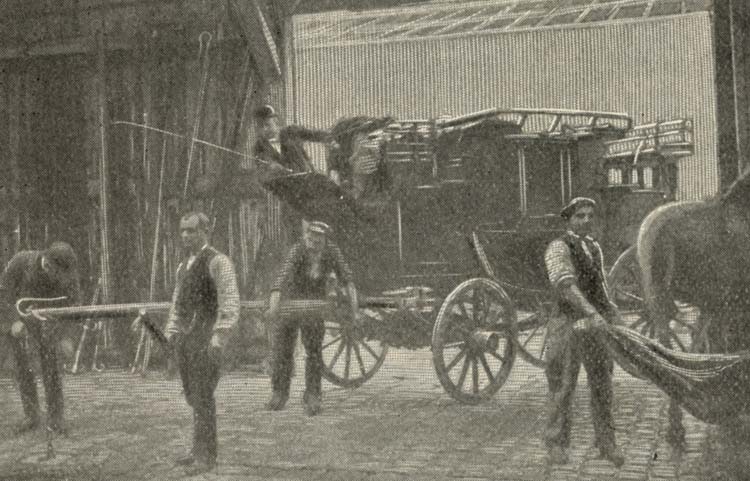
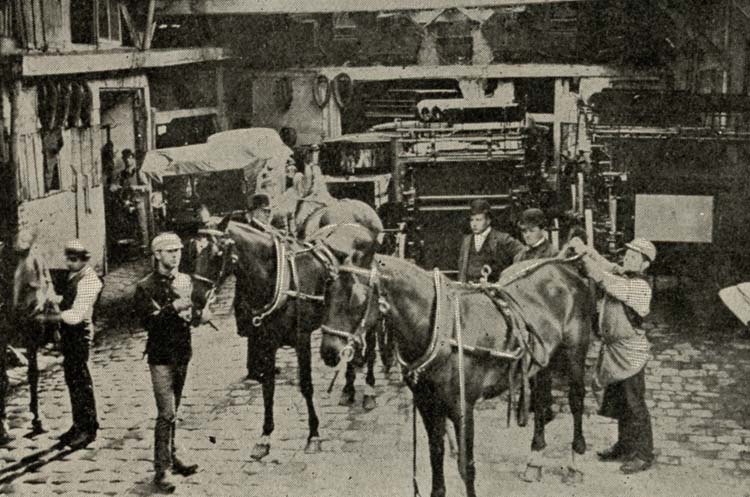
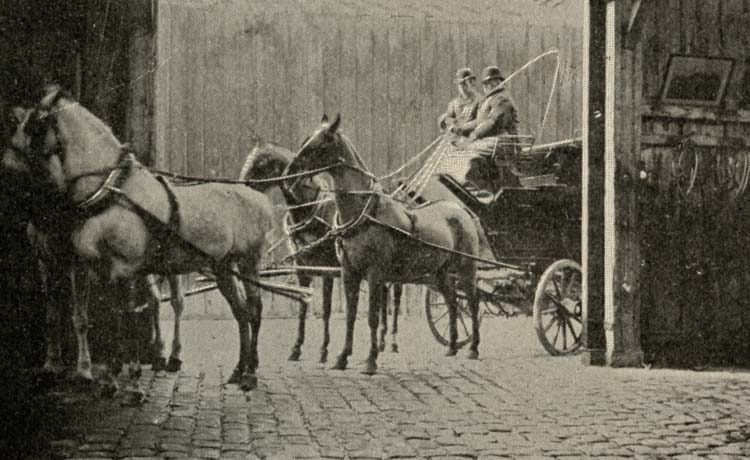
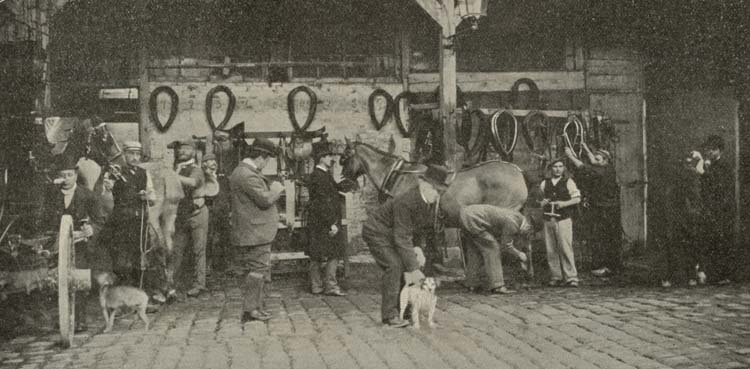
from the March 5, 1898, issue of  The Rider and Driver:

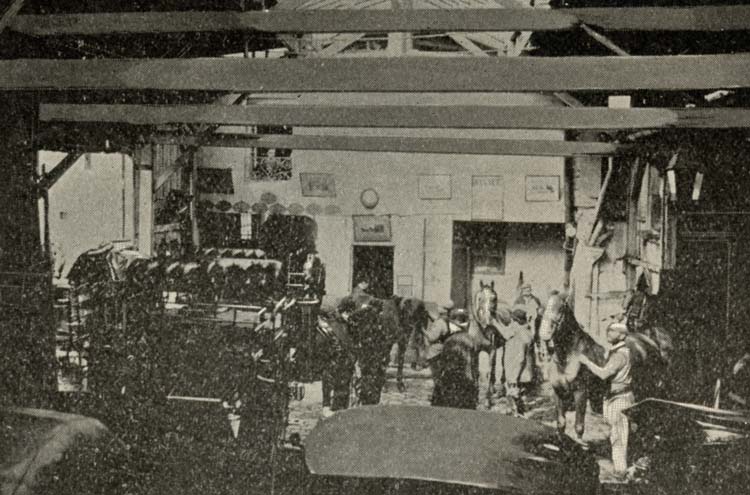
“Scenes in and around Howlett’s old stables, Paris, showing the famous coachman and his sons at everyday work.”

.

.

.

.

.

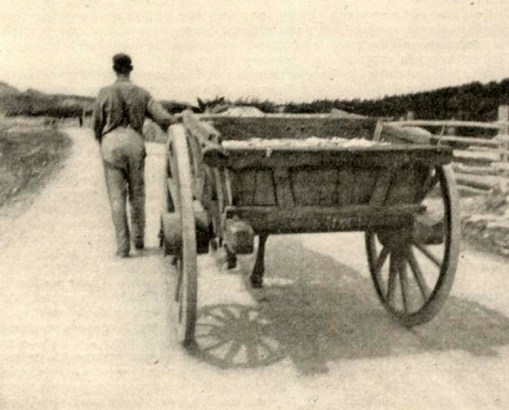
from the March 5, 1898, issue of  The Rider and Driver:

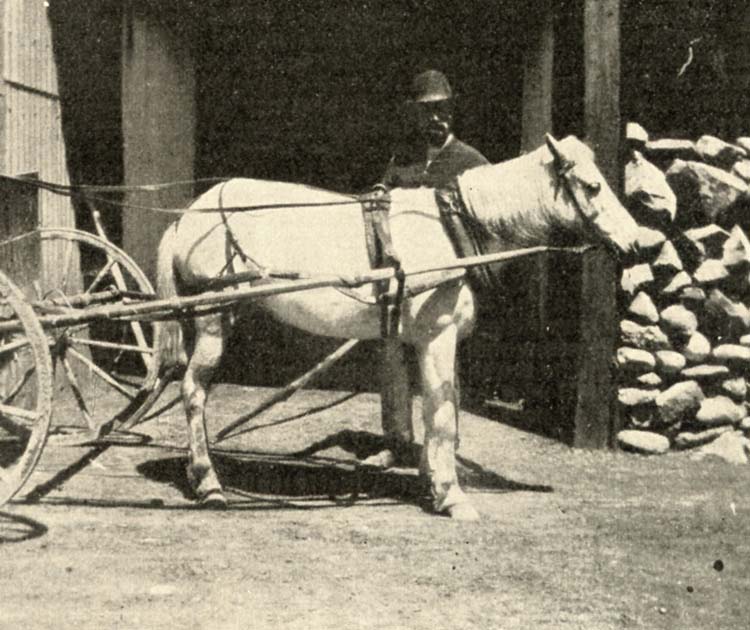
The Torbay Nag

The horseless carriage attracts the attention of the visitor to New York. In Newfoundland he is struck by the sight of the almost horseless carriage.

.

.

The gentle Torbay nags, which peck away at the hard roadway with their little hooves, seem to have such a small part in the motor arrangements of the outfit that one can hardly realize that they are doing all of the pulling. I wanted to go downhill all of the time when riding behind one them, just out of sympathy for the little beastlet, but I was assured that they preferred to go uphill. Probably on the theory that it felt so good when they got to the top.

In the cold northern climate the horses seem to contract in order to expose the smallest area of surface to the bleak winds, but all of the goodness of the big horse remains within the little one and the nags represent the peaceful ways of the hardy and hospitable inhabitants of the “Isle where sailors gang to fish for cod.”

I have often thought that these Torbay nags of Newfoundland would make interesting pets for children because they will keep good-natured under the inflictions that our dear barbarous progeny impose upon the things that they love most, and if anyone forgets to feed a nag it is of little consequence, because one such small meal as he would eat is a trifling affair. It is said that in winter they will dig down through the snow with their hooves and get a good living on the moss and dried grasses. I have also heard that in times of short rations they will eat dried cod fish, but I will not vouch for the truth of this statement.

.

from the November 26, 1898, issue of  The Rider & Driver(published in New York City):

Houses, Stables and Telephones

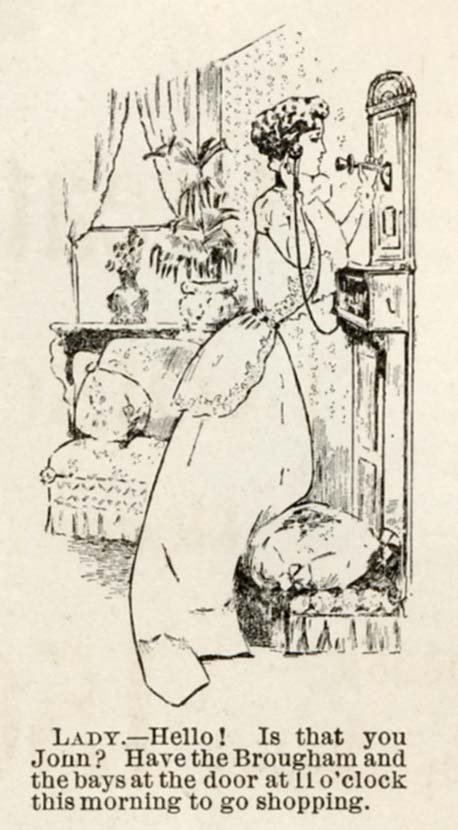
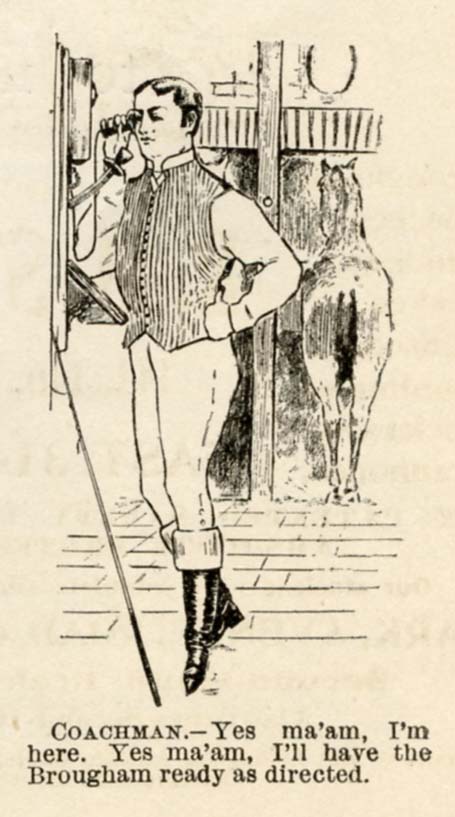
That the telephone service is one of the most useful adjuncts to life in a large city goes without saying. As the New York Telephone Company tersely states the matter, “telephone service in your house puts the whole organization of a large city at your fingers’ ends.” And this is literally true, for in every center of life in New York you find the ubiquitous telephone. Hotels, theaters, clubs, restaurants, stores of all descriptions, livery stables, express companies, railway and steamer ticket offices — in short, every place of any consequence where business is done with the public, or with a section of it, is tapped on to the telephone service and is the next door neighbor, on demand, to everybody else who has telephone service. The enormous convenience of this state of affairs has only gradually become appreciated by private house-holders. The telephone service at one time was considered by many a rather expensive luxury to have in a private house. But the system of charging by the message, adopted some years ago, has changed all that, and a first-class residence in New York is now not considered completely equipped unless it is connected with the telephone service.

.

.

The same applies to a private stable. Private stables in New York are usually separated from the owners’ houses by considerable distances and without the telephone service communication between house and stable is slow and unsatisfactory. If both places have telephone service, not only is the stable as easily available for orders as if it were next door, but it is better supervised, as the moral effect of the presence of the telephone ready to call up at any moment has a decided influence on the stable force.

.

.

The New York telephone system is considered by experts to be the best-equipped and to give the best service in the world. The telephones supplied to subscribers are all long-distance instruments and may be used for talking to any part of the country; the lines are all underground, so that interruptions are very rare, and the service is quick, and available night and day. The actual use of the service, on which the rates are based, is of course much less in a private house or stable than in a business office, so that the cost of the service at such places is proportionately less. The great convenience of the service by reason of its widespread use in all departments of the city life, the ease with which emergencies small and great may be disposed of without friction or delay are what give the telephone service its value in a private house. To many people the feeling of security that results from having at hand a ready means of communicating with the outside world at any moment of the day or night is alone worth all that the service costs.

.

And to think that we now wonder how we ever survived before cell phones and the Internet!

« Previous PageNext Page »