history


After the flurry of activity last week here at the KY Horse Park, and the resulting flurry of CDE-related posts here on the blog, I think it’s time to return to some carriage- and driving-related history, don’t you?

A.J.’s been reading a book about the founding of the U.S. Navy (Six Frigates, by Ian W. Toll), and he found this tidbit at the beginning of Chapter 3:

“On Saturday, March 4, 1797, the morning skies above Philadelphia were overcast and gray. John Adams, the newly elected president of the United States, left his lodgings at the St. Francis Hotel a little before noon and climbed into the new carriage he had recently purchased for a price of $1,500. The carriage, he told Abigail, was elegant enough for a president, but it was distinctly unpretentious when compared to his predecessor’s [George Washington’s] luxurious coach, which had been pulled through the streets of the capital by a team of six horses and attended by liveried foot servants. Adams satisfied himself with two horses who were ‘young, but clever.'”
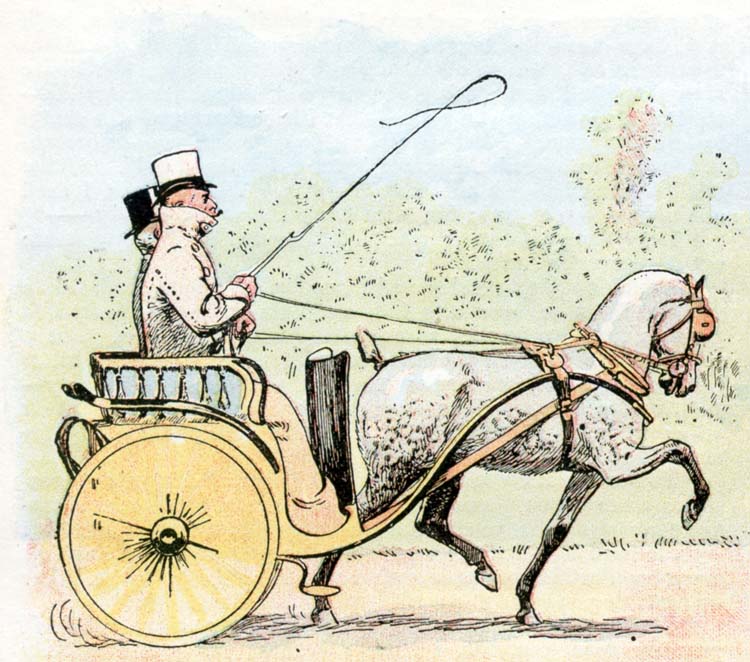
This lovely image was part of a graphic story, drawn by R. de la Neziere, in the 1896 “Christmas number” of The Graphic.

.

the story, "Pride Goes Before a Fall," opens with this image, in which "Sir M. T. Head drives to the meet of the Toffham Hunt with his famous high-stepping mare, as he knows that the Duchess of Reddimony and her charming daughters are to be present."

Whenever I’m in an antique store, I’m always on the lookout for old photographs. A couple of weekends ago, we visited a shop here in downtown Lexington, where I was, naturally, drawn to the pile of old photos sitting on a table. After looking through nearly the entire pile — mostly late-19th- and early-20th-century weddings, class reunions, camps, and the like — I found this:

.

this peddlar and his wagon, horses, and musician all appear to be decked out for a parade; the sign on the flag says, "L.W. Green Sells 90 Different Articles," and the side of the wagon is painted with "Rawleigh's Remedies," "Fine Flavoring Extracts," something ("Horehound," perhaps?) obscured by the decorations, and "Spices"

Continuing with the carriage-history references that A.J. and I kept finding on our recent “local” vacation …

While we were at Shaker Village at Pleasant Hill (a lovely historic site that also offers fabulous hiking opportunities, delicious food, and unique accommodations), we found a Kentucky historic marker in the parking lot that offers the following nuggets:

Completed by 1839, the Lexington – Harrodsburg – Perryville Turnpike (KY68) ran through the center of Pleasant Hill. The road became part of the mail stage route between Zanesville (Ohio) and Florence (Alabama). Stages were discontinued here by 1877. The turnpike brought communication and trade to the reclusive Shakers, as well as both Confederate and Union invaders during the Civil War.

This is a photo (from our vacation) of the same road mentioned on the marker. For a number of years, the “modern,” paved KY68 followed this same route, right through the center of the Shakers’ village, an area long known locally as “Shaker Town.” When the newer KY68 was built nearby and the historic area restored, this original road was, shall we say, un-paved.

.

While on our way to a museum in Bardstown, we drove past a sign describing “The Cobblestone Path.” We were intrigued enough to stop (frankly, because, from the road, the slight clearing in the woods on the hillside didn’t look like much).

Remember when I said that little Bardstown boasts a rather stunning amount of regional, state, and national history?

Here’s what the aforementioned sign says:

The Cobblestone Path is one of the oldest paved roads in all Kentucky. By 1785, this was the original entry to Bardstown from the east and part of the legendary “Wilderness Road.” Congress ordered the Pioneer Trace to be improved as a military road after 1792. The cobbled paving of this hill dates to at least c. 1790. It allowed two-way traffic by heavy freight wagons, and for all wheeled vehicles entering and leaving Bardstown. After serving for more than thirty years as the major entry connector to the east end of historic Arch Street, the steep pathway was relegated to light traffic and mounted riders after the improved turnpike was constructed c. 1830. Cut off from the city’s modern streets after 1925, the path’s isolation allowed it to survive, serving only pedestrian traffic after that date.

.

Bardstown's "Cobbled Path" dates from the late eighteenth century

.

... for perspective, here's A.J. standing on the path; this road is so steep and narrow that it's hard to imagine two-way freight-wagon traffic here ... what a job that must've been!

.

... and a close-up of some of the late-eighteenth-century cobblestones

« Previous PageNext Page »