history


CAA member Eli Anderson has gathered an extensive collection of carriages and other memorabilia of life in the rural West. And he’s working on putting everything together in one place — to be called Wagon Land Adventure — where visitors will be able to get a glimpse of life in the Old West. Fellow CAA member Craig Paulsen, also from Utah, says that Eli “is a wonderful advocate and collector of antique vehicles and a wealth of knowledge.”

Back in December 2010, Craig and fellow members Tom & Gloria Burgess (from Virginia) visited with Eli. If you missed it the first time, or want to see the photos again, you can read about their visit here

.

.

If the embedded video (showing some of Eli’s collection and his plans for Wagon Land Adventure) won’t work on your computer, click here to go directly to YouTube.
I seem to have missed a day here yesterday. Simply forgot all about it, I’m sorry to say.

Today, let’s head out to South Dakota to watch a couple of original Stagecoaches (restored by Hansen Wheel & Wagon Shop), being driven on the Ft. Pierre-to-Deadwood Trail. One especially interesting segment, I think, is seeing one of them being driven (slowly, slowly) down a steep grade. This looks like it was quite a large gathering, and I only wish the video was longer!

.

.

As always, if the embedded video won’t play on your computer, click here to go straight to YouTube.

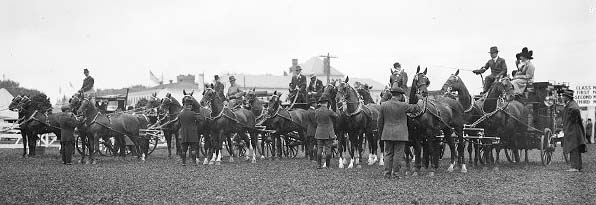
A CAA member sent us this old photo from the Rochester (New York) Horse Show. Unfortunately, we don’t know the date … but it’s an impressive set of horse teams nonetheless.

.

.

I’ve posted this silent 1904 video before, but I thought I would do so again, as it’s the perfect final entry in our several days of looking at horse-drawn haying techniques and practices. This one was filmed in England.

Enjoy!

.

.

If the embedded video won’t work on your computer, click here to go directly to YouTube.

A member sent the link to a blog post that I thought you might find interesting as well.

It’s interesting to note how much faster one could travel at the end of a seventy-six-year span in the nineteenth century than at the beginning.

Do you remember that, in 1819, it took twenty-four hours to travel a distance of twenty-five miles over Kentucky’s roads? According to the blog post I’ve linked to above, in 1895, the Red Jacket coach was expected to travel the twenty-two miles from Buffalo to Niagara Falls in a mere two hours. The mode of transportation was basically the same, so it must’ve been the quality of the roads (and the fact, perhaps, that the coach was traveling in relay stages) that made such a huge difference.

« Previous PageNext Page »