history


For our first foray into Mr. Johnson’s tale, we read that he started his journey from Eureka City, California, on June 1, 1882.

By the end of that first day, he’d reached Hydesville, having gone twenty-five miles and having passed through Humboldt, Salmon Creek, Hookton, Table Bluff, Springville, and Rohnersville.

From there, Mr. Johnson continued: “Left Hydesville June 2d and made Bridgeville the same day, having traveled twenty-five miles. On making this place, I found that there was a vast difference in roads. To Hydesville it had been good traveling. This day I found my journey had been over rough, hard, and dangerous roads. After leaving Hydesville, I came to a canyon, turning short to the left, descending about four hundred feet in less than eighty rods [about 440 yards], then turning short to the right, ascending the same distance on the opposite side. This is one way of traveling in California.

“Going on, I came to a large, broad river, and meeting a man with a team asked him if it was Eel river. ‘Oh no, it is not,’ said the man, ‘it is the Vandozen.’ ‘How is it about fording?’ ‘Oh, it is a good ford, but the water is rather deep now, with a good hard bottom.’ Went on, and came to the ford; stopped, looked at it, and continued to look at it. All of this time I was thinking. My thoughts were covering a large space — from the Pacific to the Atlantic. ‘Can this be done?’ I had struck out on a long, rough, and dangerous journey — from the Pacific to the Atlantic, with a horse and wagon, cow and dog. Can it be done, can this be accomplished, all alone, no one with me?

“Let happen what will, I decided to try it. I approached the ford; the water was deep; I was not able to see the bottom, with a strong, swift current.

“There I must decide, go on or go back. If I return back I should never be satisfied. If I go on and make a success, then I have accomplished a wonderful undertaking. I there decided to go on, and did. I put my little dog on the wagon, got on myself, drove down into the river and got across all right.”

And so his long journey has begun …
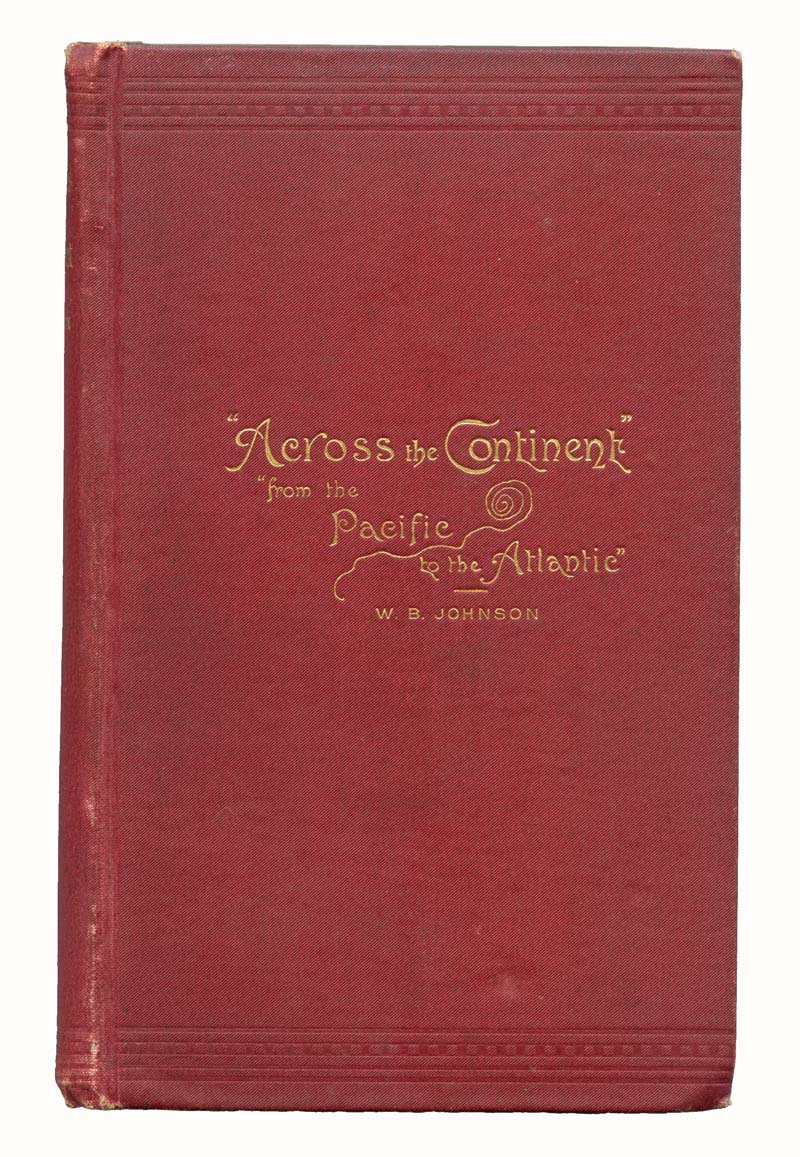
I found yet another treasure in the CAA’s library!

Warren B. Johnson published his tale in 1887, calling it Across the Continent: From the Pacific to the Atlantic, being an Account of a Journey Overland from Eureka, Humboldt Co., California, to Webster, Worcester Co., Mass., with a Horse, Carriage, Cow and Dog.

.

.

In his preface, Mr. Johnson explained that he was sixty-eight years old when he published his tale, and that he was “a native of Connecticut, born in Woodstock, and lived there until he was nine years of age. At that time he moved with his parents to that portion of the present town of Webster, which was then called Oxford South Gore. … From that time until the outbreak of the Rebellion, he was an inhabitant of the town. In August of that year [1861] he enlisted in the 21st Regiment, Massachusetts Volunteers. In 1864, he re-enlisted in the First Brigade Band, of the First Division of the 20th Army Corps, being with General Sherman in his march from Atlanta to the Sea. He left Sherman’s Army at Fayetteville, N.C., and went into the hospital at New York for treatment, where he was transferred to Dale Hospital in Massachusetts and soon afterwards mustered out. For his disability incurred in the army, he has since received a small pension. He went to California in 1880 at the solicitation of friends and relatives, and took this means of getting back to Massachusetts [beginning in June 1882], as he did not like California, and was short of means to bring himself, horse, and cow back to Massachusetts by railroad.”

So, in the end, Mr. Johnson (and his horse and his cow) walked from coast to coast.

.

.

In occasional excerpts, I’m going to share portions of Mr. Johnson’s journey, as they relate to carriages, driving, and the roads that he encountered along the way.

Several days ago, I was looking for something in the CAA library and came across a book I didn’t even know we had: a 1912 reprint of Margaret Van Horn Dwight’s diary, which she kept during her 1810 journey from New Haven, Connecticut, to Warren, Ohio. She had addressed the diary entries to her cousin Elizabeth, and then sent the entire diary to her once she’d reached Ohio.

I’d like to share a bit of it here, as it relates to travel and roads of the era.

From an entry labeled “Friday night — Allegany Mtn” (mid-November, after the party had been on the road for several weeks):

“After a comfortable nights rest, we set out on foot to reach the height of the mtn — It rain’d fast for a long time, & at length began snowing– We found the roads bad past description, — worse than you can possibly imagine– Large stones & deep mud holes every step of the way– We were oblig’d to walk as much as we possibly could, as the horses could scarcely stir the waggon the mud was so deep & the stones so large– It has grown so cold that I fear we shall all perish tomorrow– We suffer’d with cold excessively, to day–

“From what I have seen and heard, I think the State of Ohio will be well fill’d before winter,– Waggons without number, every day go on– One went on containing forty people– We almost every day, see them with 18 or 20– one stopt here to night with 21– We are at a baker’s, near a tavern which is fill’d with movers* & waggoners.”**

* = those moving west with their families

** = those hired by movers to transport them, or those ferrying goods toward Pittsburgh and Ohio

This street scene by the Syracuse, NY, train station (c. 1905) shows a train locomotive, a horseless brougham (with a set of pretty substantial-looking rear wheels) sitting next to the tracks, a number of baggage trolleys, a few (horsed) broughams awaiting passengers, and a “ghost” horse (that driver must’ve picked up his passengers and started moving out of the frame during the exposure).

Here are two interesting blog posts that I found today via Twitter …

First: a description and picture of a nineteenth-century Hackney coach waterman, whose job it was to bring food and water to the horses waiting at his particular Hackney-coach [i.e., taxi] stand in London.

By the end of that century, lumbering old coaches had been largely replaced in their role as “taxicabs” by lighter four-wheeled “growlers” …

.

.

… and the ubiquitous and unmistakable Hansom Cab, of which there were reportedly 10,000 on London’s streets in 1890. …

.

.

.

And today’s second fascinating blog post (containing beautiful images, as well) is about the perils of traveling across the Lancaster Sands. Be sure to scroll through the comments and watch the video of the Duke of Edinburgh and several other drivers making the same trip in the mid-1980s.

« Previous PageNext Page »