history


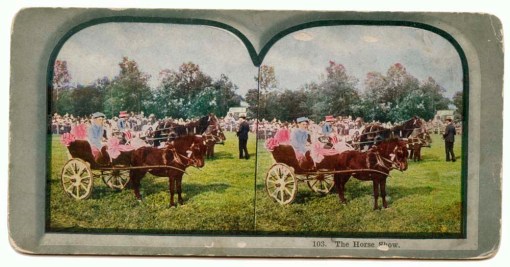
About a week ago, A.J. and I were in an antique store in Georgia, where I found a couple of stereoscope cards with horses and carriages. This brightly colored one shows a line-up of the participants at a horse show, with a fat, furry pony in the foreground.

.
.

I believe the CMA has a few of these cards in its collection as well.

Obviously, I can’t give you the proper 3-D effect here on the blog, nor can you see it by looking at these in person. Clearly, the next thing we’ll need to find is an old handheld viewer.* I know I’ve seen them in various antique stores here in Lexington, so I’ll be on the lookout the next time we’re browsing!

.

* For a brief history of the earliest forms of 3-D, and a photo of a handheld stereoscopic viewer, click here. If you happen to watch the video (about a Canadian museum exhibition on early 3-D methods) embedded in this article, it also has some nice old stereoscopic photos of horses and carriages.

Here’s a view of Eleventh Avenue in New York City, c. 1910. The street was dubbed “Death Avenue” around the turn of the nineteenth / twentieth centuries because of the large numbers of pedestrians killed by the freight trains (!) that ran, albeit slowly, on these street-level tracks. In an attempt to not frighten the horses, the coal-powered steam locomotives were disguised to look (somewhat) like streetcars. But I do wonder whether the horses were really fooled …

In the foreground, on the left, a delivery van waits by the curb, and a wagon loaded with barrels is driving right on the tracks, between the train’s flag-man on horseback and the train itself. To the wagon’s right (to its left as we look at the photo) is a Hansom Cab. You can see a number of other delivery and commercial vehicles, and a streetcar, next to the train.

According to the caption on this next photo — another view of the same street —  it was supposedly taken about a year later. But I think it was actually taken on the same day (near the same time, even) as the photo above. The horse and delivery van by the curb are clearly the same in both photos.

The street-level tracks were replaced in the 1920s with an elevated track.

Several days after we left Mr. Johnson in yesterday’s post, he …

“Left Blocksberg on the 9th and made Alder Point the same day, distance thirteen miles.

Alder Point. — From Blocksberg to this place proved a very hard day’s journey, the road being very rough, hard, and hilly. It was hard on the cattle, wagon, and myself. The road had been sideling – very much so. It was bluffs, mountains, and canyons. Travelers do not go over the bluffs or mountains, but around them.

“In laying out this road, if it ever was laid out, which I suppose it must have been, as it is a county road, their work was crudely done. If you desire to reach a given point on mountain or bluff, say Alder Point, you start at the base and go on following the same until you have made a half circle, keeping to the right till you come to a point or plateau, you have made a mile. You then turn to the right, cross the end of the canyon, [and] this places you on the right of another bluff. Following its base you travel until you reach the point opposite where you started, thus making a second mile, and so on, until the summit of the bluff is reached. Could you have crossed the canyon at the first point two miles of traveling would have been saved.

“The foregoing gives an idea of the roads and the mode of crossing the bluffs, mountains, or canyons in northern and eastern California, outside of the valleys. I have said the roads are sideling and they are.

“Over the road on which I am traveling, the mail from San Francisco is carried three hundred and three miles in thirty-six hours, nearly nine miles to the hour, by two horses in a wagon that weighs eight hundred pounds; as this team tears round the bluff, it is no wonder that one rut is lower than the other.

“There is no money expended on the roads, only the bridges are kept in repair.”

After deciding that he really did want to undertake his massive journey, and after crossing the Vandozen river, Mr. Johnson gives us our first glimpse into a particular habit of travelers in 1880s California.

“Went on again, coming to the same river, which I had again to ford. I did not stop but drove down into the river and across all right. Ascended the bluff, leaving the river to my right, and soon came once more in sight of the river. I am now ascending a bluff; on my right down hundreds of feet is the river; the road is just wide enough for one team only. There is a precedent established for those traveling these bluffs. It is this: on ascending a bluff, mountain, or canyon, you are required to carry a horn or bell. On arriving at any turnout, stop, blow your horn or ring your bell. Should you hear no bell or horn in answer, go on to the next turnout and stop, ring bell or blow horn, and no answer, go on as before.

“Should you meet a team, the one ascending is required to back down to the turnout. This mode of proceeding has become a law, and so understood by those who travel.”

Tomorrow is Thanksgiving, and our downtown Christmas-tree vendor is setting up shop for the season. If I recall correctly, we’d already had our first snow by about this time last year. And it’s T-shirt weather here right now.

In honor of our freakish delightful-but-unseasonably warm weather, here’s a photo of hot-weather charity for horses.

« Previous PageNext Page »