history


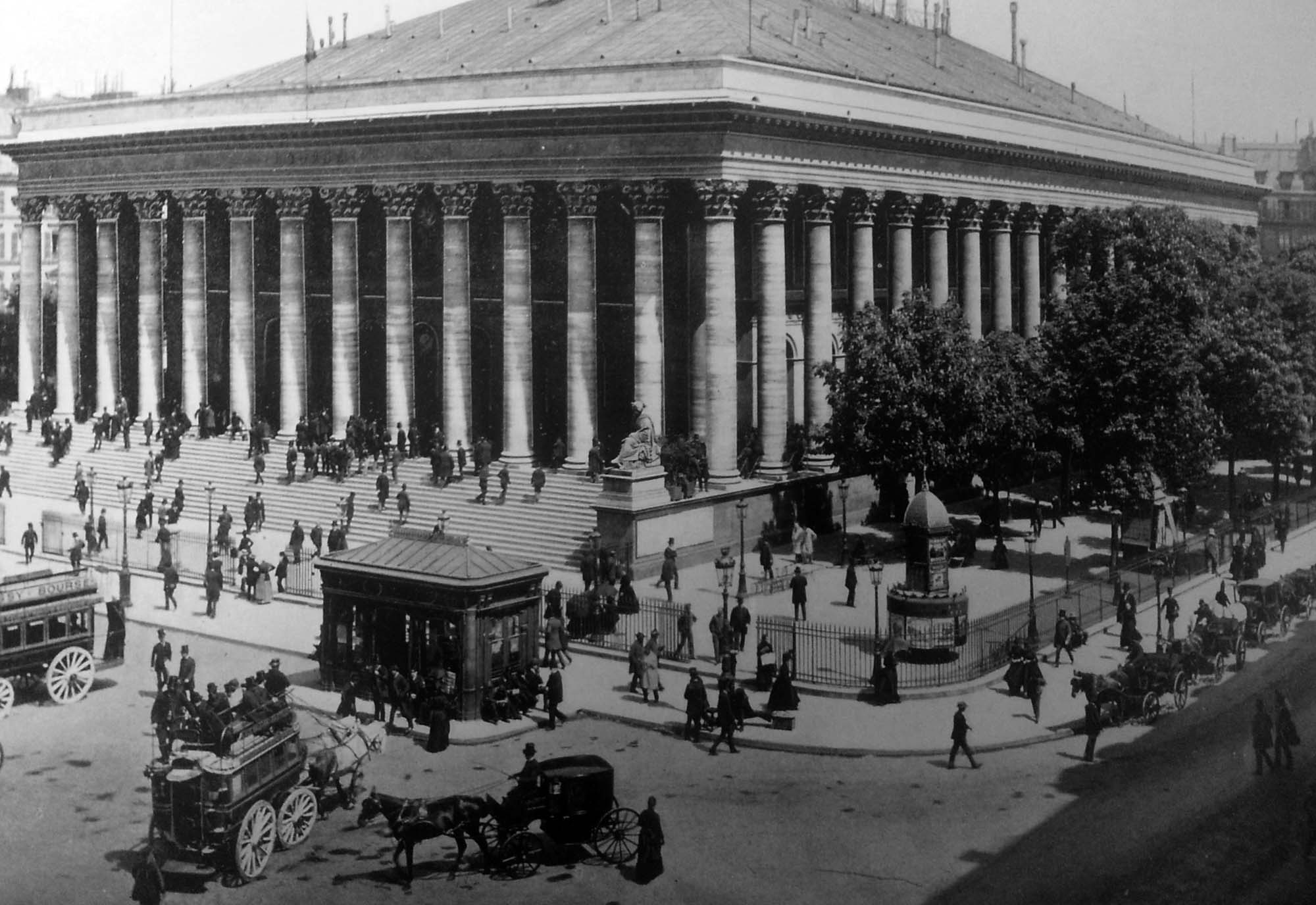
Here’s our next photo (and a wonderful caption) from the 1892 Glimpses of the World book

.

from Glimpses of the World (1892), page 33

.

The Bourse (or Exchange), Paris

A handsome structure is this edifice where fortunes are so easily made and lost. Surrounded by sixty-six Corinthian columns this building is not unlike the model of a temple in the Roman Forum. When the traveler has seen the stock exchange of New York or the Board of Trade in Chicago, there is nothing especially new or strange in the transactions of this Paris Bourse. Nevertheless, the tumult and incessant uproar which wake the echoes of these walls from twelve o’clock to three are well worth noting, as an indication of the feverish excitement of the “Bulls and Bears,” whose characteristics do not differ materially, whether the arena where their combats take place be in Wall Street or by Lake Michigan, in the vicinity of the Thames or here in Paris. To stand in the gallery of this Bourse and watch the pandemonium below or merely, as one lingers on these steps, to scrutinize the faces of successful or unfortunate speculators as they leave the building, affords an admirable chance to study interesting phases of human experience. This square, or “Place de la Bourse,” is a great point of arrival and departure of the Parisian omnibuses, the demand for which is usually greater than the supply. But no such crowding is possible here as in our public vehicles in America. Each passenger is entitled to a seat, which he secures by applying for a “number,” at the office in the square. The rule of “first come, first served” is rigidly enforced, and when the seats in the coach are filled, it rolls away, displaying over its door the word “Complet” (full). Who does not recollect the story of the disappointed tourist who exclaimed that the only place in Paris he did not go to was one called “Complet.” “Whenever I see an omnibus going there,” he cried, “it will never stop for me!”

At the end of yesterday’s post, Mr. Sherwood guessed that perhaps Mr. Johnson didn’t like California, because he was returning to Massachusetts so soon after arriving there. Based on this long, detailed response (probably his longest comment on any particular subject so far in the book), I’d say that Mr. Johnson *really* didn’t like California at all …

“I think this, that there are those who are responsible for the deception that has been sent abroad in regard to California. So much has been said on paper that brought out thousands who are not able to get back, who would if they could. I have heard many say that much. Oh, such a climate, so warm and pleasant, and so beautiful. I will admit that the months of December, January, and February, to Eastern people are most agreeable, that is, in regard to heat and cold. But in April and the summer months, till December, everything is dried up, except what irrigation has kept green. If you are located on the river valleys you are all right, but these are scarce. I have seen the sands blow like our eastern snows. I prefer snow to sand every time, when the wind blows. No rain is expected until the month of December. In the northern sections you may get some rain in November, but seldom.

“After the first rain things change; when the second rain comes, should it prove a good substantial one, say, so many inches, you put in your seeds and in order to get back the value of your seed and labor, you must have so much rain, or so many inches of rainfall in order to warrant a crop. Now during the months of December and January, these two month, the rains come. The best months are the first four.

“In April, things begin to dry up; May is dry, June is very dry, in July you are trying to get your sheep to the mountains. Can wait no longer, and you have to be smart to get them there or they will perish on the way. It is not yet August and don’t expect rain for several months. August, September, October, November; four months, all dried up. Think of it; ten months out of twelve, no rain. You get up in the morning, say five o’clock, the sun is just up, not a cloud to be seen. The day advances; nine o’clock, hot; twelve at noon, very hot, not a cloud to be seen. No, no rain today — no showers to lay the dust — all dried up.

“I prefer living where it is cold, warm, hot, with showers occasionally, to lying down in the hot burning sands, to bring out the rich colors of the shrubbery and make nature grand and sublime. A smart thunderstorm that will burn up the nitrogen and give us in [its] place a healthy oxygen, that is what I admire.”

I can just imagine poor Mr. Sherwood, at the end of this rant, thinking, “Well, ok, then. Off you go, back to Massachusetts.”

When we last checked in with Mr. Johnson, he was about three miles from Graniteville, California.

When he reached that town, he made an arrangement with a local couple to camp on their property, paying them with fresh milk from his cow, as he’d done previously. He also went to the post office to get directions to the home of a Mr. Sherwood, who was a miner in the area. Before he’d even left Massachusetts for California a couple of years earlier, Mr. Johnson had been asked by that man’s sister (a fellow resident of Webster, Mass.) to give him her greetings. The lady’s brother (Mr. Sherwood) had moved west before she was born, but she’d been corresponding with him for years.

This is where we pick up Mr. Johnson’s story again:

“On the morning of the 16th [of August 1882] I was up as usual, feeding the cattle, milking the cow, greasing the wagon, doing this and that, looking here and there, and I came to the conclusion that Graniteville was a smart, lively, business town. It has a hotel, two stores, livery stable, two saloons, two blacksmith shops, a market, and many houses.

“When the right time came I carried in the milk, presenting it to the lady. She looked at it and said, ‘You must have a good cow that gave such a quantity and good at that. Our breakfast will soon be ready, come in and take breakfast with us; make yourself at home as long as you are here.’ The bell rang, I went in and the lady gave me a seat at the table and was my waiter.

“I remarked to her that I was going west about three miles, to the canyon in search of a man named Sherwood, and asked would my outfit be safe with them. ‘I will keep a lookout myself, I think they will not be disturbed; how long would you be gone?’ queried the lady. ‘I hope to return by noon, and I think I will.’

“I started for the canyon, taking the road for the creek and finding the trail as directed, crossing the creek on towards the cabin. Going up to the cabin door I knocked and listened, but did not hear anything; knocked again, listened and heard a noise inside. I gave a louder knock, when a voice answered, ‘Who is there?’ ‘No one who will harm you,’ I answered, ‘I want to see Mr. Sherwood, is he not at home?’

“‘He is not, he is up at the mines.’ ‘Where is the mine?’ ‘Up in the canyon.’ ‘My home is in the far East and I am on my way back to Webster, Mass. I have come a long distance to see Mr. Sherwood, and I don’t want to go away without seeing him. I have a message from his sister, whom he never saw, that lives in the town I come from. Now dare you open the door?’ ‘Yes, when I hear the name of Webster.’

“The person came and opened the door and said, ‘You [are] from Webster?’ ‘I am, and know those whom neither you nor your husband ever saw. Mr. and Mrs. B___, by me send their most sincere love to you and yours; this is why I was anxious to see you.’

“She sounded a horn, and soon after a young man came in, to whom she said: ‘Go up the canyon and tell your father a man wishes to see him.’ It was not long before a man came to the cabin, when the woman said, ‘This man came to the door and knocked three times before I dared to open it. Had he not said he was from Webster, Mass., and had a message from Mr. and Mrs. B___, I should not have dared to let him in.’ ‘You are from Webster, Mass.?’ ‘I am, sir.’ ‘You know my brother and sister, B___?’ ‘I do.’ ‘When did you leave Massachusetts?’ ‘In April 1880.’ ‘How long have you been in California?’ ‘Two years, I arrived at Eureka on the 28th of May, 1880, and have been there ever since that time.’ ‘You are on your way back to [Massachusetts]?’ ‘I am.’ ‘I think you do not like California by returning so soon, is that so?'”

… Check back in tomorrow to read Mr. Johnson’s emphatic response to this question.

I missed posting anything here yesterday. It was the weekend, and it rained all day, and for much of the day, I was relaxing on the couch with a very comfortable cat lounging on my lap.

At any rate …

On Saturday, A.J. and I did a bit of antiques-browsing in nearby Georgetown, Kentucky. In one shop, I found several old postcards. This one, unfortunately, has no text anywhere on it, so I can’t be sure what (or where) it’s depicting, or when the image was created. But it’s clearly a carriage factory. And the workers appear to be making delivery vans. There’s a near-side rear wheel in the lower left corner. On the left is a man working with wooden parts of some sort. On the right is a blacksmith. And in the background, a worker appears to be painting a completed vehicle.

.

.

Of the next morning, in North Bloomfield, Mr. Johnson wrote: “The morning of the 15th [of August 1882] found me up early, making ready for my day’s travel.

“I went to the hotel and found only the lady of the house up; I asked for a pail in which to milk, promising her the milk. I gave it to her, saying she was welcome to it, on which she said, ‘Stranger, please sit down and I will broil you a bit of steak.’ In about five minutes she brought in steak, potatoes, hot biscuits, and coffee. This I did not expect, but did ample justice to the repast and thanked her for the same.

“I left on my journey about half-past five o’clock; on leaving this place I took the road to my right, by so doing I saved about four miles of travel, and came into the same highway. The road to my left would have taken me to a large mining town; at half-past eleven I came to the main road. Here was a small pond, of which my cattle drank heartily. I gave them grain and had a lunch myself; I rested a little over an hour and at one o’clock resumed my journey.

“The road we are now traveling is tip-top; during the rest of the afternoon I crossed several bridges over small rivers. In crossing one, off to my right, I noticed one stream rushing along with great power. Here I met a four-horse team and asked the driver how far it was to Graniteville. He answered, ‘Not quite three miles.'”

« Previous PageNext Page »