history


Here’s a wonderful portrait of a milk-delivery vehicle, from New Orleans, c. 1910.

Luckily for us, a descendant of that very milkman posted this comment on the photo at the Shorpy website:

“This was a milk cart that belonged to my great-great-grandfather, Adam Schoendorf. I was delighted to see this, as I had only seen a few photos of it from the back, taken by his daughter Marie. (Those photos were probably lost after Katrina and the levee failure.) Adam Schoendorf owned Hunter’s Dairy in New Orleans, located at the corner of Havana and Ne Plus Ultra streets. Ne Plus Ultra is now Lafreniere Street.

“A more well-known photo of a different, larger Schoendorf vehicle can be seen here. This wagon is harnessed to a horse named Billy – ‘the ugliest horse my papa owed, but the smartest’ according to Aunt Marie. Billy’s harness features medallions with the initials ‘A.S.’ The original [photo] is in the Library of Congress, and appears in many books about New Orleans.”

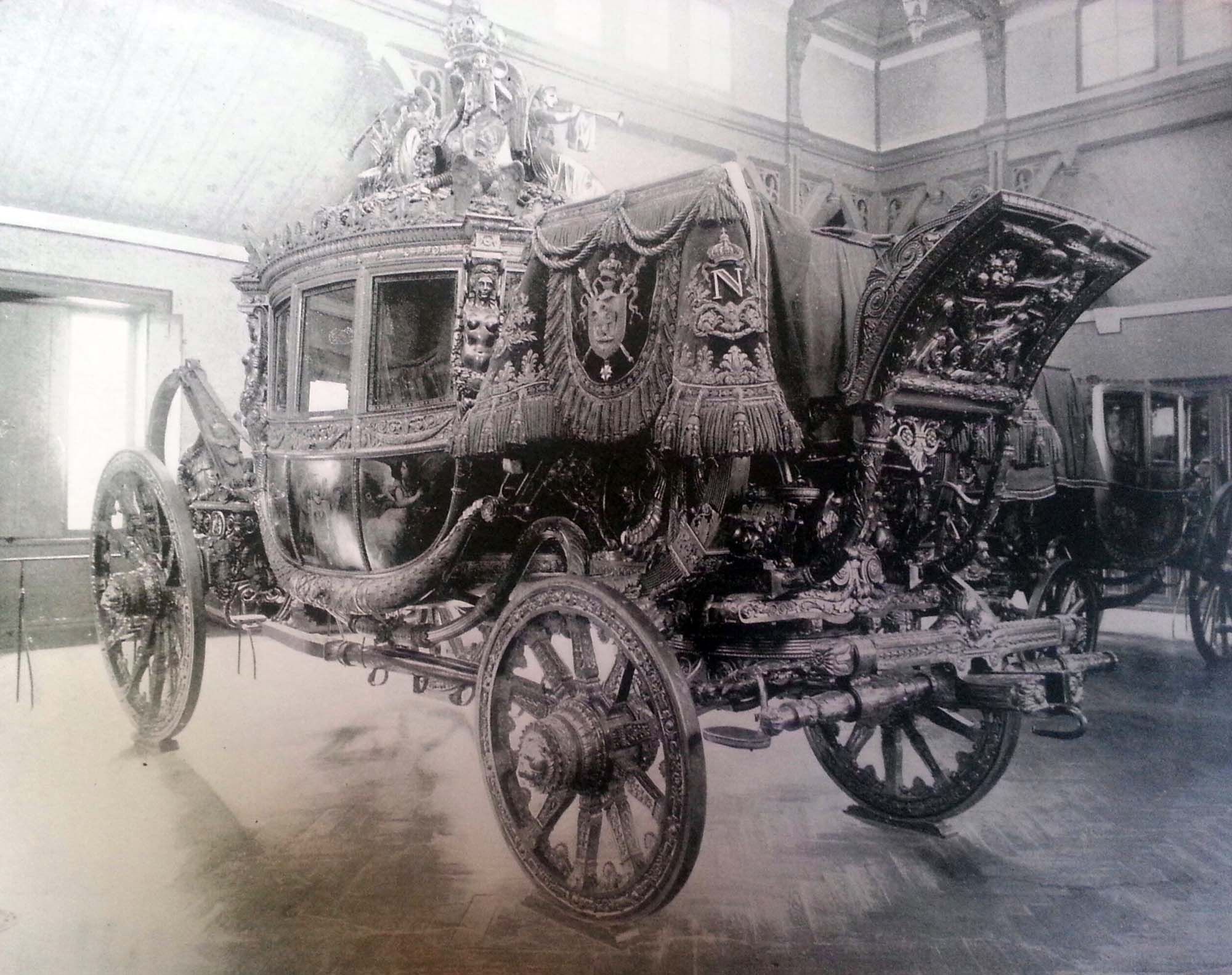
For our next Glimpses of the World photo, and the last from France, we have this magnificent coach:

.

from Glimpses of the World (1892) - page 55.

Here is the caption that accompanies the image in the book:

Among the relics of royalty and of the empire displayed at Versailles is this magnificent vehicle, the woodwork of which is one mass of gilding, while the interior decorations are of the most elegant description. This is said to be the carriage in which the Emperor Napoleon I went with the Empress Marie Louise to solemnize their [1810] marriage in the Cathedral of Notre Dame. [Their wedding actually took place at the Louvre.] All Paris was in the greatest excitement, and Napoleon’s future seemed then brilliant beyond all precedent in modern history. Yet in reality these gilded wheels were swiftly bearing him to what Napoleon himself subsequently called, “an abyss covered with flowers.” And such indeed proved to be this fatal marriage following his divorce from Josephine. No doubt Napoleon’s pride was gratified, as in this gorgeous vehicle he sat beside his Austrian bride, but it was certainly impossible for him to ever love her as he had once loved Josephine. The latter, slightly older than himself, had been his life-long confidant and friend. She had at first contributed much to his success. Her intuitions made her a most useful counselor. But what was Marie Louise? A simple, inexperienced girl, with whom the emperor always wore a mask, lest his designs should through her reach the court of Austria! The one possessed a character as weak and vacillating at her face would indicate. The other proved herself a heroine by sacrificing to the interests of France not only the most enviable throne in Europe, but also the most famous of earth’s sovereigns, and the man she loved. “It will not bring him fortune,” said the common people when the divorce had been proclaimed, and they were right.

.

Interestingly, even though our book was published only eighty-two years after the events of 1810, the caption is incorrect.

This coach was not used by Napoleon I. Rather, a whopping thirty-four ceremonial Berlins were ordered (from fourteen Paris coachbuilders) specifically for the wedding procession. The two known as “La Victoire” and “La Cornaline” were used by the imperial couple.

The ornate coach shown above was built in 1814 and was used in 1825 as Charles X’s coronation coach. In 1856, it was renovated — and the Napoleonic “N”s were added — and was used for the baptism of Napoleon III’s son.

It’s now in the collection at the Palace of Versailles and is, in fact, currently on display in the “Roulez carrosses!” exhibit (through November 10) at Le Musée des Beaux-Arts d’Arras in France.

You can see color photos of the coach and read more about it here.

(continued from yesterday) …

“This is a very good road, I have had none like it so far on my journey. I am traveling in the rear of a large flock of sheep and cannot get by them. On my left is a deep canyon, and on my right is a high bluff or mountain. I asked the herdsman where they intended to camp? He said, just this side of Silver Peak, but a short distance further.

“At six o’clock we came to a saw mill. At the left of this mill the herdsman turned in and drove down into the canyon. I was informed that there was good feeding, but did not go down to see. I pitched my camp opposite the mill, where there was a good feeding of wild oats, which my cattle readily devoured. They were the first wild oats on which they had fed. I made a fire, wood being around in abundance; made a dish of tea and ate my supper and laid down for a while.

“About nine o’clock I got up and after securing the cattle for the night I again laid down, but could not go to slepp, on account of the sheep bleating for their young, there being about six thousand of them in the canyon. About half-past ten o’clock I heard the report of a gun, then another, and another.

“I called out, ‘What is the matter down there?’ ‘Matter enough, the wolves are after our mutton, the canyon is full of them. We dare not set our dogs on them as they will be killed, so we blaze at them.’ ‘Come up here and get some milk, I have some and you can have all you wish.’

“The man was soon at my camp who said, ‘I have come for that milk, thinking it must be worth coming after.’ ‘But what have you to carry it in?’ ‘Oh, the devil. I did not think to bring anything. Can’t I take the can, I will bring it back; what is it worth?’ ‘I paid a dollar for it in Sacramento.’ ‘Will you sell it, I will give what it cost you and more if you say so.’ I let him have the can at cost and he gave me a dollar. He wished to pay me for the milk also but I declined to take it. ‘What is the matter among your sheep?’ I asked. ‘The wolves want mutton; they were as thick as rabbits when I came up, I could hear them in the brush after the sheep; they can smell a sheep a long way off. Our sheep are hungry, still we dare not let them feed at nights; they must wait till morning and then the dogs can take care of them,’ said the shepherd. ‘In what kind of a place are your sheep tonight?’ ‘They are in a kind of oblong square, and there are six thousand of them; they will cover about two acres. On one side we have three camp fires, on the other are six dogs and four men with guns.’ ‘Do you fear the coyote?’ ‘No, we do not, we set our dogs on them, but the wolf would kill a dog mighty quick. When the wolves show themselves we quickly blaze at them; we try not to kill but to wound them. If a wolf is wounded we are not troubled with others for some time.’ ‘You was not afraid to come for the milk?’ ‘I should not have dared to come had I not had this lantern, it is enough to keep any wolf away from me.’ ‘Do you think they will make an attack on me?’ ‘They will not trouble you as long as the sheep are there, if they were not around they might attack your cattle; but you need not fear.’

“Bang, bang, bang, went three guns. ‘I must go back, there may be something for me to do; they may have a strong army and if they attack us would make a clean sweep of the sheep. Stranger, you have been passing through a wild country; have you not been troubled by these infernals during the night? If not, you are remarkably lucky.’ ‘At Graniteville, I was told that I was entering a wild region and should be ready to meet them. Since then I have been on the lookout, and tonight the varmints are plentiful around and should be handled with firmness.'”
Did you see the pictures of Dr. Webber’s hotel, and the area around the lake, where Mr. Johnson stopped in August 1882?

The day after we last checked in with Mr. Johnson, he left Webber’s Lake to travel the twenty-eight miles to Silver Peak …

“This morning I got up early as usual and made ready to move another stage on my journey. Having had a good night’s rest, I feel tip-top and am anxious to reach Reno tomorrow. There I hope to be able to shoe my cow, if not, I do not know when it can be done. It is just half-past five and all ready to start.

“I went to the hotel to see if the doctor was up and told him I was ready to start but he would not let me till I had had some breakfast. ‘I do not wish to offend you, but am very anxious to cover as many miles today as possible,’ I said. ‘You stop and get a good breakfast and you will make more miles,’ he replied. I reluctantly stopped and requested a pail and went and milked my cow and handed him the milking. ‘You have a fine cow, she will more than pay her way,’ said the doctor.

“I sat down to a breakfast of beef and veal steak, boiled eggs, fried potatoes, biscuit and hot coffee, which I thought was well worth stopping for, and turning to the doctor I said, ‘Doctor, I have been well paid for the stopping, good morning.’ ‘I knew you would be; good morning. I hope you will make a success of your undertaking.’

“It was just half-past six o’clock as I left the hotel. My road was a good one, on a down grade. Traveling a little ways I came to where four roads crossed and took the left-hand road. About eleven o’clock, I came to a ranch where I stopped, giving my cattle a ration of water and grain. I then went on and after traveling about two miles came to another ranch, where I again halted for a short rest. Traveling still further, I came to a valley and passed through a timber lot which had been felled and the logs were scattered in the road and all around. This timber was handsome, not large but a good size for use — say, about two to four feet in diameter.

“I am still but a short distance from the Central Pacific Railroad, not more than two miles. It was with great difficulty I got through the timber lot, and when through I emerged into the turnpike for Reno.” …

If you’ve enjoyed Mr. Johnson’s descriptions of Webber’s Lake (from his visit there in 1882), over the past two days, I have an extraordinary bonus for you.

Nancy in California gave me this link to a December 3, 2012, San Francisco Chronicle article about recent efforts to save Webber Lake and the surrounding area for public use and enjoyment. Luckily for us, the article includes stories about Mr. Webber and some of his guests and even current photos of the lake, the still-beautiful wilderness around it, and Mr. Webber’s hotel. Thank you, Nancy!

« Previous PageNext Page »