history


I saw a photo floating around on Facebook earlier today that featured two stagecoaches in Nevada, c. 1903. And that photo led me to an article from several years ago on a website called True West.

If you can stomach it, the article offers a rather nauseating look at stagecoach travel in the West. The vehicles themselves are beautiful, but … blech.

Enjoy!  😉

In honor of our remaining (last?) bit of summer — we’re expecting a high of ninety degrees tomorrow! — here’s a photo of what looks like a hot day at the harbor in Havana, Cuba, c. 1904. In addition to a number of ships (even a wrecked one in the middle of the harbor), there are several waiting wagons, most of which appear to be hitched to mules.

.

Just about a year after his hair-raising drive in London, Albert Johnson passed away. Here, with the fascinating tale of his early life, is an excerpt from an obituary of Mr. Johnson, from the July 7, 1901, issue of the Cincinnati Enquirer

“For a man who had been a controlling spirit in huge enterprises from the Mississippi to the Atlantic, and who for years had been prominent in that most public of industries, street railway operation, Albert L. Johnson was not widely known. That is, as a man. His name, his power as an organizer and his daring as a promoter were familiar to all who follow the course of events in the financial world and the ever-present problem of local transportation. But the man himself was not really a public character.

“Yet his personality was at least as interesting as that of many men who are pictured and described from day to day. He accomplished many things in his thirty-nine years of life, things worth while, whether from his own standpoint or that of the public. His original capital, too, was no greater than that of others whose rapid rise to wealth has furnished texts. It consisted of poverty, determination and daring.

“In many phases he was personally a type of the modern American, keen, aggressive and self-confident in business, tireless as a worker, and delighting in recreation where muscle ruled. Sometimes, when his superabundant energy demanded an outlet, he would choose an unusual form of exercise. Several times, when he was general manager of street railways in Cleveland, he spent the night clearing the tracks of snow. After a heavy fall, this was not a task for a weak man. The snow plows were huge machines, drawn by teams of eighteen horses. In the midst of a whirling blizzard, Johnson would take charge of one of the big plows and, holding the reins himself, would drive the team at furious pace through the silent streets, finding the keenest joy in battling with the cold and the driving snow and guiding the plunging animals.

“His liking for this strange amusement was doubtless due in part to his love of horses. He was never so satisfied as when driving a spirited team, and in this he followed the bend of his Kentucky forebears. His skill was extraordinary, too, for there was not a man in the country, perhaps, who could handle a four-in-hand with such deftness and skirt danger so closely without mishap.

“From his boyhood, Al Johnson was associated with his brother, Tom L., now mayor of Cleveland, who was ten years his senior. They were Kentucky-bred boys, sons of a Confederate officer who lost all his property in the Civil War. Their first venture in street railways was in running a line in Covington. They had three or four battered cars, a few mules and infinite patience. Al Johnson was driver and conductor combined of one of the cars, but assisted also in the management of the company.

“When Tom Johnson took hold of the street railway business of Indianapolis his brother, Al, joined him. He started in as a conductor, though a stockholder in the road. This double position made him one of the most faithful employees of the company. He rose from the ranks, however, and at twenty-two was general manager.

“It was in 1883 that the Johnsons entered Cleveland and began the long fight against entrenched rivals, which ended in victory. They bought the Brooklyn road, a one-horse line of bobtail cars, which started out in the suburbs and ended nowhere in particular. All the other lines on the west side of the city were controlled by Mark Hanna; those on the east by Dr. Everett. These magnates laughed at the puny beginnings of the Johnsons. They continued to charge fifteen cents for a ride from one side of the city to the other.

“But gradually the Johnsons began to reach out. They offered to pave Scovill avenue if the city would allow them to lay tracks on it. The city consented, and three and a half miles were added to the line. Then they began a fight to cross the viaduct, where Hanna had sole rights. Al Johnson was the leader in this assault and, after patient work, he succeeded in having an ordinance passed making the viaduct free.

“But there was still a strip of a mile separating the Scovill avenue line from the Brooklyn line, and Al Johnson set about getting it. It took him four years, but he never ceased work until he succeeded. He had been elected an alderman in the meantime, and had great influence with young men in politics. Having maneuvered so that the mayor and his rivals were out of town, he laid the tracks at night, and his rivals failed to dislodge him.

“Once it was completed, the Johnson line began to do business with the people. One fare was made the rate for any distance over the line, and it was not long before the Hanna-Everett companies had to meet the rate. Now one many ride fifteen miles in Cleveland for five cents.”
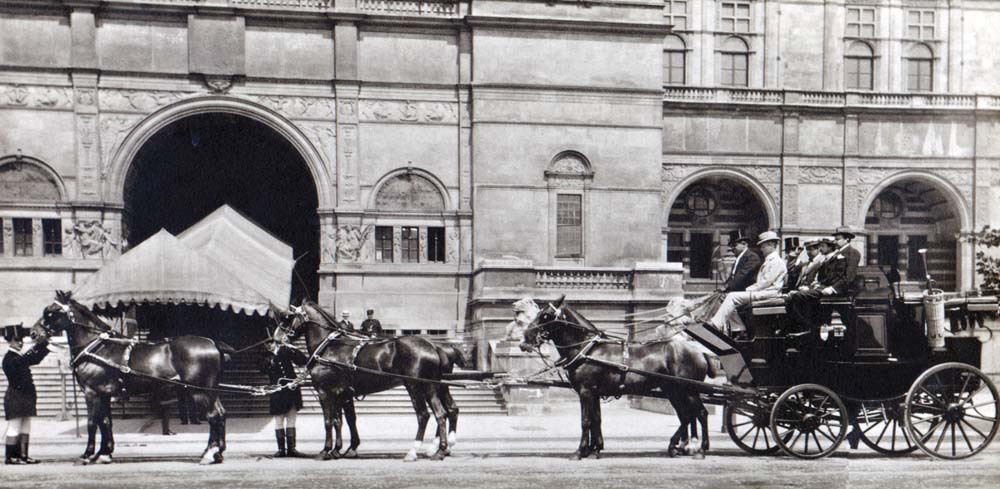
If you have (or had) a copy of the October 2012 issue of The Carriage Journal, do you remember that issue’s “The Road Behind” column? Here’s what it said …

[CAA member] Marc Kelley sent us this photo of his great-great-grandfather, along with a great many newspaper clippings, where we found the following story.

.

.

In the summer of 1900, Albert L. Johnson, a Cleveland-based owner and promoter of electric streetcars, took his Brewster Park Drag and six horses to London. On July 7, New York’s Herald newspaper printed this story, submitted by the paper’s European correspondent.

“Considerable sensation would appear to have been created yesterday afternoon when Mr. Albert L. Johnson, the American coaching expert, drove a team of six horses out of the small yard where he keeps his coach, at Knightsbridge. It had been suggested that he should put on the leaders outside, but this very remarkable driver would have none of that. A large crowd had gathered to see what would happen, and people lined the streets in Hansom Cabs at the curbs, expecting evidently that there would be at least a tangle up.

“Mr. Johnson drove out undisturbed by the amount of attention paid to him and with apparently the same ease as though he were driving a four or even a pair. The team consisted of a shapely lot of bays, three American and three English, with a swing bar connecting the pole and the leaders and running between the swinging team.

“Amid gaping policemen and people, and buses and cabs, stopping to watch Mr. Johnson drive into Hyde Park, there began a series of tests in driving figures of eight and short turns. Then, through the green park he drove through the crowded traffic of Pall Mall, drawing up in fine style at the Carlton Hotel. From there, he turned short round in the street, and through congested traffic, amid the same scene of attention and apparent amazement, drove with fast speed through Knightsbridge, turning in and out, and finally driving through the narrow gate of the Rutland Yard, under an archway in which all on the roof had to bend low, with scarce six inches to spare on either side of the hubs.

“Even with four-in-hands it is customary in the Rutland Yard to put on the leaders in the street, so you may judge how Mr. Johnson astonished them by calmly driving in and out, and all through the journey he never scraped a bit of varnish.”

Check back here tomorrow afternoon to learn more about Mr. Albert Johnson …

It’s been quite a long while since I’ve shared any of the Glimpses of the World photos.

Today’s photo doesn’t have any horses or vehicles in it … at least not that we can see. But, if you happen to have a copy of the January 2011 issue of The Carriage Journal, you may’ve read Andres Furger’s article on Swiss traveling carriages. In that article — and in his 2010 CAA / CWF International Carriage Symposium lecture, in case you were at Colonial Williamsburg and heard it — he talked about this very same St. Gotthard Pass.

.

.

The photo’s caption in Glimpses of the World says, “The king of Alpine routes from Switzerland to Italy is the St. Gotthard. It is impossible to speak too highly of this noble road. Scaling the loftiest cliffs, spanning the wildest torrents, and winding through the deepest gorges, it seems like a gigantic chain, which man, the Victor, has imposed upon the vanquished Alps; the first end guarded by the Lion of Lucerne, the last sunk deep in the Italian lakes, but all the intervening links kept gilded brightly by the hand of trade! It is a splendid instance of the way in which these roads are made to thwart at every turn the sudden fury of the avalanche or mountain torrent. For where experience proves a place to be unusually exposed, a solid roof extends to break the fall of rocks and ice. Still, in these days of steam and telegraph, even this mode of travel in the Alps appears too slow for those who journey here for business purposes, and one of the most important works of this or any age is the tunnel of St. Gotthard. This perforates yonder chain of mountains for a distance of nine and one half miles, yet is sufficiently wide for two railway trains to run abreast. What labor must have been expended here by myriads of men, who most of the time were thousands of feet beneath the mountains, yet who at last, by the perfection of engineering skill, met and shook hands through the narrow aperture which they had pierced from the opposite sides of Switzerland and Italy!”

« Previous PageNext Page »