… and traditional examples of national costume …
Check out these scenes from the coronation procession of Russia’s Tsar Nicholas II, in 1896:
.
January 9, 2011
… and traditional examples of national costume …
Check out these scenes from the coronation procession of Russia’s Tsar Nicholas II, in 1896:
.
January 8, 2011
Two very short video clips here. The first one (from Balmoral in 1896) has an awful lot of camera shake, but the view of Queen Victoria with her pony and her lap dog are worth the eye strain! The second clip (from 1897) shows a vehicle that’s more along the lines of what one would expect a queen to be riding in …
.
January 6, 2011
Here’s a quick but wonderful look at downtown Los Angeles, Calif., in February 1898, with horse-drawn vehicles (even a six-in-hand) going by at speed.
Watch for the bump in the road at about the 19-second mark. How would you like to be that guy on the back seat??
.
January 5, 2011
The January issue of our magazine, The Carriage Journal, includes a fascinating article on horse-drawn travel in Switzerland. The article is adapted from Andres Furger’s lecture at the 2010 CAA / CWF International Carriage Symposium.
Andres shared the following story with the symposium attendees, and his lively storytelling prompted an awful lot of laughter in the room. Except for the general intro (below), however, this story didn’t make it into the magazine article. So I offer it here:
.
“Over two thousand, five hundred years ago, the area that today is Switzerland lay in the heartland of the Celts. These people, the Helvetii, were excellent craftsmen particularly when it came to building vehicles. During their time the concept of using spoked wheels was introduced into Europe. These were constructed in much the same way as they are today, maybe even better, as the Celts understood the need to make the wheel rim out of a single piece of wood, which they bent using steam.
“Using archaeological evidence, I was able to reconstruct a working Celtic war chariot for the Swiss National Museum in 1987.
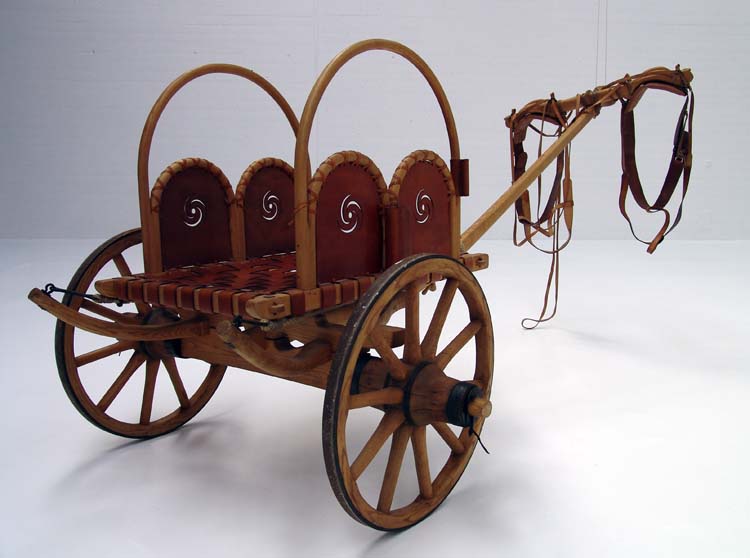
Andres Furger built this reconstruction of a Celtic war chariot in 1987
.
“Unlike the Greeks and Egyptians, the Celtic driver sat while the warrior stood behind him on the back of the chariot, which was suspended even then. I had the opportunity to test this with my good friend Daniel Würgler, today one of the world’s top four-in-hand drivers.
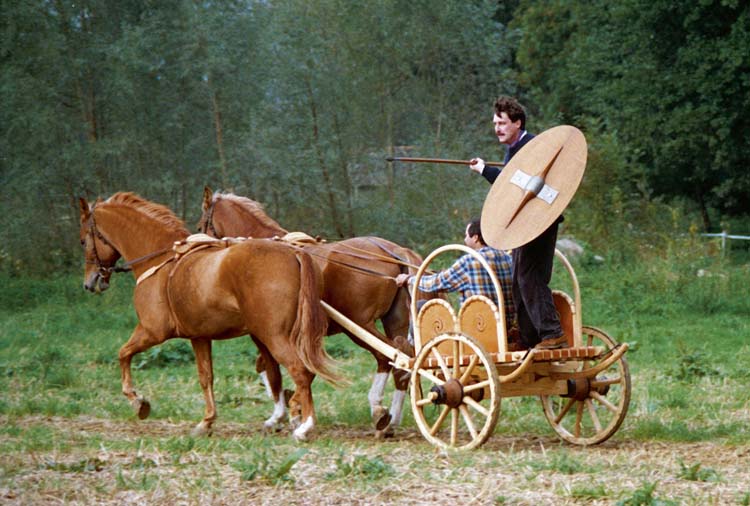
... and he put it to an actual test (that's him, standing at the back), with his friend Daniel Wuergler driving (seated at the front)
.
“The test was going splendidly until I tried my hand at something that Julius Caesar himself had described, which was the “warrior method” of leaping at full gallop from the back of the vehicle onto the pole and up to the yoke to be able to throw the spear down from a great height. This my horses tolerated at the halt. However when I tried it again at speed they shot forward, catapulting me backwards between their hind legs.
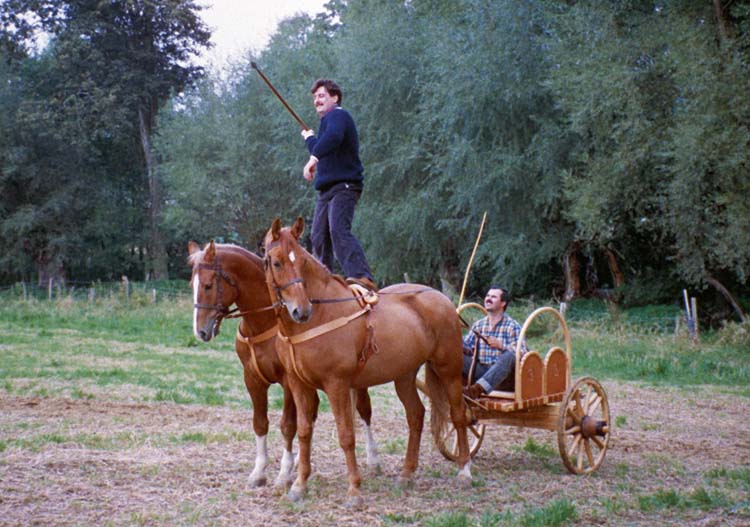
Furger's first attempt at the "warrior method" of throwing a spear (here, at the halt) was successful ... the second attempt, not so much
.
“Only some quick thinking and a roll to the left saved me from becoming yet another statistic concerning itself with the rise and fall of the Roman Empire.”
January 4, 2011
Below, a video montage of photos — both old and new — from the Buffalo Bill Historical Center in Cody, Wyoming. Enjoy!
.
 The Slower Road