history


As you may have realized by now, I’ve been digging through old issues of Bit & Spur, from a box in the CMA’s library and archives, which are housed here in our CAA office.

Today, I offer the following installment in that magazine’s “Portraits of Champions” series, which was sent as a supplement to the October 1905 issue:

.

"a six-in-hand of Percheron geldings, owned by the Pabst Brewing Co."

.

From page 253 of the October 1905 issue:

Apropos of the nearing American Royal and International shows — famous for their wonderful display of heavy draft horses — we are pleased to bring before our readers this month [number] seven in the supplements of Portraits of Champions from the George Fred Morris portfolio, this depicting the heavy six-in-hand of the Pabst Brewing Company, considered the six best all-around Percherons in this country. At the International and World’s Fair Shows last fall these geldings swept everything before them, and carried away an unbroken string of rosettes, testimonial of their quality in the pair, four and six classes, defeating the best competitors in heavy horses that money could buy in the entrants of Nelson Morris, Armour, Swift and other big commercial firms.

Star and Big Bill, the two wheel horses, were four years old last spring. They were shown in Chicago at the International last year as three-year-olds and won in the heavy six the first time they were ever put together. They were both raised in Illinois. One of them is a purebred Percheron, and the other a three-quarter-bred horse.

The swing (middle) pair were six years old last spring. Harry, the near horse, was raised in Iowa and is a perfect type of a Percheron. His mate, George, is claimed to have been bred in South Dakota. He was purchased at the stockyards in Chicago. On a recent trip to Minneapolis the buyer met a South Dakota man who claimed to know George and his breeding, and he stated that he is a three-quarters-bred Percheron. George never was outside the ribbons. He was shown in the heavy cart class at the International in 1903, winning fourth place when he weighed less than 1,800 pounds. When he was shipped to the International last year he weighed 2,140 pounds and defeated imported Scottish horses.

Dan, the near horse of the lead team, and Tom, his mate, won in the light class in 1903 at the International as a pair, and at the International last year (1904), as a pair in the light four and on the lead in the heavy six. These same six horses are the ones that were shown and won everything at the World’s Fair in St. Louis last year, with the exception of the off-wheel horse.

The harlequin Great Dane, New York, which accompanies the Pabst six-horse team, but is not shown in the drawing, stands thirty-two inches high at the shoulder and is of a very rare marking, being of a species seldom seen. His blood lines are of the very best breeding from imported stock, and he is valued at a thousand dollars. As a puppy he took first prize at the Madison Square Show, New York, and now, at the age of two years, is a very handsome and well-matured dog.
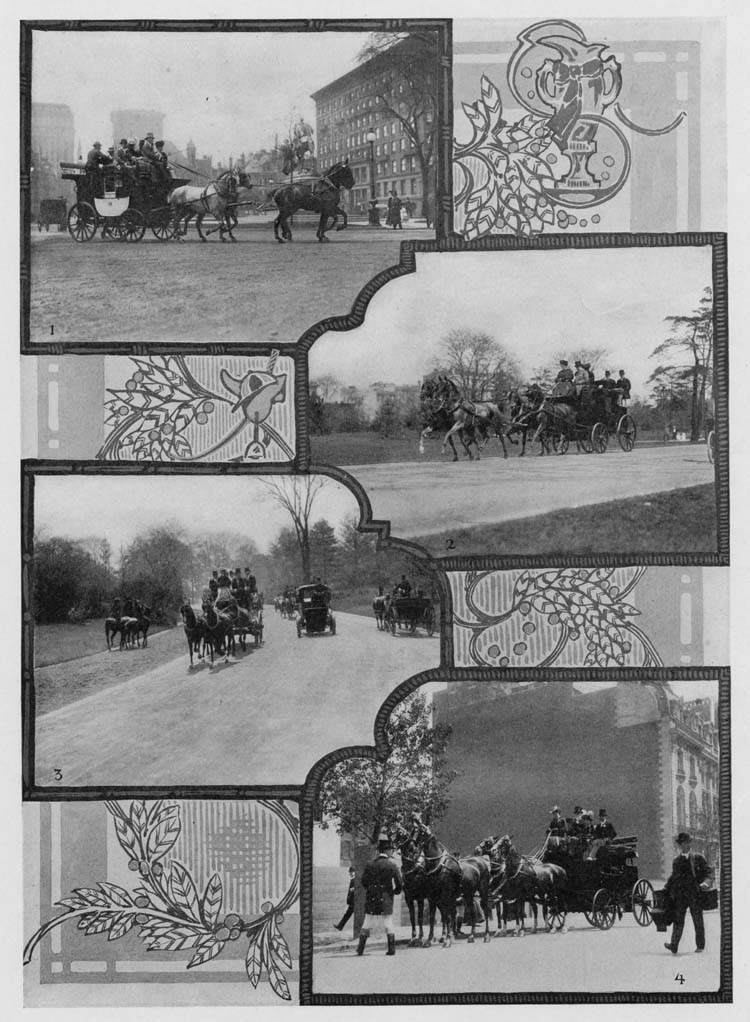
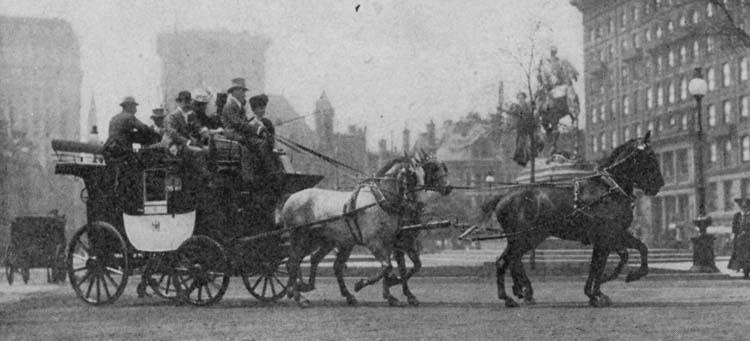
… from a supplement page to the June 1905 issue of Bit & Spur:

.

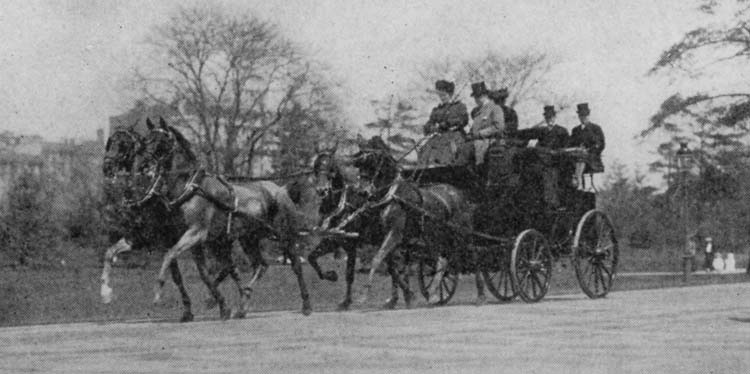
prominent drags at meets of the Ladies' Four-in-Hand and New York Coaching Clubs

.

… and close-ups of each one:

.

Alfred Vanderbilt

.

Miss Louise Gulliver

.

Mrs. Thomas Hastings

.

Miss Jean Reid

More on the photo in yesterday’s post …

Elsewhere in the same issue of Bit & Spur (May 1905), is this tidbit:

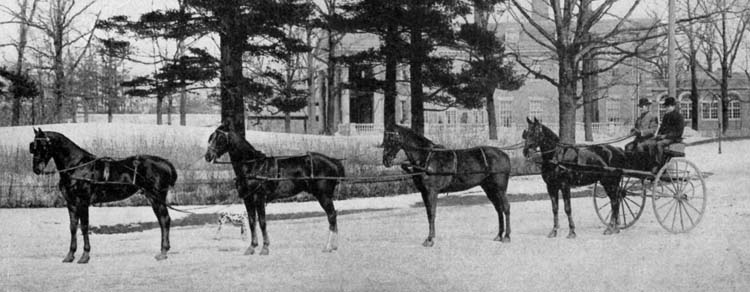
“The [photo] of the four horses owned by George Pepper, shown in this number, and put to tandem-fashion one ahead of the other, is an interesting study. Here is a team of mixed show horses probably never stepping in similar harness more than two or three times; two of them are champion jumpers, holding the height record for the seasons of 1903 and 1904. Another is a combination jumper walk-trot entry, and the leader is a Gig type. The photographer has caught them in perfect form, standing quietly and waiting for the signal to go ahead; versatile, I should say. That is the beauty of the show horse, he catches a new idea quickly. However, it is much to the credit of Fred Bork’s real knack as a handler that he is able to show a made-up team evidencing such form, ease and mannerliness.”

If nothing else, this photo of George Pepper’s “Four Team” proves that horses were trained to do more than one task. Yes, those are, in fact, champion jumpers in harness.

.

"Bit & Spur contends this should be called a quadrem. Leader high stepper, Dr. Sherman; second Glendale, champion saddle horse; third Rupert, champion high jumper season of 1903; wheeler, Senator, champion high jumper season 1904. Taken in Queen's Park, Toronto. Fred Bork driving." ... from the May 1905 issue of Bit & Spur

In honor of our CAA Winter Conference, which takes place next week in Minnesota (St. Paul), I offer the following story and photos, from the July 1905 issue of Bit & Spur:

.

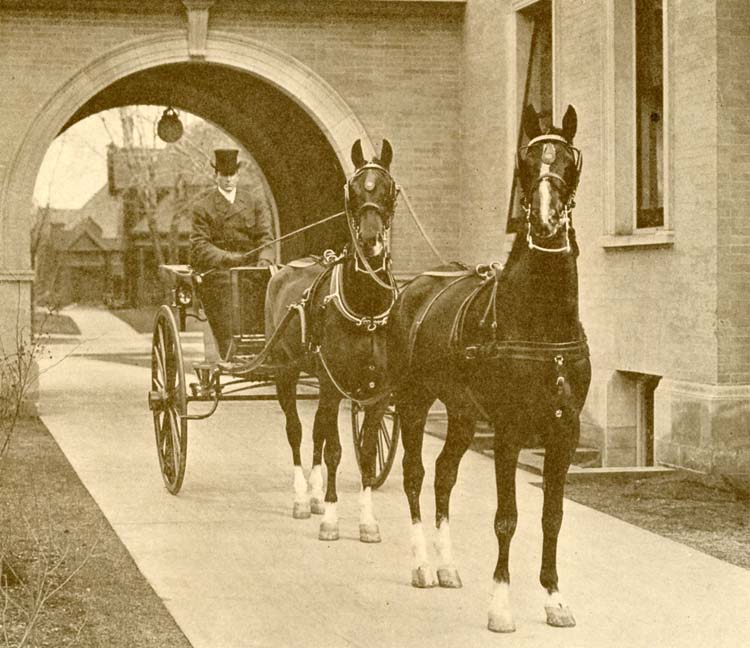
"an attractive tandem from the handsome private stable of George W. Peavey, Minneapolis, Minn." ... from the cover of the July 1905 issue of Bit & Spur

.

An Elaborate Minneapolis Stable

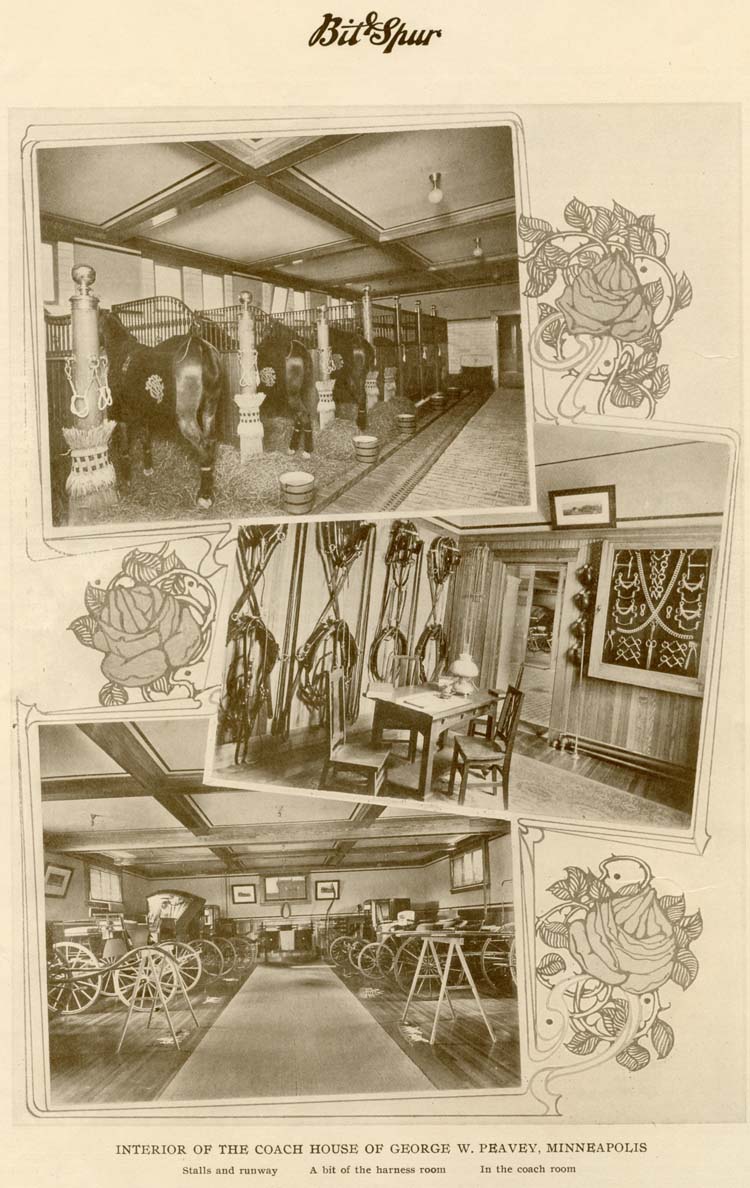
Among the many handsome private stables which are part of the menage of the wealth of the Queen City of the Northwest — Minneapolis — none are more imposing in character or more faultlessly set up than the recently outfitted establishment of Geo. W. Peavey of Park avenue. With a decided taste for horses, and their proper accoutrements, and unlimited means to gratify his fancy, it is only within the last year, however, that Mr. Peavey has furnished his stable on a scale as complete and lavish as now marks his establishment. The new modern structure is of pressed brick, the main entrance breaking its center in imposing dignity. To the left is the stable proper and hitching room, with walls of glazed white brick, and polished cross-beamed ceilings. The four single and two box stalls are abundantly lighted and ventilated by broad low windows running in groups of two above their length, the stalls being fitted with sanitary stall drains and enameled accessories. Runway and floors are of hard pressed brick. The coach and harness rooms to the left of the entrance have floors and dadoes of hardwood,  and splendid lighting facilities, the harness room being handsomely furnished in mission furniture, with its complement of bit cabinets and whip racks, etc.

Elaborate quarters for coachmen and grooms occupy the second floor. The stable is modern in every sense that heat, light, ventilating and mechanical skill can contrive. The stable colors of black and yellow appear in the entire stable furnishings, from the dress blankets of the horses blazoned with their yellow monogram, “G.W.P.,” to the markings of the stable buckets. The day clothing of the horses is fawn color with black trimmings, upholstering of the vehicles black, and liveries same color. The horses include a pair of chestnut cobs and a gigster purchased from that purveyor of fancy harness horses, W. C. Bryant, of Marion, Iowa; also a 16.1 bay gelding of lofty type for single brougham use. The cobs are well suited to tandem use, and the gigster is a high all round actor.

Though still incomplete from Mr. Peavey’s critical standpoint, the coach room contains a smart dogcart, a single and an extension brougham, runabout, Goddard gig, trap, and several other modish turnouts. Both Mr. and Mrs. Peavey are good whips and often drive tandem, and will ship part of their stable to their summer home, “Highcroft,” at Minnetonka, for the summer.

In Joseph Nightingale, Mr. Peavey has the smartest of caretakers, who not only looks fit on the box but whose careful hand is shown in the preciseness of his stable decorations, and the genuine cleverness of his sporting pictures in sand, which point the hallmarks of his profession before each vehicle on the polished coach room floor.

.

interior views of Mr. Peavey's stable -- (top to bottom): "stalls and runway," "a bit of the harness room," and "in the coach room"

« Previous PageNext Page »