history


I found this interesting entry in the March 19, 1898, issue of Rider & Driver:

The four-horse coach Pioneer will start from the Holland house, 5th Avenue and 32nd Street [in New York City], on Monday, April 11, at 10 a.m., leaving Ardsley on return, at 3:15 p.m., and arriving at the Holland House at 6 p.m. The coach will make daily trips, Sundays excepted, until June 4. This coach stops to take up and set down passengers anywhere on the road except between the Holland House and 59th Street. The route will be via Fifth Avenue, Central Park, Harlem, Washington Bridge, King’s Bridge, Van Cortlandt, Yonkers, Hastings, and Dobb’s Ferry. Single trip $3, round trip $5. Box seat $1 extra each way. Passengers are cautioned to be on time.

The public four-horse coach Good Times will begin its regular trips between the Waldorf-Astoria, New York, entrance No 2, 34th Street, and Woodmansten Inn, Westchester, on Monday, April 4, at 10:30 a.m. sharp. The season will continue with daily runs, Sundays excepted, until June 25. Daily time table will be as follows:

Departure from Waldorf-Astoria, 10:30 a.m.; arrival Woodmansten Inn, 1:00 p.m.; departure Woodmansten Inn, 3:30 p.m.; arrival Waldord-Astoria, 5:30.

The route of the Good Times will be as follows: Going out, via Fifth Avenue to Central Park, to 72nd Street to Riverside Drive, with stop of five minutes at Grant’s Tomb, to Manhattanville, to St. Nicholas Avenue and Kingsbridge Road, across Washington Bridge to Bronx Park and Morris Park to Woodmansten. Returning, via Jerome (Central) Avenue, Macomb’s Dam Bridge (Central Avenue Bridge), 7th Avenue, and Central Park East Drive. The fares will be single outside $3, inside $2; round trip outside $5, inside $3.50; box seat $1 extra each way. The coach will stop to pick up and set down passengers en route. The guard will book parcels. Seats may be booked at the office of the Waldorf-Astoria. A special $1.50 coach luncheon will be served at the Woodmansten Inn. We are requested to announce the following nota bene — Coach starts on time.

Mayor Van Wyck and Hon. George C. Clausen have issued licenses for running the public stage coaches Pioneer and Good Times from the Holland House and Waldorf-Astoria, respectively, through New York and the parks to Ardsley Casino at Tarrytown-on-the-Hudson and Woodmansten Inn, Westchester.

… to be continued tomorrow …

Thanks to CAA members Jerry & Rita Trapani for alerting us to this wonderful old video. Be sure to look for both the traditional Hansom Cab and the “Hansom Cab” automobile taxis.

.

.

According to the blog where Jerry & Rita found this (which, in turn, was quoting the Library of Congress): “This may be the first annual automobile parade, held on November 4, 1899, in downtown Manhattan. At least ten different makes and models are seen, including electric and steam-powered machines. Only three years earlier, in 1896, Henry Ford, Charles Brady King, Alexander Winton and Ransom Eli Olds had each introduced their gasoline cars. In 1900, the first National Auto Show was held at Madison Square Garden and the favorites were the electrics and the steamers.”

To see the entire blog post where Jerry & Rita found this video, check out last Wednesday’s entry at The Vanderbilt Cup Races.

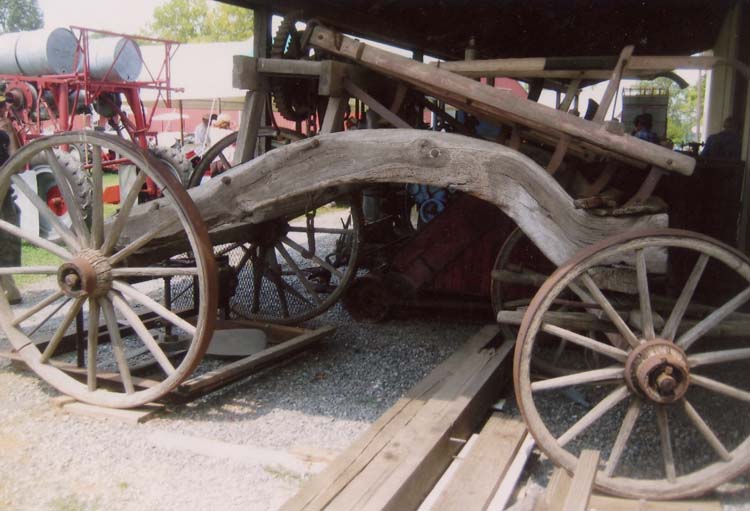
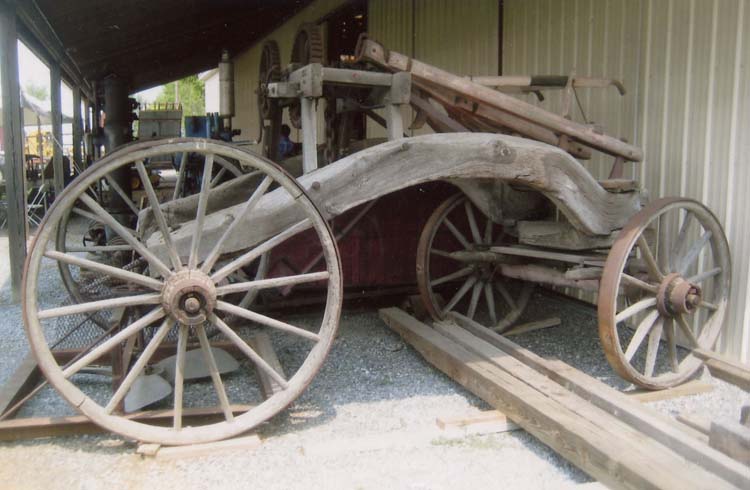
Here’s an unusual piece of horse-drawn machinery. CAA members Jack & Marge Day saw this vehicle at a “rough and tumble” sale in Lancaster County, Pennyslvania, and sent these photos of it.

Jack wrote to say that this is a “stump or rock mover; note the curved wood beams for higher clearance.”

.

photo by Jack Day

.

photo by Jack Day

In this final part, we learn about the perils of travel, and the abysmal state of American roads in the eighteenth century. Once again, the information is from the Maryland Geological Survey (1899).

Danger, as well as discomfort, attends the passage of the many ferries which are found on the line of the main road. If the wind is high the trip is perilous as well as uncomfortable. If the water is low we may have to mount upon the backs of sturdy watermen and so be “toted” out, with possibilities of descent into the mud.*

But even on land the journey may be filled with discomfort. One traveler has left a particularly dolorous account of his misfortunes, experienced, strange to say, upon the main road from Philadelphia via Baltimore to Washington. His own words must recount his adventures: “But the best cultivated parts of the country are not seen from the road, which passes chiefly over barren and hilly tracts, called ‘ridges.’ The reason for carrying the road over these is, because it is found to be longer than if carried over the flat part of the country, where the soil is deep, a circumstance which the people of Maryland always take into consideration; for after a road is once cut, they never take pains to keep it in good repair. The roads in this state are worse than in any one in the Union; indeed, so very bad are they, that in going from Elkton to the Susquehannah ferry the driver frequently had to call to the passengers in the stage to lean out of the carriage first at one side, then at the other, to prevent it from oversetting in the deep ruts with which the road abounds: ‘Now, gentlemen, to the right,’ upon which the passengers all stretched their bodies half-way out of the carriage to balance it on that side: ‘Now, gentlemen, to the left,’ and so on. This was found absolutely necessary at least a dozen times in half the number of miles.”

His comments on the road construction of the times are interesting: “Wherever they attempt to mend these roads, it is always by filling the ruts with saplings or bushes, and covering them over with earth. This, however, is done only when there are fields on each side of the road. If the road runs contiguous to a wood, then, instead of mending it where it is bad, they open a new passage through the trees, which they call making a road. It is very common in Maryland to see six or seven different roads branching out from one, which all lead to the same place. A stranger, before he is acquainted with the circumstance, is frequently puzzled to know which he ought to take. The dexterity with which the drivers of the stages guide their horses along these new roads, which are full of stumps of trees, is astonishing.”

Speaking of the travel between Baltimore and Washington, he recites: “The roads passing over these bottoms are worse than any I ever met with elsewhere. In driving over one of them, near the headwaters of a branch of [the] Patuxent river, a few days after a heavy fall of rain, the wheels of a sulky which I was in sank up to the very boxes. For a moment I despaired of being able to get out without assistance, when my horse, which was very powerful, finding himself impeded, threw himself upon his haunches, and disengaging his forefeet, made a vigorous plunge forward, which luckily disengaged both himself and the sulky and freed me from my embarrassment. I was afterwards informed that General Washington, as he was going to meet Congress a short time before, was stopped in the very same place, his carriage sinking so deep in the mud that it was found necessary to send to a neighboring house for ropes and poles to extricate it. Over some of these bottoms, which were absolutely impassable in their natural state, causeways have been thrown which are made with large trees laid side by side across the road. For a time these causeways afford a commodious passage; but they do not last long, as many of the trees sinking into the soft soil, and others exposed to the continual attrition of the wagon-wheels in a particular part, break asunder. In this state, full of unseen obstacles, it is absolutely a matter of danger for a person unacquainted with the road to attempt to run a carriage along it. The bridges over the creeks, covered with loose boards, are as bad as the causeways and totter as a carriage passes over. That the Legislature of Maryland can be so inactive and not take some steps to repair this, which is one of the principal roads in the state, the great road from north to south and the high road to the city of Washington, is most wonderful!” **

* The description of the water journey is from Sutcliff’s Travels in some parts of North America in the Years 1804, 1805 and 1806, published in 1812.

** The stories about the difficulties of traveling by road from Phila. to Washington, and about the terrible state of the roads, are from Travels through the States of North America during the years 1795, 1796 and 1797 (by Isaac Weld, Jr., published in 1799).
In this third part, we learn about some of the joys — and the tribulations — of travel by stage. Once again, the information is from the Maryland Geological Survey (1899).

One advantage certainly was afforded by the vehicles of the last century—time for observation. In such a conveyance as has been described [in yesterday’s post], one might travel at the rate of four or five miles in fine summer weather, but in winter often not more than one mile an hour could be made. Yet time spent in this manner was certainly not disagreeably employed, for many picturesque scenes would present themselves to the traveler. Seated in such a conveyance, he might be entertained as was one gentleman in his journey through Maryland, on a Sunday morning a century ago [that would be around 1799], at the sight of girls riding to the parish church nearby, escorted by a boy perched behind one of the fair equestriennes, for whom he jumped down every few minutes to open the numerous gates that barred the road, and then nimbly resumed his seat without any detention of the party. On a working day one might meet a long procession of horses, mules, or, more probably, oxen, dragging hogsheads of tobacco by pivots driven into each end and shafts attached.*

At another turn in the road one might barely escape collision with a monstrous family coach, escorted by gorgeously liveried outriders, and proceeding on its journey with more style than comfort to its occupants. Again, there is need to pull up sharply in order to yield the road to the more rapid wagon or “coachee” which has overtaken the coach. Numbers of carts are passing along, and farm-wagons, with high-ribbed bows covered with canvas, to shield the farmer from the sun by day and the dews by night. Nearer Baltimore Town one meets large gangs of “wheelbarrow men,” those convicts who, before the institution of the penitentiary system, were condemned to labor upon the highways. Accompanying each group is an overseer, wearing side-arms and often carrying a musket. Here and there are cabins in which the convicts at night are lodged or imprisoned.**

The driver is a steady man with a wonderful knack of avoiding the many stumps and large trunks of trees that fill the road. He guides his horses, usually named after the prominent politicians of the day, more by the different noises he makes than by the use of the reins. Stopping over night at one of the wayside inns one may get a bed for a quarter of a dollar the night. It will not do to appear too anxious about accommodations, for the host, in an injured tone, informs one gentleman that he need give himself no trouble on that score, because no less than eleven beds may be found in one of his rooms. For breakfast or supper one pays half a dollar; for dinner, one dollar. On the bill-of-fare may be found tea, coffee, fish, beefsteak, mutton-chops, sausages, eggs, several kinds of bread and butter, “cakes of buckwheat, &c.” ***

* These stories were taken from Mr. Sutcliff’s Travels in some parts of North America in the Years 1804, 1805 and 1806, which was published in Philadelphia in 1812.

** This tale is taken from M.E. Tyson’s book, A Brief Account of the Settlement of Ellicott’s Mills. (I could not find the book’s publication date.)

*** Most of this description was taken from Volume I of Richard Parkinson’s Tour in America in 1798, 1799 and 1800, although the anecdote about the innkeeper with eleven beds to a room is from Travels through the States of North America during the years 1795, 1796 and 1797 (by Isaac Weld, Jr., published in London in 1799).

« Previous PageNext Page »