Mr. Johnson’s trek


… continuing with Mr. Johnson’s tale from the previous post …

“I left the ranch near Emory on the 16th, and made Evanston, a distance of twenty-six miles. I was up early as usual, feeding and getting ready to move forward. My friend of the ranch came to the barn and we bade each other good morning. ‘You find your cattle all here, I suppose?’ ‘Yes, sir, and doing well. I have fed them with hay.’ ‘You will find grain in that box, give them all you dare; you must keep them well, or fail in your undertaking.’ ‘I carry grain.’ ‘You do, then you are all right; put the grain into them. Our breakfast is ready. I told my wife that you would like to start early.’ We went into the house and partook of a good breakfast.

“As I was about to leave them I said, ‘We have all been well cared for, and are now ready to go on. Since leaving California, many times have we been well entertained, but your hospitality stands ahead of any. Yours was entirely voluntary. I have asked and received many times, but you did not give me a chance to ask; that is where there is a difference. I wish I could have an opportunity to do the same for you.’

“After bidding each other goodbye, I moved on my journey toward Evanston, leaving the railroad on my left. In reaching this town I passed but one station, Wahsatch, which is a telegraph station. Its location is desolate, being on a high elevation, cold and windy. The road to this station from the west is of a very heavy grade. Trains labor hard in making it; its elevation is six thousand eight hundred and seventy-nine feet above the level of the sea. The highway is good, and about 5:00 p.m. I reached Evanston. Driving up to near the depot, I stopped at a livery stable and inquired for the proprietor, who came and asked what he could do for me. ‘I am traveling and would like to get my cattle out of the wind for the night. That shed would answer my purpose, if you will consent to it?’ ‘Yes, sir, I will consent.’ ‘Will you sell me some hay for my cattle?’ ‘Hay is very scarce with me. I ought to have gone for some today, but being so windy and cold, I did not go. Your cattle must have some; I will go up [in the loft] and throw some down. When there is enough, call out.’ I did so when he had put down a liberal supply. I have now to feed strong on grain as I cannot depend on hay or grass. ‘Which way are you traveling?’ asked the livery man. ‘I am going East.’ ‘Where are you from?’ ‘I left Ogden last Monday morning.’ ‘You came from Ogden since last Monday, with that cow?’ ‘I have, sir.’ ‘That is a big story to tell; you look as though you ought to tell the truth. From Ogden to this place is three days; you have traveled more than eighty miles — yes, eighty-five. It is seventy-six by railroad, and your road around the foothills of the valley is more than that distance. Then you are from Ogden, where in the name of God are you going to?’ ‘I am going to Green River City, and when I get there I am going to Laramie and so on to Omaha, and thus on to Massachusetts.’ ‘Are you the man that is on his way from California with a horse, carriage, cow, and a little dog? I read about him in the papers a while ago.’ ‘I think I must be the man; I am sure I am.’

“[He continued,] ‘You are early to travel East, over the mountains; I do not think you can ford the rivers, they are already high and will be higher.’ ‘I am told there are two roads to Green River City, one to follow the railroad, the other take the old emigrant road.’ ‘If I were in your boots going to Green River City, I would take the old Emigrant Trail every time. It is the best, traveled the most, and the shortest.’ ‘How about fording the rivers?’ ‘They are high at this time, but will be higher before you get through.’ ‘Are there more rivers one way than the other?’ ‘No. Either way, you will have the same rivers and the same road a part of the way.’ ‘There is Bear River to begin with. How about that one?’ ‘It is the best river to ford on your whole route: a good hard bottom and no rocks.’ ‘Is it a broad river?’ ‘Yes, it is. That makes it much better to ford. If it were narrow, the water would be much deeper and a much stronger current. When do you leave here?’ ‘Tomorrow morning.’ ‘On the morrow, I will harness up and drive my team to the river and across. You follow me closely, then you will be all right for the next river.'”

Tomorrow: crossing the Bear River …
Checking back in with Mr. Johnson, he says …

“I left Weber at 7:00 a.m., and reached Emory the same day, a distance of twenty-five miles. In making this place, we passed two stations, Corydon and Echo, the latter is a first-class station. It is a junction, a railroad from Park City comes in. On leaving this station, on the left you pass around a number of high bluffs; they are handsome and grand. Here, nature is to be seen at her best. Bluff after bluff arise one after another, hundreds of feet high, a short distance from the road. Between the bluffs, at their bases, are spaces wide enough to pass through with a team, and on emerging come out on beautiful plains. Reader, should you ever travel this way, stay and look at nature’s works around Echo.

“On leaving this town, I made the acquaintance of a gentleman, while sitting in his carriage, who said, ‘Stranger, you will just reach my place tonight. It is about a mile beyond the station. If you will call, I will entertain you the best I can. I have plenty of hay and grain for your cattle, for yourself I will say nothing; my wife shall look after you. … It is about eleven miles to my home. How long will you be in traveling there?’ ‘I travel about two and a half miles to the hour, day or night, just as it happens; so it will take four and a half hours to make that distance.’ ‘I will overtake you before you get to the station; if I don’t, it is the first house beyond the station, on the right of the road on the hillside.’ ‘All right, I will be going on.’ There was a very large number of people around me, and as I was leaving, one of their number called out, ‘Three cheers and success to the man from California on his way to Massachusetts.’ They were given with a will, you bet.

“About four miles from the station, I was overtaken by a cavalcade of Indians, eighteen in number, mounted on fine horses. They were civil and courteous and spoke fair English. I traveled in their company several miles. Before reaching the station, the gentleman who had invited me to stop overnight overtook me and kept me company as far as his house. On our arrival, he introduced me to his wife, saying, ‘Wife, this stranger is from California, just as he is, and is going East, to Massachusetts, where he belongs; make him as comfortable as you can, I think he is worthy of it.’

“My cattle were put in the barn, fed with good hay and grain, and were made safe under a good lock; after this was done I went into the house to a good supper, which was waiting. ‘Had I known that I was to have company to tea, I might have done better, however, excuse me,’ said the wife. Well, what did we have? It consisted of mutton chop, hot potatoes, biscuit, coffee, and mince pies. That was all there was on the table; to me it tasted delicious. We sat at the table nearly two hours, asking and answering questions. When the time came for retiring, I told them that I had at all times and places slept with my cattle, having been advised to do so, so that should anybody attempt to take them, I should be there to see to them.”

… to be continued.

The last time we checked in with Mr. Johnson was back in October. Like us with our re-reading of his journey, he was obliged to spend the winter in one place, spending several months waiting for the mountain passes to clear. …

“I left Ogden [Utah] on May 14, 1883, for the East, and made Weber the same day, a distance of twenty-five miles. I followed the Union Pacific Railroad most of the way to Omaha. Leaving the city I left the railroad to my right. My direction was south to Uintah, about eight miles. There I crossed the railroad and the Weber river also. Following the river and railroad to the canyon I am on the right of both, the three running parallel for many miles. Crossing the river on the railroad bridge, I now follow on the left and enter the Weber Valley. This canyon that I have just passed through is most wonderful. There are places that are not sixty feet wide, from rock to rock, and the road is very narrow in places, not more than eight feet. On my right is a wall of solid rock, hundreds of feet perpendicular; on my left is the river, down to its waters are many feet. There are many rocks in the river that would weigh thousands of tons. Waters are dashing and roaring against these rocks that make one feel awful.

“As I was about to cross the river, I heard the sound of an engine’s whistle. I stopped, looking up and down the railroad, but could see no cars. I was sure that I heard a whistle and soon came the train. The roar of the water was so great among the rocks that I could not hear the train as it passed. Soon after entering this canyon I came to a company of men, who were building a flume to carry the waters of the river into a canal, which had been made for miles on the plains, south and west of Ogden; between the Wahsatch Mountains, Salt Lake, and Salt Lake City. I was informed by the superintendent of these works, Mr. Brown, that this enterprise would cost over one hundred and thirty thousand dollars. The bridge on which I crossed is one of the best I have seen on my way, thus far. My road is now on the east side of the valley, winding around its foothills. On the west side of this valley is a place called Peterson, a telegraph station.

“Before leaving Ogden I got my cattle shod; the horse was well done, but the cow was not, and she was troubled to travel. On arriving at Weber, I called on a blacksmith to ascertain if I could get the cow shod and learned that I could. The blacksmith said he could shoe her and would do so at five o’clock the next morning.

“On the morning of the 15th I was up early; fed my cattle, got breakfast, and made everything ready for a start, and waited for the blacksmith till five a.m., the time set for shoeing the cow. He was on time, saying it would be a hard job. ‘I think you are going to be mistaken; she will behave like a lady. Won’t you, Bessie?’ I said.  ‘We will soon know,’ said the blacksmith. I led Bessie into the brake, and the blacksmith was about to sling her up, but I told him not to do so, but put the slings under her and let her stand on her feet. I said I would show him how when she was in the brake. The sling was then drawn tight under her, but not so tight as to lift her from her feet. A rope was then passed around both legs, below the fetlocks, and drawn tight so that it would not slip, and made fast to the brakes. The front right foot was taken up and the nail clinches cut, the pincers were put to the shoe for its removal, and after a strong pull it was quickly off all right. The other shoes were removed in a like manner. The shoes were then cut and made one-half inch less in length and replaced; this made a good job. In traveling, there was no friction of the shoes, and they were evidently easy to the feet of the cow.”

When we last heard from Mr. Johnson, he’d reached Blue Creek station and had (finally!) been able to give his thirsty horse and cow some much-needed water.

Later that day …

“I kept on the old trail, following it for some four miles. I found that this trail went to Corinne, but it was going to make twenty-five miles more of travel, so I at once left this trail and struck across to the railroad trail coming to Quarry station. From this place to Corinne was a good road all the way, and we reached Corinne about dark. A little distance off I saw a man with a lantern go into a barn, and I went for him as he was coming out and said, ‘Good evening. Friend, I have just arrived in town, I have a horse and cow and wish to stop for the night; I would like some hay for my cattle, can you accommodate me, sir?’ ‘I have hay. Stranger, which way are you traveling, sir?’ ‘I am traveling east.’ ‘Traveling east, sir,’ he repeated and then stepped out to where my cattle was. ‘You say you have come from the west, sir. What part of the west?’ ‘From California.’ ‘What, with that horse, carriage, and cow? You must be the man I read about in a western paper, who is going east?’ ‘Yes, sir; I think I am. The papers are ahead of me.’ ‘Lead your horse up to the barn, take her from the carriage, remove the harness and put her in that stall. The cow, what shall we do with her?’ ‘She will stand beside the horse; she knows her very well.’ ‘Well, put the cow beside the horse and give them all the hay they will eat. Grain, do they know what it it?’ ‘Yes, sir. They have had grain every day since I left home.’ ‘Home! Where is your home?’ ‘My home is in Massachusetts. When I said home, I meant where I started from.’ ‘What part of California did you start from, sir?’ ‘From the northern part, Eureka city, Humboldt Bay.’ ‘That is a long distance; more than a thousand miles.’ ‘Yes, sir. More than three hundred north of San Francisco.’ ‘Well, sir; you have done well, but you have not gone half the way yet.’ ‘No, sir; not more than a quarter.’ ‘Come into the house and get something to eat, your cattle are doing well.’

“We went into the house, my host saying, ‘Wife, here is a man that has traveled more than thirteen hundred miles, with a horse and carriage, and leading a cow all that distance. This is the man we read of in the papers coming from California to Massachusetts. I have just put his cattle in the barn and they are feeding on hay, and I asked him in to get something to eat. What have you got that is good for him? I think he is worthy of something good.’

… “After supper I went back to the barn and gave the cattle more hay and some grain. Then I did not recollect having loosened my dog, so I went and got him and returned back to the house. The wife then asked, ‘Has that dog too, come all that way?’ ‘He has,’ I answered. ‘Oh, you little beauty, you shall have some supper.'”

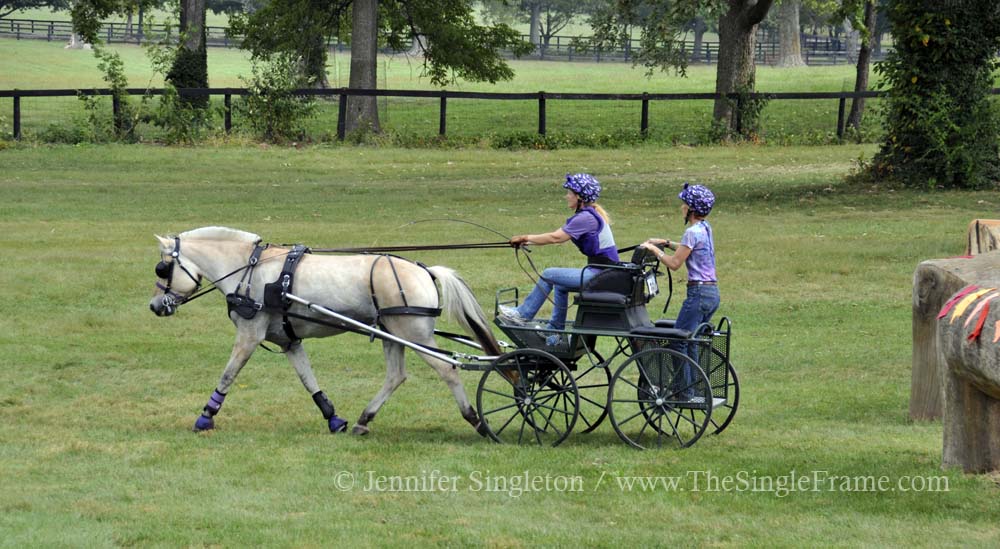
First, here are a few more photos from last Saturday’s Kentucky Classic CDE marathon. Then, tomorrow, for a different sort of cross-country, I think we’ll check back in with Mr. Johnson and see how he’s doing on his cross-continent trek.

Shown, in alphabetical order: Jennifer Harber, Debbie Lawrence, Max Montoya, Carrie Ostrowski, Colten Parker, and Casey Zubeck.

.

.

.

.

.

.

.

« Previous PageNext Page »