early roads


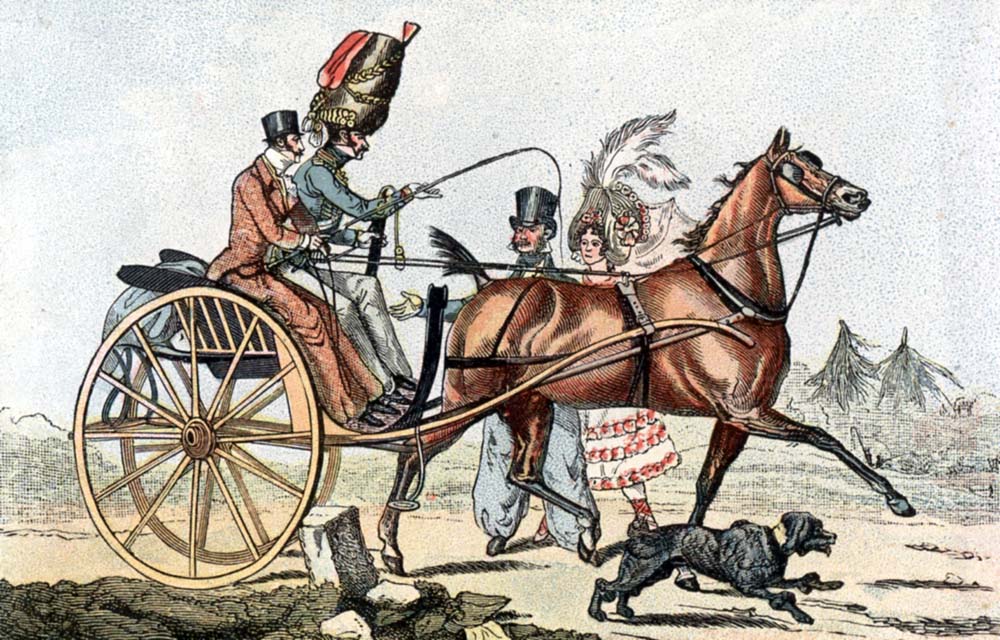
This old print is by Henry Alken, and it serves as a warning to all those not paying attention to the road while driving …

.

"Making a dash with a gay Tilbury, your friend recognises a brother officer not famous for his beauty and with a very dashing lass. In the endeavour to gain her attention, you discover you have overlooked a small post on your whip hand." ... ooops

After the last few text-heavy days, I thought we might take a look at some old prints this weekend.

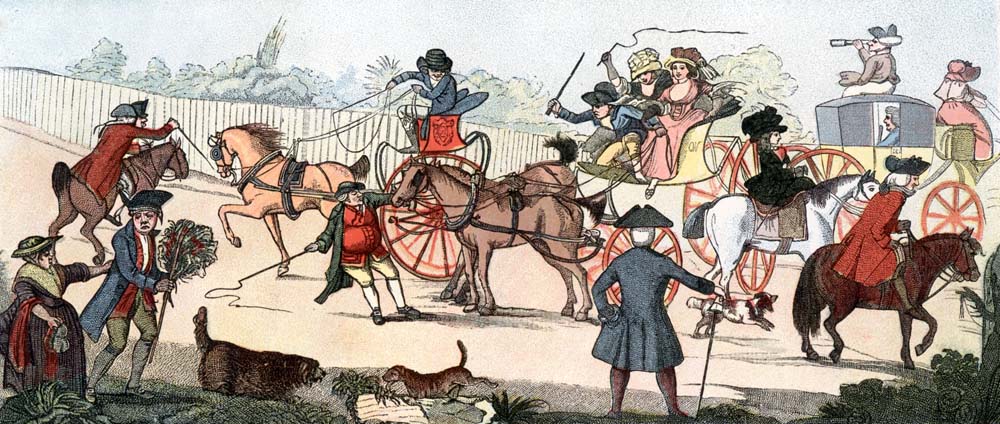
I was in the CMA’s library and found these three displayed on the library shelves.

First up is “Sunday Trip to Richmond Hill,” by Mr. Bunbury. There’s an awful lot going on here, and it’s a pretty steep hill by the looks of things. (You should be able to click on the image to get a larger version.)

.

Today, the final part of our re-reading of the National Republic article from August 1927:

… The first representatives from California had adventurous times in reaching the nation’s capital. John C. Fremont and William M. Gwin almost fought their way back to Washington in order to represent their own state in 1850 — seventy-seven years ago [from 1927, that is].

Indians were on the war path, cholera was scourging the “Great American Desert,” so the supposedly easier Panama route was taken. Senator Fremont’s wife was not well and his daughter was still young. They left San Francisco on January 1, 1850.

Mrs. Fremont at one time wrote one of her close friends telling of the trip.

“Getting to and from steamers in those days of wharfless Pacific ports was dangerous,” she related. “At San Francisco we had to row to the steamer. At Mazatlan, Mexico, the first stop, sailors, after rowing passengers near land, jumped into the water and laid their oars to [make] a compact bridge from boat to shore. Each of us took cold from an imprudent change of dress at Mazatlan. Fevers soon came on. When we reached Panama, I was too exhausted to make the land crossing on mule back. Senator Fremont was crippled. The chilling he received at Mazatlan brought on rheumatic fever in the leg, which had been frostbitten the winter before. We were carried down the gangplank and taken to the house of Mr. Stephens, one of the supervisors of the Panama railroad construction. Four weeks we lay there. The steamer which left East Panama for New York February 1 sailed without us. My little girl’s fever became worse and her splendid hair was cut close. To get me across the isthmus without jarring, the captain of a man-of-war, which was in the harbor, prepared a palanquin. This was a ship’s cot, swung to two poles, with a light awning and curtains over a frame. We had to have a sufficiently strong party to meet a new danger which had grown up on the isthmus — a banditti force, which waylaid and robbed, and sometimes murdered passengers. My men were very proud of my unique equipage. People flocked to look at it as they would at any other show. The carriers stopped to explain it and my condition. The natives at times seemed to be betting whether I would live to reach the other side. At Gorgena we heard of the recent murder of thirteen persons, a whole party, by the banditti. This made us decide to boat down the river. After two days and a night of moving slowly down this stream, we reached Portobello and boarded a New York-bound steamer. I was lashed to a sofa in the main cabin to keep from rolling off, for it was now March and the boat rolled and pitched tremendously. Thin and haggard, we docked at New York City in mid-March, seventy-five days after leaving San Francisco. How good it was to get to regular things again! The warm, carpeted rooms, large bath, the white roses and my dear violets.”

General Fremont’s successor, who was fearful of the long trip because of his wife’s delicate health, left his family at home. Senator John B. Wheeler said in a speech in the Senate, “I can have no correspondence with my family short of a month.” He was lamenting the lack of telegraph and fast mail service between the capital and the Pacific coast.

Fast sailing ships — the fastest known — that went around the Horn, around South America — took five months. It was not until May 10, 1869, that the East and the West were joined by rails.

But “it took the first transcontinental locomotives nine days to go from San Francisco to Chicago,” said Representative Charles F. Curry, of California, who more than fifty years ago made the trip, and from “Chicago to Washington took three more days,” he added.

“The trains had neither sleeping nor dining cars. At night passengers lay on boards placed over seats, or rested heads against window panes. Those who did not bring food for several days had to snatch meals at stations where the train stopped. Seats were not upholstered.”

Senator Francis E. Warren, of Cheyenne, Wyoming, who came to the Senate [in 1890], before any other present senator was there, said, “In 1890 it took me four days and nights to come from Cheyenne to Washington. This year [1926?], I came in two days and two nights. Then only one or two trains reached Cheyenne each day, now eight or nine leave and arrive daily.”

But congressional transportation is [in 1927] still improving, for Representative Roy G. Fitzgerald flies to his congressional duties. He breakfasts in Dayton, Ohio, home, then flies five hundred miles to Washington in three hours and eight minutes and lunches in the Capitol restaurant.

.

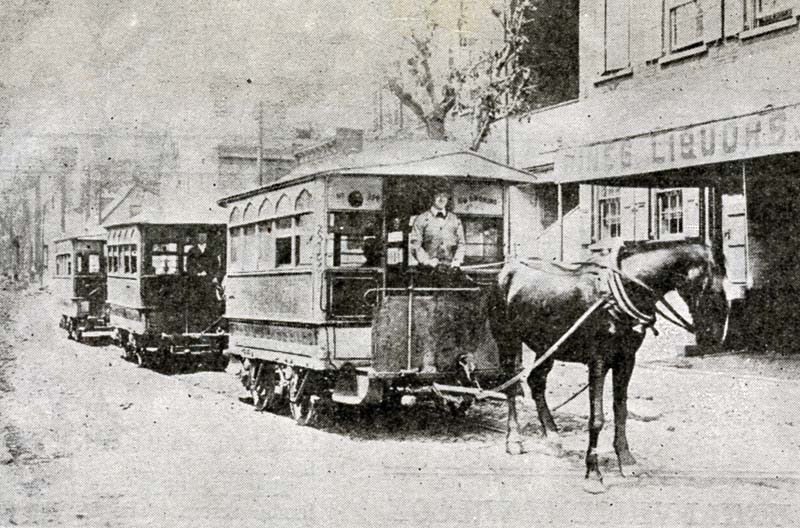
horse-drawn "railway" cars operated by the People's Passenger Railway Company of Philadelphia in the early 1880s (from the National Republic, August 1927)

.

Continuing with our article from the August 1927 issue of the National Republic:

.

… But even such companionship would have been welcomed by the congressmen who came from west of the Appalachian Mountains. The laborers and the republicans could have given necessary aid at the time of a mishap.

David Crockett, representative from Tennessee (1827-1831 and 1833-1835), tells in one of his writings of a journeying preacher who needed all his resourcefulness to arouse aid:

“Hurrying up to the river crossing we were struck all of a heap at beholding a man seated in a sulky in the middle of the river, and playing on a fiddle. The horse was up to his middle in the water and it seemed as if the flimsy vehicle was ready to be swept away by the current. Still the fiddler fiddled.

” ‘You have missed the crossing!’ shouted one of my men.

” ‘I know I have,’ returned the fiddler.

” ‘If you go ten feet farther you will be drowned.’

” ‘I know I shall,’ replied the fiddler.

” ‘Turn back,’ cried the man.

” ‘I can’t. Come you and help me.’

“Several who understood the river rode their horses up to the sulky and after some difficulty brought the parson safe to shore. He said that he had been fiddling to the fishes for a full hour and had exhausted all the tunes that he could play without notes. We asked him what induced him to fiddle at a time of such peril. He replied that there was nothing in universal nature so well calculated to draw people together as the sound of a fiddle. He knew he might bawl until he was hoarse for assistance and no one would stir a peg; but that they would no sooner hear the scraping of his fiddle string than they would quit their business and come to the spot in flocks.”

About the time of Crockett there were bits of railroad track in many places. To leave Washington for home, July 2, 1835, Crockett went by stage to Baltimore. From Baltimore he sailed down Chesapeake Bay to “a place where we boarded the railroad cars.” 

“This was a clean new sight to me: about a dozen big stages hung onto one machine and it aimed to start up a hill,” Crockett wrote. “After a good deal of fuss, we moved slowly off, the engine wheezing as if she had the tizzick. By and by she began to take short breaths and away we went with a blue streak after us. The whole distance was seventeen miles and it was run in fifty-five minutes.”

A steamboat took Crockett from Delaware City to Philadelphia. The “fast stage” carried him to Pittsburgh in four days. Here, he boarded an Ohio River boat. After changing boats at Cincinnati, Ohio, and Louisville, Kentucky, he landed at Mills Point, Tennessee. His son there met him with a sulky in which they drove thirty-five miles to the Crockett home.

Maintenance of schedules didn’t mean much to railways or steamboats in those days. Sometimes rain delayed the trains while a steamer captain might “take the notion” to meet the request of a friend. Crockett told of how Captain Stone held his boat and its other passengers at Pittsburgh one day after starting time to wait for the representatives. Then the Wheeling, Ohio, city fathers asked the captain to steam back up the river several miles and enter the port again, so they might fire a salute to Crockett the captain promptly acquiesced.

With various schedules and methods of getting over the ground, it took Crockett twenty days to go from Washington, D.C., to his home. One can now go from the capital to Tokyo, Japan, in about that time. [My, how things have changed — again, and rapidly — since 1927!]

… to be continued …

.

"the 'Old Atlantic' was an engine of the type that hauled Davy Crockett to Congress in the 1830s" (from the National Republic, August 1927)

.


.


This article appeared in the National Republic (“a monthly review of American history and public affairs”) in August 1927, eighty-five years ago this summer. It offers a fascinating look back at horse-drawn travel, plus a look back (for us) at common modes of travel in the 1920s.

.

From Oxcart to Aeroplane

Transformation In Methods of Travel by Congressmen to Capital Illustrates Transportation Progress of a Century

by Uthai Vincent Wilcox

At the opening session of the Congress ninety-eight years ago this December [so, Dec. 1829] it was stated in a most emphatic way that “traveling to Washington is the most laborious of Congressmen’s duties.”

Many illustrations of these difficulties are recorded in the debates and writings of that time. They were filled with incidents and vivid descriptions of the trips to the nation’s capital. The early sessions of Congress were enlivened with the stories. Representative Charles A. Wickliffe, of Bardstown, Kentucky, and nine other members of Congress who were with him traveling in the “Congressional East Stagecoach,” were upset on the way into the city. “We were like a load of live hogs in a country wagon, uttering a squealing sound as the stage rolled into the gully,” he told Congress.

Such experiences made entertaining contrasts with the luxurious, speedy transportation enjoyed by senators and representatives who are now in Congress [in 1927, that is], who might, if they told the truth, say that traveling to Washington was now their pleasantest duty. Before the nation could be crossed in ninety-four hours there was a century of horseback riding, covered wagons, roundabout ship routes, and slower locomotives.

It was the covered wagon days in 1846 when Iowa was admitted to the Union. These rolling ships of the plains were the only means of reaching Washington available to Iowa’s first senators — Augustus C. Dodge and George W. Jones.

C. C. Dowell, a present representative from Des Moines, Iowa, tells of the time when “past my mother’s early home, oxen drew those large canvas wagons. Senators plodded along beside their teams, whip in one hand, rifle in the other. Indians, bears, and snakes were near, and forts were far apart.” [He continues,] “Few were the ferries and fewer the bridges to help the national legislators over rivers. Sometimes streams were so swollen that a senator’s family could not cross safely in their wagon.”

The senator’s wife and children alighted and securely fastened their baggage to the wagon floor. The oxen would be unyoked and swam across the river. The senator having attached strong ropes to the wagon, towed with the ropes across the stream, and hitched to his team, the wagon was rolled into the river and the senator started the oxen, shouting at and cheering them. Thus the equipage was hauled through the current and up the opposite bank. The next thing was to get his family across. The senator took soundings until he found a strip where the water was not above his waist. Then he carried over those who could not swim.

Nightfall usually brought new dangers, even though the congressional family might be fortunate enough to reach some trading post hut. One fearful night was described by Jessie, daughter of Thomas H. Benton, Missouri’s pioneer senator: “I was awakened by a sound full of pain and grief and wild rage. It was a she-wolf looking for her cubs, which hunters had killed that day. A panic swept over me as I realized that Aunt Kitty was the only one in the room with me. Sight of the great fire that we had builded brought a new fear. The windows were near the ground and without shutters or curtains. What if the blaze should serve to guide the wolf? We hair-pinned shawls over the windows, but by that time men’s voices and sounds of the dogs gave us a sense of being protected.”

The delegate from the state of Washington, Major General Isaac I. Stevens, had to travel across the snow-capped Rockies. It was necessary to swim, beside his horse, many times. His meals he obtained with his rifle and his fishing rod. When at last he reached the Mississippi, he took a slow train the rest of the way.

It wasn’t the distant Western places alone that made traveling the legislators’ most laborious duty. There were the men from the Southern states and even from the East. Senator Gouverneur Morris, of New York, wrote in 1801 that “from Annapolis to Washington was one sea of mud so deep that the stage was stalled and stuck fast. It took ten hours to go twenty-five miles.”

Another national legislator stated that “the road from Baltimore to Washington is so exceedingly bad that a carriage sometimes sinks so deep as to defy the utmost exertions of the strongest horse to draw forward. Bridges built across creeks are perilous, being formed of a few loose boards that totter while a carriage passes over them. For miles the driver has to wind between great stones, logs, and stumps.”

Such handicaps made coach-riding to Washington about as slow as walking. Twenty-five miles in twenty-four hours was the rate over Kentucky roads as late as 1819. To go from Richmond, Virginia, to Fredericksburg, which is sixty-nine miles, required two days in 1817. From Buffalo, New York, to New York City, 475 miles, took a hundred hours of actual travel in 1816. Such are the records of the members of Congress that made the trips.

These legislators not only had slow, tedious traveling but exceedingly rough going, for very few coaches had springs in those days and the seats were of wood and rarely covered. Thomas Moore, the Irish poet, in telling of his trip to Washington, said that the “coach takes twelve passengers which generally consist of squalling children, stinking laborers, and republicans smoking cigars.” This was in 1804.

… to be continued …

.

.

According to the caption accompanying this photo, on the first page of the National Republic article quoted above, “airplanes were operated by the Philadelphia Rapid Transit Company between Philadelphia and Washington during the sesquicentennial [1926], and now passenger and mail service is planned.”
« Previous PageNext Page »