early roads


Here’s the third part of our look at the chapter related to driving horses in a horse-care book from 1731. If you’re just joining us, you can scroll down or click through to read parts one and two.

.

“Nothing looks more graceful than to see a coach drawn by managed* horses; but these are chiefly fit to make an appearance and not for drudgery. The lessons in the manage* make them struke with such force upon the ground that they are very apt to have their feet battered, especially in the roads about London, where there are so many sharp stones, which in the summer-time lie very loose, so that a managed* horse cannot move with stability, but is exposed to diverse accidents. And in winter the tracks are in many places so narrow that they have not sufficient play; and some places so mirey, that they throw up the dirt intolerably; and therefore, those who have a set of managed* horses for their coaches ought always to have another for labor and drudgery.”

* “manage” is an old term that refers to the paces of a trained horse

.

I’ll post the fourth (final) part tomorrow …

Continuing on from yesterday’s post of Chapter IX from The True Method of Dieting Horses (1731):

“But those which draw stagecoaches into the country are exposed to several accidents, and their labor is, for the most part, pretty hard; though this is oftentimes owing to the driver or stagecoachmen, who rather than not indulge themselves by tarrying too long at some places, are forced to hurry over a good part of the way, that they may accomplish their set journeys. Sometimes those persons, though they are thoroughly acquainted with the road, take no great care, but where they are good, drive their horses until they are all in a foam; and in that condition bring them into places, which are either deep with water or clay, and where they cannot move but at a very slow pace, whereby they are exposed to great colds. But although a constant use upon the road may habituate the bodies of those horses, so as they may bear frequent heats and colds, without any immediate injury; yet such usage as this must unavoidably be felt one time or other, and horses that have been treated after this manner soon grow old and unserviceable.

“It is no doubt reasonable, as well as necessary, for all coachmen to make the best of their way, where the roads are good; but they ought, at the same time, to drive softly before they come into those parts, where they cannot move a sufficient pace to keep their horses in a reasonable degree of heat. These instructions may also be useful to gentlemen’s coachmen, who often fall into the same error when they go into the country. But the hazard is the less, with respect to them, as they are commonly better provided with a number of horses, by which means they not so tedious, but get through the bad way sooner than the other, especially when their horses have been used to the country roads.”

To be continued …

Now that we’re all caught up on Windsor photos (except for one last upcoming guest post), let’s switch gears and spend a few days looking back in time.

In earlier centuries, books on horse health and horse care were extremely popular and plentiful. We have a copy of the third (corrected) edition of a book by W. Gibson. It’s called The True Method of Dieting Horses. Containing Many Curious and Useful Observations concerning their Marks, Color and External Shape; their Temper and Instinct; and how they are to be governed, so as to prevent Accidents and Diseases. It was printed in London in 1731.

.

Chapter IX is the only one that specifically covers driving horses.

“Having laid down the proper method of ordering traveling horses, we are, in the next place, to take some notice of those that work; under which term, are chiefly understood draft horses, or such as carry burdens. If proper care be taken of laboring horses, they may last many years in good condition. And there is no labor which exposes a horse so much to accidents, as drawing in a coach. The team, or waggon, always goes at a slow rate; and unless where there happens to be very bad road, or in places where there are steep ascents, their labor is uniform; and is so far from being injurious and hurtful, that nothing conduces more to the health of those horses, which are large and fit for draft.

“As this is the business assigned to them by their make and size; so we can never meet with any of them in so good a condition, as when they are taken out of a farmer’s team. Drawing makes them not only eat heartily, but digest what they eat; so that their food turns to good nourishment. And while they are in this service, they are exposed to no accidents after their shoulders are once hardened, but such as may easily be avoided.

“But the drawing in a coach has a quite different effect upon the bodies of those large horses. And, besides the inconveniences at first from the harness, they are oftentimes put out to a full trot, which, albeit they have no rider, yet, as has been observed, their own weight exposes them to chest-foundring, and many other accidents; especially, to such as affect their wind. And by reason many of that kind are thick and fleshy about their legs and pasterns; they are, upon the least excess, either of feeding or exercise, subject to gourdiness and swellings in those parts, and to all the other accidents subsequent thereunto.

“The labor of coach horses is not very hard while they only work in the streets; and the greatest and most necessary care to be had of them, is of their feet, that they be well shod. And they should be frequently looked to, that they be not wounded with rusty nails, pieces of glass, or earthenware, which people are apt to throw out of their houses. The coachman ought also in cold weather never to suffer them to stand too long without gently moving them. And if he be so hemmed in, that he cannot have room to drive, as it sometimes happens, he ought now and then to let them hear the lash, and even sometimes to touch them gently with it, unless they be such as are full of mettle and spirit, which alone will keep them in sufficient action, and be the means to prevent many of those accidents which happen to others of a sluggish, unactive disposition.”

We’ll continue with Chapter IX tomorrow …
 

A member sent the link to a blog post that I thought you might find interesting as well.

It’s interesting to note how much faster one could travel at the end of a seventy-six-year span in the nineteenth century than at the beginning.

Do you remember that, in 1819, it took twenty-four hours to travel a distance of twenty-five miles over Kentucky’s roads? According to the blog post I’ve linked to above, in 1895, the Red Jacket coach was expected to travel the twenty-two miles from Buffalo to Niagara Falls in a mere two hours. The mode of transportation was basically the same, so it must’ve been the quality of the roads (and the fact, perhaps, that the coach was traveling in relay stages) that made such a huge difference.

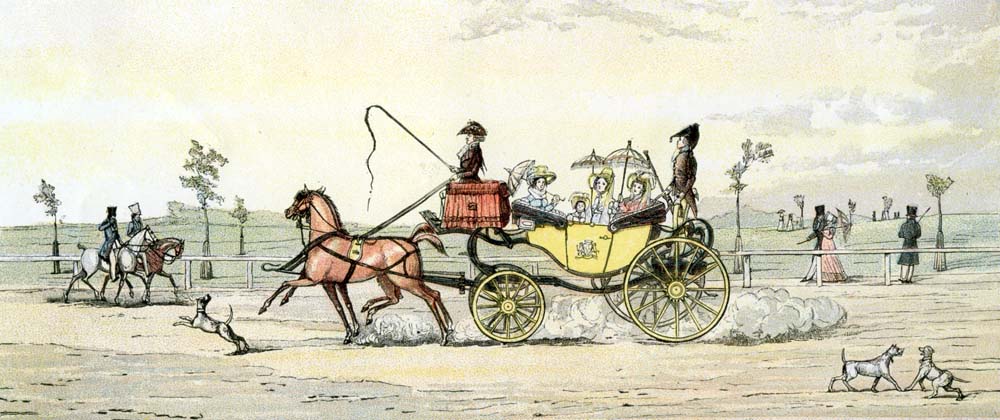
As the final entry in our weekend of old prints, here’s a lovely picture of a Barouche, c. 1825:

.

« Previous PageNext Page »