world championships


… and, finally, here are the last report and photos from Karen & Pat Garrett:

The cones course proved to be difficult for the pony singles and pairs, with only two double clears for the singles and none for the pairs. The teams fared better with an extra twenty seconds and six double clears.

Individual single-pony driver Suzy Stafford and team single-pony driver Randy Cadwell came very close to double clears with only seconds over the time allowed of 133 seconds, with 0.97 and 1.88 time penalties, respectively. This put Suzy in fifth place for cones and Randy in seventh place. Single-pony team driver Shelly Temple experienced difficulty in the sand arena, taking out two cones, including cone 19, the nemesis of many drivers. The cone was tight in the corner of the “C” end of the arena and required a sharp right turn. It appeared the sand was deeper at that point; although this may have been from the numerous carriages taking the same tight turn. Shelly also was slightly over the time and was eighteenth overall. Fundamentally, for the singles, it became a time competition with the first nine placings having no cones down.

Unlike the singles, very few of the pairs drivers survived without a cone down and with only two seconds added to the singles’ time, they also struggled with time penalties. The two U.S. drivers were no exception, with Wendy O’Brien, the first of the two to go, having three balls down and with time penalties for a total of 15.45 penalties. Jennifer Matheson also struggled, having fewer time penalties than Wendy but four balls down for total penalty points of 15.47. This put Wendy and Jennifer in twenty-second and twenty-third place, respectively. They were among the eleven pairs drivers who took out cone 19.

The U.S. spectators with whom we were sitting thought Lisa Stroud had a double-clear, as did the announcer; however, the official results (posted minutes before the prize-giving) showed Lisa with one ball down but no time penalties and in eighth place. Laurie Astegiano’s results are still confusing (at least to us). She took out cone 4 (but not the marker) and apparently was charged with ten seconds for a rebuild and five points for disobedience. This is a guess because the announcer was unclear, and the official scoring does not give any detail. We did not have a chance to discuss the scoring with any of our sources. Presumably, this will become clear in the next few days. From where we were sitting, it appeared the call (if our assumption as to the call is correct) was confusing. In any case, these penalties and one other cone down resulted in Laurie finishing in eighteenth place. Laurie went before Lisa, and although there was disappointment in Laurie’s individual result, there was jubilation that her result had clinched the medal for the U.S. team.

As in previous pony championships, Germany came in first and the Netherlands second, with the U.S. third. The U.S. was around twenty-five points behind the Netherlands and roughly thirty points in front of fourth-place Great Britain.

Suzy Stafford driving as an individual built on her impressive pony championship record by taking the individual bronze medal. Consistency was the order of the day, with Suzy being fifth in dressage, thirteenth in the marathon, and fifth in cones. Suzy was also third overall in 2009 and first in 2005. Randy Cadwell finished sixth overall, having been ninth in dressage, eighteenth in marathon, and seventh in cones. Randy was first overall in 2007 in the pairs division.

Jennifer Matheson finished in tenth place overall in the pairs division.

Lisa Stroud and her Connemara team finished in an impressive sixth place, behind two Dutch and three German drivers.

As we mentioned in our report following the marathon, there was one particularly unique judging call in the marathon. We have parsed together details from “usually reliable sources,” none of whom are U.S. team competitors or officials. As far as we know, nothing has been publicly reported by the FEI on the situation. Dutch pairs driver Ewoud Boom broke a swingletree in or as he was leaving the eighth obstacle in the marathon. He stopped outside the obstacle, which was about 350 meters from the end of E and made a repair that consisted of attaching traces directly to the carriage. He then completed section E. Apparently, certain of the other teams suggested he should either be given penalty points for incorrect harness or eliminated because the repair endangered the welfare of the horses. In the end, as we understand it, he was given a yellow card but no penalty points or elimination. Had he been eliminated, it appears the Dutch team would have still been second, but only by a hair.

The second situation is partially based on public information and partially on “usually reliable sources,” who again are not U.S. competitors or officials. As we reported after the marathon, Hungarian driver Jozsef Dobrovitz was eliminated in obstacle 4. We sent that report at about 7:00 p.m. Slovenian time. Sunday morning, we discovered that about two hours later, the elimination had been removed. This moved Hungary to fourth place, slightly behind the U.S., and moved Dobrovitz well up in the individual rankings. Apparently, the Hungarian team had appealed directly to the Appeals Committee, which had reversed the earlier elimination. Ultimately, FEI officials voided the action of the Appeals Committee and the elimination was reinstated. Interestingly, Dobrovitz went on to win the four-in-hand cones competition.

While it is possible that more detail has been or will ultimately be reported publically by the FEI about the above, it would be beneficial for spectators for there to be more real-time transparency as to critical decisions when they are made. It is the umpire’s decisions, as well as the balls and strikes and home runs, which make baseball interesting. If we only have the balls and strikes in combined driving and do not know how they were affected by decisions of officials, a dimension of the sport is lost.

In summary, this was a great competition in a superb venue. We can all be proud of the U.S. competitors. The U.S. is now the only team other than Germany and the Netherlands to have had a medal more than once in the pony championships.

.
Randy Cadwell (photo by Karen & Pat Garrett)

.

Shelly Temple (photo by Karen & Pat Garrett)

.

Wendy O'Brien (photo by Karen & Pat Garrett)


Jennifer Matheson (photo by Karen & Pat Garrett)


Laurie Astegiano (photo by Karen & Pat Garrett)


Lisa Stroud (photo by Karen & Pat Garrett)


Suzy Stafford (photo by Karen & Pat Garrett)


I apologize for the delay … I was Internet-challenged yesterday. Here is Wendy’s final report from Lipica (the Garretts’ final report and photos will be in the next post).

Pony Team USA wins team Bronze!!

After a great day of cones, the all-woman Pony Team USA clinched the bronze medal. Germany won team gold with 350.40 penalty points, the Netherlands won team silver with 376.39 points, and the USA posted a score of 402.41, with Great Britain close behind with 433.75.

And, to top it off, Suzy Stafford won the individual bronze medal!

Denmark’s individual competitor, Kristina Klindt, won the individual gold medal with her Lipizzan pony, and the individual driver from Sweden, Susanne Ankermark, won the silver with her adorable Fjord / Trotting-bred cross.

For the pairs, the individual gold and silver medals went to German drivers Dieter Baackmann and Stephan Koch, and the bronze to Italian Johann Weitlaner. In the four-in-hand division, the individual gold and silver medals went to the two adorable gray Dutch teams of Bram Chardon and Jan de Boer, and the bronze medal went to the individual German driver, Daniel Schneiders. Really great driving by all!

In the press conference with the winners, Tom Rumff, president of the organizing committee, thanked all the competitors for a weekend of great sport, and he said he was happy that the sun had smiled on Lipica for the World Pony Driving Championships.

Bram Chardon, son of four-in-hand driver Isbrand Chardon was asked, “Now that you have won the World Championships with pony teams, what’s next?” He answered, “Everyone asked, will I move to horses, but I have no plans for that. When my father shows a team, I am his navigator, and when I show a team, he is my trainer and that works for our family. The Netherlands is also strong in pony sport, and I hope to compete with a pony team if the Netherlands is host of the 2013 World Pony Championships.”

The single-pony champion, Kristina Klindt, who also has a driving father, was asked about the difference between her driving and her father’s. She said that she and her father are very similar and that is why they sometimes argue at shows, so she prefers him to cheer for her rather than coach her. I sat next to her father in the stands during cones. Kristina had come in at the silver-medal spot and posted a double-clear round. The overnight leader, Dennis Schneiders came into cones with less than a ball between them and unfortunately hit three, dropping him to fourth, just out of the medals. Kristina’s father jumped for joy at his daughter’s gold medal win and ran out of the stadium to meet her at the vet check with the great news.

Thanks for all your support of Pony Team USA!!

Karen & Pat Garrett sent this report and photos from today’s marathon phase of the World Pony Driving Championships. Also, just to clarify, I’ve been giving credit to both Karen & Pat, but I believe Pat’s been writing the reports and Karen’t been taking the photos. Just so you know.

First, the numbers and then at least a bit of the story. While the U.S. singles and pair drivers were not in the top ten for marathon, their consistency between dressage and marathon has left several of them well-placed to have a shot at medal positions.

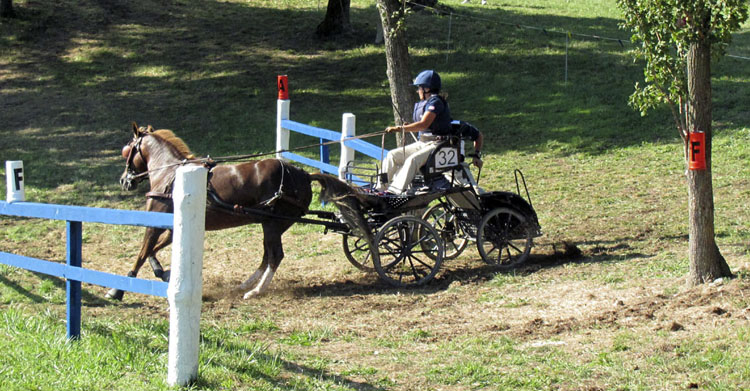
Individual driver Suzy Stafford was fastest of the U.S. single-pony drivers with total penalty points of 73.28, which put her in thirteenth place in the marathon and, except for a problem entering F at the first obstacle, she had a smooth, impressive round. But for that small bobble, she would have been in the top ten on the marathon. In any case, she stands in an impressive fourth place overall after the dressage and marathon phases, with a score of 118.34, or fewer than two balls behind the leader, Germany’s Dennis Schneiders (114.73).

Team driver Randy Cadwell had 76.36 penalty points, which put her in eighteenth place in the marathon and, again, but for one issue in obstacle 3, she would have been significantly higher in the standings. Overall, after dressage and marathon, she is in ninth place in the single-pony division, with a score of 124.49, putting her just over three balls from first place.

Shelly Temple had a smooth round that gave her a 79.39 in the marathon (twenty-third place) and an overall combined 124.06, for eighth place and, again, just over three balls out.

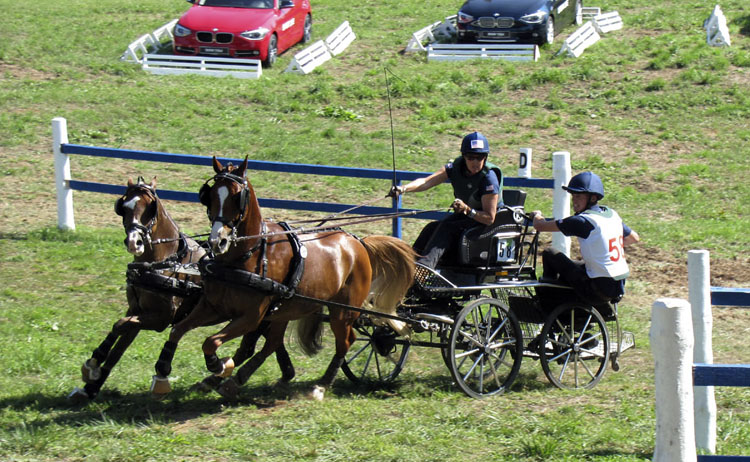
Having seen Jennifer Matheson’s beautiful drive it is difficult to believe that she was thirteenth among the pony pairs in the marathon, with a 76.72, compared to the 70.66 of the pairs winner, Ewoud Boom of the Netherlands. Jennifer’s consistency in the two phases is shown by the fact that she is in sixth place overall with a combined dressage and marathon score of 122.8, fewer than three balls behind leader Dieter Baackmann, who has 114.16 points.

Wendy O’Brien, competing in her first championship, had 93.61 in the marathon and 155.43 overall. Wendy was one of numerous drivers who had a problem in obstacle 6 going from gate F to the exit. There was a tight, slightly off-center path going up a steep slope, and the risk of hitting a post on the left or a tree on the right. Wendy hit the post and nearly came out of the seat; however, she and her groom pulled off the post and all was well.

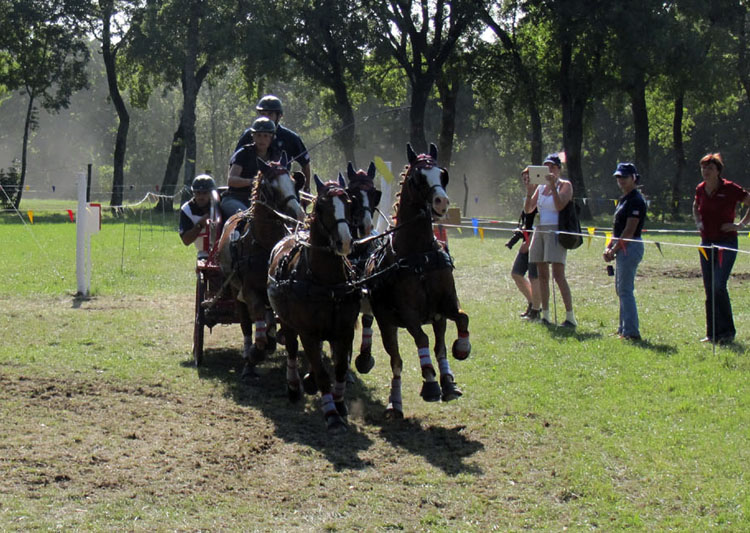
Both U.S. four-in-hand drivers, Laurie Astegiano and Lisa Stroud, had confident, smooth marathon rounds. Laurie had 91.96 points and Lisa Stroud had 87.05, putting them in eighth and fifth places respectively in the marathon, compared to the 73.4 for Dutch driver Bram Chardon, son of the well-known four-in-hand driver Ysbrand Chardon. Overall, Lisa has 138.25 (sixth place) and Laurie has 148.66 (eighth place), compared to the 117.43 of the leader.

Overall, the United States has held its third-place position in the nations’ competition, behind Germany and the Netherlands. With the elimination of Dutch driver Yvonne De Ruyter, which cost the Netherlands her dressage score of 44.03 and substituted the 52.74 of Melanie Becker, there was some hope the U.S. would move up; however, with strong scores by Dutch pairs driver Ewoud Boom and four-in-hand driver Bram Chardon, this was not to be the case. After the marathon the U.S. has 382.08 points, compared to 360.39 for the Netherlands and 345.01 for Germany. The U.S. remains 38.61 points ahead of fourth-place Great Britain.

There are many stories that will be related over time. However, the most interesting of a long day was near the end. Lisa Stroud had completed obstacle 2 and was out on course when Aart Van De Kamp, an individual driver from the Netherlands driving a Shetland pony team, had a wreck in obstacle 3. One of the leaders tripped and the wheelers ran up over the leaders, creating a huge pile-up of ponies. As they were being disentangled (successfully, with no harm to the ponies) another drama was unfolding in the fourth obstacle as Josef Dobrovitz of Hungary missed his turn into E but hit the post in E and took out the fence of which it was a part. He went on through F and was, of course, eliminated. However, this required a rebuild of a portion of the obstacle. In the end, the entire marathon course was put on hold while the issues in obstacles 3 and 4 were resolved.

The results were delayed as a result of an interesting question as to whether a Dutch driver should be eliminated. The result was no elimination, but we do not have completely clear information about what is a very unique question. We will relay this tomorrow.

.

Suzy Stafford in obstacle 3 (photo by Karen & Pat Garrett)

.

Randy Cadwell in obstacle 1 (photo by Karen & Pat Garrett)

.

Shelly Temple in obstacle 4 (photo by Karen & Pat Garrett)

.

Wendy O'Brien in obstacle 4 (photo by Karen & Pat Garrett)

.

Wendy's granddaughters (photo by Karen & Pat Garrett)

.

Jennifer Matheson in obstacle 4 (photo by Karen & Pat Garrett)

.

Laurie Astegiano in obstacle 3 (photo by Karen & Pat Garrett)

.

Lisa Stroud in obstacle 4 (photo by Karen & Pat Garrett)

Wendy Ying attended the post-dressage press conference at Lipica and sent the following report:

Tom Rumff, president of the organizing committee, welcomed the competitors and guests to Lipica and congratulated the winners of dressage: Peter Koux of Denmark with a single pony, Dieter Baackmann of Germany with a pair of ponies, and Bucker Tobias with a four-in-hand team of ponies.

When asked why the organizers chose to host the pony championships rather than a horse championship, Rumff responded: “We wanted to start with the pony championships and see if we could do it here in Slovenia. Most of the show infrastructure is new, and we have hopes of using it for future championships.”

The competitors’ impressions of Slovenia were all positive.

Tobias was impressed with the facility and the surroundings.

Koux was also impressed with the facility but said they have had a very wet, cold summer in Denmark and while the weather is great for people on holiday (like this reporter), it is a bit of a challenge for conditioning from the northern climates.

When asked about the course: Tobias thinks obsctacle 6 on the hill will be the most difficult for both ponies and drivers.
Baackmann thinks the course is a good mix of technical and open galloping hazards, and the water is not to be underestimated. 

Jan De Boer was asked what the challenge is for showing small ponies against the larger ponies. He said, “When showing the smaller ponies, we prefer the more technical hazards, while the larger ponies have an advantage in the galloping hazards. The Dutch are close behind Germany, so will take risks tomorrow.”

Shelly Temple was asked about the difficulties of traveling from America to Europe to compete. She said, “The travel has taken its toll on our ponies. It was hot when we left the U.S., then cold in Germany, now hot again in Slovenia, but we are looking forward to the rest of the competition.”

As I said in my first post, this is a great place for a competition. I saw first-hand today that the flow of traffic for competitors works easily and keeps the horses relaxed. It is basically one-way traffic as your work your way around the grounds to the main arena and then driver have a very short walk to back to the barns to untack. For the support people, it is very easy to walk a few steps from the last warm-up arena to the stands to watch. Then they can easily access the barn area directly from the stands with the proper credentials. For the spectators, they can observe the last warm-up arena from the top of the stands and then walk around the seating area to meet the competitors at the exit of the ring for a congratulatory hug.

There are also two hotels on the grounds with full-service restaurants open late for horse-show people. For overflow, the town is only a five-minute drive and has a few nice hotels and restaurants and a large grocery store and shopping mall. Every night in the tent, the show hosts a party for horse-show folk. Here in Europe, most competitors camp on the grounds, so show organizers bring in bathrooms and showers. In the campground, the smells of cuisine from around Europe are in the air. “Burger Bob” had already had a cultural exchange with the Hungarians, who are cooking goulash in a giant cauldron over an open flame next to our camp.

Now I am off to the nightly team debriefing with Chester and Michael. After that, the competitors will be back to walking hazards and then, at 9:00 p.m. is “Slovenia Night” and the dressage awards ceremonies. 
 

Karen & Pat Garrett sent this report and photos from earlier today:

At the end of dressage on Friday, three seems to be the lucky number for the USA. The U.S. team is in third place. As reported yesterday, Jennifer Matheson won third place in pony-pairs dressage, and today Shelly Temple’s result from yesterday was confirmed as third in the single-pony dressage. Meanwhile, to support the U.S. team score, Lisa Stroud had a solid seventh place in the four-in-hand division.

While Shelly was third overall, she was second among the countries with teams. Her score of 44.67 was barely beaten by the 44.03 of Dutch driver Yvonne De Ruyter. The overall singles winner was Peter Koux, an individual driver from Denmark, with a 41.47. The defending gold medalist, Melanie Becker from the Netherlands, was one of the last to go and earned a 52.75. Individual single-pony driver Suzy Stafford had a 45.08, and team single-pony driver Randy Cadwell had a very lovely test with a 48.13.

In the pony-teams division, Lisa Stroud, as the sixth driver to go, briefly held first place until an onslaught of primarily German and Dutch drivers took the top score down to a 38.53, driven by Tobias Bucker, the reigning four-in-hand champion from the 2009 World Championships. U.S. driver Laurie Astegiano had a strong 56.70, which provides the U.S. with some security as we enter the uncertainties of the marathon phase.

All in all, it was a good two days for the U.S. in dressage.

The nations’ team standings are Germany (123.01), the Netherlands (132.86), USA (141.95), Hungary (152.71), Great Britain (152.83), and Austria (173.69). As we all know, anything and everything can happen in the marathon and cones, and the U.S. team has a credible chance of improving its position.

As was the case yesterday, there was some inconsistency in the judging and as the scores are analyzed, one may notice a higher coefficient of coincidental national scoring than one would hope.

.

Janelle Marshall (photo by Karen & Pat Garrett)

.

Laurie Astegiano (photo by Karen & Pat Garrett)

.

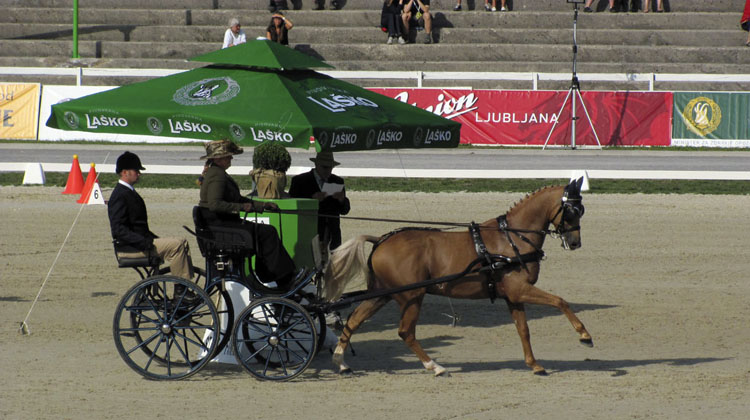
Lisa Stroud, entering the tunnel into the main arena (photo by Karen & Pat Garrett)

.

Randy Cadwell (photo by Karen & Pat Garrett)

.

Suzy Stafford (photo by Karen & Pat Garrett)

.

The marathon starts at 9:00 Saturday morning. The singles are first, followed by pairs, and then teams. The first U.S. driver, Suzy Stafford, goes at 9:25 a.m., and the last is Lisa Stroud at 3:10 p.m. It will be a busy day for the U.S. supporters.

In walking the obstacles, we found them to be challenging but not impossible. Most seemed reasonably open, but as all drivers know, a seemingly open hazard can quickly be filled up when you drive in. The first is appropriately open to allow the ponies to get their “marathon minds.” The second has a long run in and, once A and B are navigated, the rest flows easily; however, the surface is gravel and a fair amount of sliding may be expected. Number 3 is generally open, while number 4 has a severe elevation change, and the turn following C will be challenging against a steep slope. The water hazard, number 5, is interesting with only four gates and a concrete surface with the potential of slipping. Obstacle 6 again has severe elevation changes with tight turns. Again, number 7 is open, and the final obstacle is very open and will likely be a “pony race.” All in all, for obstacles built for singles, pairs, and teams the necessary compromises have been well handled.

« Previous PageNext Page »