WEG 2010


Here (finally!) are the promised notes from my conversation with Michael Freund last Thursday.

Germany’s Michael Freund is a twelve-time German national champion and two-time world champion (in 1994 and 2004) in the sport of four-in-hand driving. He was on the world championship gold-medal team four times (in 1992, 1994, 2000, and 2006). In the relatively new sport of World Cup driving, Michael finished the year in first place in 2001/02, 2002/03, 2003/04, and 2004/05 (he was tied that year with Holland’s Ysbrand Chardon). He (Michael) won the 2007 World Cup Final and was the winner of the FEI Top Driver Award in both 2001 and 2004.

He was hired earlier this year to serve as the coach of the U.S. team for next year’s Alltech FEI World Equestrian Games. Of course, at the moment, there is no team, so he’s keeping an eye on the up-and-coming U.S. drivers working with Germany’s Peter Tischer, who was hired last year as the coach for the developing U.S. drivers.

Michael also continues to work with his individual, longtime clients: Chester Weber, Tucker Johnson, and others here in the U.S. and elsewhere.

He’s had quite a lot of practice in the art and sport of driving, having grown up in a driving family. He says that he’s probably been driving altogether for a total of thirty-five or forty years. He first competed in the four-in-hand division in 1975, having competed before then in the pony, single, and pair divisions. He retired from competition after winning the team gold medal at the 2006 WEG in Aachen.

I asked Michael whether he focuses on training people or horses. He said that after he won his first world championship (team gold in 1992 in Riesenbeck, Germany), people started to ask, “Can you help me?” and so he was more and more in demand as a trainer of people wanting to improve their driving skills. At that point in his career, Michael still had a regular job, and horses (driving, competing, and training) were a hobby. But from 1992 up through 1999, he was asked to do more and more training. In 1999, he made the career switch to make training his full-time profession. He and his brother, Fred, now run a barn/training facility with twenty-seven stalls. Michael explains that he works with people and horses as a driving unit but that he doesn’t start horses. All the horses that come to him are already broke to drive.

Having heard that Michael’s son, Marco, is also in the “family business,” I was curious to know whether his son competes and how well he’s doing. Michael proudly reported that Marco was the youngest driver to have qualified for his local state (Hessen) driving championships, where he competed last month against eighteen other drivers in the open class. Marco started driving when he was five years old and now drives and competes with a pair of Shetlands. Michael assured me that the ponies are “trained just like the big horses.”

I asked Michael what he thinks has been the most influential change in the sport during the time he’s been involved. Almost without hesitation, he said that he believes the indoor World Cup competitions have been a big help in making the sport more public. (If you’re not familiar with World Cup driving, it’s like a combined marathon obstacle and small cones course, held at high speed in an indoor arena.) Michael said that these events bring a lot of publicity to driving, and they’re easy for people to see and understand, which is one way to sell the sport to those who know nothing about horses.

Michal admitted that one of his gripes with the traditional marathon courses is that, while people can stand by the marathon obstacles and see who goes the fastest, they might not understand when the fastest driver doesn’t place well because of penalty points on the walk section, for instance. He says that the marathon walk section makes little sense anymore. “When the marathons were very long, it was a ‘relax’ section but now it only causes stress.” He explained that driving attracts so many different breeds of horses, and many of them simply can’t walk fast enough to make the correct times.

Going back to the World Cup competitions, he said that for many of the shows that hosted World Cup events, those nights were sold out, and attendance at the “regular” driving events (the CAIs) increased as well.

Looking forward to the Lexington Combined Driving Classic (the WEG test event), which will take place here at the KY Horse Park the first weekend in October: Michael will be here to help a few clients and to observe the developing U.S. drivers. He said that he’s not been to either the KHP or this event before, so I hope to catch up with him during or after the event to see what he thinks of the WEG preparations.

This new KHP marathon obstacle appears to be in a more nearly-finished state than the “hill” illustrated last week. We’ll check back on the progress of the hill later this week. This new obstacle is in the area known here as the “in-field” … that area surrounded by the KHP’s permanent steeplechase course. The reflection at the base of this obstacle is more water so this one, too, will incorporate a splash.

another new KHP marathon obstacle with a water splash

Stay tuned for more updates on the evolving marathon course.

In preparation for next year’s World Equestrian Games, construction of several new marathon obstacles is underway here at the Kentucky Horse Park. This one (below, from several angles) has a large hill at one end and will have a ditch filled with water at the base of the hill. According to the course designer, Richard Nicoll, the “splash” will make this particular obstacle one of three (!) with water.

Five of the marathon obstacles being used for this October’s Lexington Combined Driving Classic & WEG Test Event will be used again next year for the World Equestrian Games. Two of these (the “head of the lake” and the “hollow”) will be used jointly by the driving and eventing competitors, for their respective marathon and cross-country phases.

one of the three water obstacles planned for the WEG driving marathon, currently under construction at the Kentucky Horse Park

one of the three water obstacles planned for the WEG driving marathon, currently under construction at the Kentucky Horse Park

at the lower left, you can see the ditch that will be filled with water to give this obstacle a "splash"

at the lower left is the ditch that will be filled with water to give this obstacle a “splash”

a close up of the hill at the new marathon obstacle

a close up of the hill at the new marathon obstacle

the polo field where the driving dressage and cones arena will be situated for this year's Lexington Combined Driving Classic and next year's World Equestrian Games

the polo field where the driving dressage and cones arena will be situated for this year’s Lexington Combined Driving Classic and next year’s World Equestrian Games

The course designer is not only planning for the competitors but is also considering the spectators’ needs. Several of the marathon obstacles are (or will be) situated in low areas of the horse park’s rolling fields. With higher ground near the obstacles, spectators will be able to stand or sit to watch one or more from a bit of distance, for a good view of all the action.

We’ll have more photos … of more new obstacles during their various phases of construction and as the horse park prepares for the WEG test event and the WEG itself.

As you might imagine, the Kentucky Horse Park is (and has been for quite some time now!) in the midst of a flurry of activity in preparation for next year’s FEI Alltech World Equestrian Games. The beautiful new indoor arena is finished, and attached stabling is now under construction. The arena itself was inaugurated with this summer’s WEG test events in the sports of reining and vaulting.

The new outdoor arena was formally inaugurated earlier this year and has been used for the dressage and jumping phases of the Rolex KY Three-Day Event in April, the FEI North American Junior / Young Riders Championships this summer, and more.

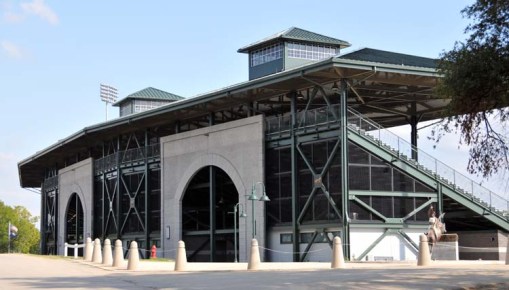
the grandstand structure of the KHP's new outdoor arena, as seen from the "people entrance" on Nina Bonnie Blvd

the grandstand structure of the KHP’s new outdoor arena, seen from Nina Bonnie Blvd

The roads into and around the park are continually under construction, being widened, improved, and beautified. Nearly every week that we attempt to drive in to work, there’s a different road closed, re-done, or re-routed.

And … here’s the most exciting part as far as we’re concerned … construction has begun on the new marathon obstacles for the driving portion of the WEG. I’ll post photos of one amazing-looking structure tomorrow. Stay tuned!

[Extra-credit points for anyone who can name the movie!]

Spent part of this afternoon testing out our new little video camera, at the Kentucky Cup vaulting event. This international event (CVI*/**) features competitors from eight nations and is being contested in the (beautiful!) new indoor arena here at the Kentucky Horse Park in Lexington. This is also the second of the test events for next year’s World Equestrian Games. (Unfortunately, we didn’t have our new-fangled video capability for last month’s reining test event.)

So, if you’re not familiar with vaulting and would like to see what it’s like, here is a video clip of the final freestyle performances for one of the competitors in the CVI* Individiual Women’s Competition. This young woman received the highest score in this round of all the ones I watched. Her three-day total put her in second place overall as of the end of her performance (there was still a third of the class to go when I had to leave, though).

« Previous Page