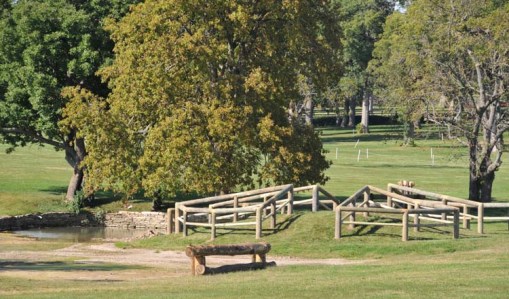
WEG 2010


The most recent test event for next year’s WEG was yesterday’s endurance race … and endure they did, both the horses and the riders. We’ve had an oddly wet October here in Lexington, and yesterday’s weather varied from pouring rain to misty and windy, with temps that never climbed out of the 40s. It’s usually the safety and well-being of the horses that is topmost in everyone’s mind during an endurance race, but I read in the newspaper this morning that one of the riders was treated for hypothermia at the first vet check. The track, which wound through the Horse Park and a dozen or so neighboring and nearby farms, turned into slippery grass and/or sloppy mud in most places. 

There were actually two races being contested at the same time: a CEI** of 120 km (approx. 75 miles) and a CEI*** of 160 km (approx. 100 miles). In the end, the 3-star event was reduced to 120 km as well because the conditions were becoming dangerous, with horses slipping and sliding too much in the mud and, as one vet said, a lot of “low-level lameness” showing up in the vet checks.

It had all started well enough, with a big, impressive first horse inspection on Tuesday in the new outdoor arena. Horses were presented in teams, or by nation. Six jogging lanes arranged side by side allowed for several horses to be inspected at any one time. Because the sport of endurance depends so much on purely objective factors — whether the horse is fit to continue — the judges here are all veterinarians.

Over to the side, away from the jogging lanes, riders were being weighed with their tack.

In a fantastic show of international support for this test event and, we can only hope, for the WEG itself, riders from 23 countries competed at this event. They came from all over the Americas, Europe, the Middle East, the Far East, and Africa. Some brought their own horses and some borrowed or leased them (this is a fairly typical practice in endurance, unlike many of the other WEG sports).

I didn’t make it out to the start/finish line yesterday to watch everyone leave in the early-morning gloom (and pouring rain), but I did make it just in time in the afternoon to hear the announcer welcome the first-place finisher in the 2-star event. Of course, crossing the finish line first doesn’t mean that you’ve won the race. Once over the line, there is a final cool-down period and a final vet check. Even at the end, the horse must be declared by the vets to be “fit to continue” before it’s officially done for the day. Surprisingly, given the mud and water one had to slop through to get to the back field where the finish line, vet check lanes, two-story VIP “party” tent, food vendors, etc, were set up, there were quite a lot of people there.

This morning, I happened in to the awards ceremony in the Horse Park’s covered arena. There had been a delay in getting things started, which allowed the crowd to continue to enjoy the huge breakfast spread that had been laid out for them (hot egg casserole, scones, croissants, yogurt, fruit, juice, coffee).

In the 2-star event, 22-year-old HE Sheikh Majid bin Mohammed Al Maktoum, son of HH Sheikh Mohammed bin Rashid Al Maktoum (ruler of Dubai; husband of the FEI president, Princess Haya; and horse- and land-owner here in Kentucky), won the race with a ride time of six hours, five minutes, and thirty seconds. The ride time, of course, doesn’t indicate the actual time elapsed on course. During each event, there are a number of vet checks (also known as gates). When the horse and rider arrive at the check, the rider jumps off and the crew strips the saddle and begins cooling the horse down. Once the horse’s heart rate has reached the maximum allowed (64 bpm), he is checked by a veterinarian. Once deemed “fit to continue,” the horse enters a mandatory rest period of either 30 or 50 minutes. When that’s done, out they go again.

The medals in the KY Cup event (the 3-star) were all won by American women. Danielle McGunigal (daughter of endurance superstar Valerie Kanavy) won the gold medal with a ride time of 6:30:41. Ellyn Rapp won the silver medal with a ride time of 6:52:16; and Jan Worthington won the bronze medal (and her mount, Golden Lightning, won the Best Conditioned Award) with a ride time of 7:01:33.

The poignant moment in the awards ceremony came when we all were asked to stand for the national anthem … and the music wouldn’t play. So everyone in the audience sang the Star-Spangled Banner instead of just humming along.
Our hearts go out to everyone in the southeast dealing with the recent incessant rain and terrible flooding. We’re grateful that, although we’ve had some downpours here over the past several days, it hasn’t been too terrible.

With luck, the storms will move through in time for the ground to dry out before next week’s driving event.

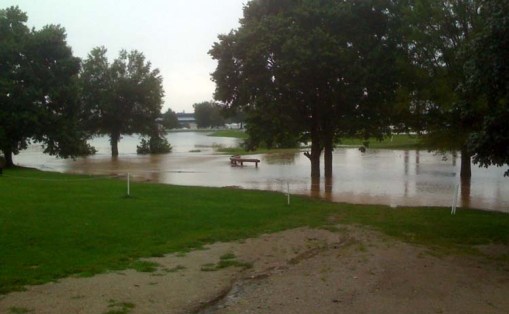
Speaking of rain … back in early August, a huge storm system blew through Kentucky and dumped nearly half a foot of rain on parts of Louisville, in just a few hours. We here in Lexington were fortunate that we didn’t get quite that much rain, but we still got quite a lot. Most of the KY Horse Park’s roads and pathways turned into rivers, any low-lying grassy areas or paddocks turned into lakes, and the floor of the covered arena was completely flooded. All of this took place just as hundreds of kids, parents, and ponies had arrived at the park for this year’s Pony Finals.

Here we have a photo, courtesy of Mick Costello, of what should be the grassy area next to the “head of the lake” … the cross-country / marathon water complex. This was that same day in early August.

this is normally just a low-lying area on the cross-country / marathon course; the "head of the lake" is (or should be) to the far left. Do you see the jump in the middle of the lake?

this is normally just a low-lying area on the cross-country / marathon course; the "head of the lake" is (or should be) to the far left. Do you see the jump in the middle of the lake?

These photos were actually taken later in the same day that the gravel was delivered (see the previous post from Tuesday) … I’m just a bit late in posting them here.

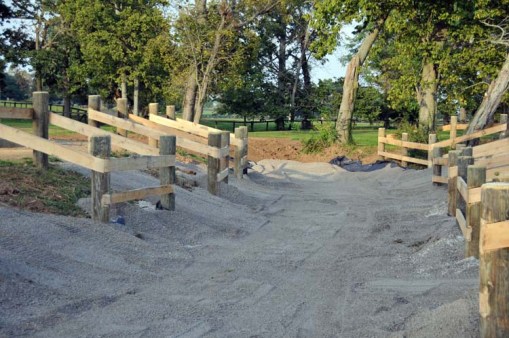
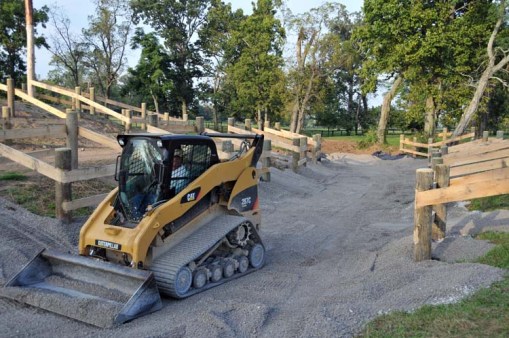
The big pile of nearly 70 tons of gravel became this, which Mick is spreading here with his trusty … whatever this machinery is called …

someone told me that it was difficult to get a sense of scale from these photos, so if you’ll look to the left … there’s the hill

And, voila, a level creek bed and ramps up and down the hillsides leading into and out of the creek.

a lovely, gravel-y creek bed; at the end there (where the pile of dirt is) will be a dam, so this will actually end up as more of a pond than a creek

First, a photo from yesterday …

the “creek bed” at the base of the hill obstacle, scraped and leveled (somewhat) and awaiting more supplies …

Then, all the progress as of about midday today …

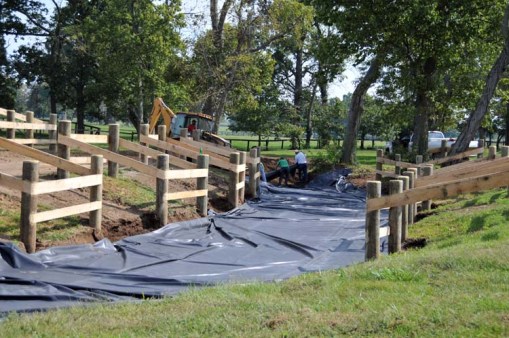
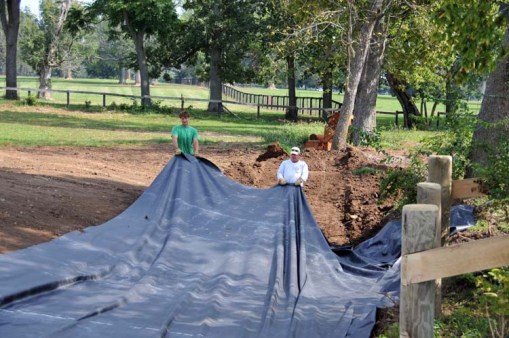
the “creek bed” liner being installed …

… and pulled a bit straighter

… and the view in the other direction

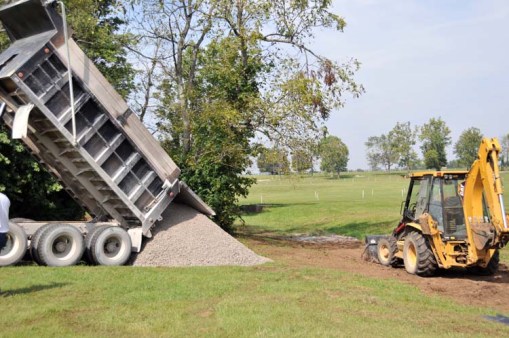
one of several gravel deliveries … 70 tons of the stuff in all

I’ll have more photos of this impressive obstacle as it continues to take shape, in preparation for the driving event that is now mere weeks away!

Over the weekend, I spoke with Richard Nicoll, course designer for the driving portion of the WEG. He was in town to check on the progress of the new marathon obstacles and to work with the course builder, Mick Costello.

Richard said that six of the marathon-obstacle sites being used at this year’s Lexington Combined Driving Classic / WEG test event will also be used in the WEG itself … the sites, that is, but not necessarily the obstacles themselves. This will let the crew test the ground conditions, and work on any “weak” areas they find. This sort of advance testing and tweaking isn’t usually possible at “one-off” events and championships, and Richard’s glad for the chance to be able to work out any difficulties ahead of the WEG. All this advance work will also allow the ground to settle and the grass to grow, so that what will in 2010 essentially be a new marathon course won’t actually look new and raw. It will look like part of the horse park.

The “hill” obstacle, which we featured here back at the end of August, is coming along quite nicely and is one obstacle that will (mostly) remain intact from this year’s event to the WEG. Richard assured me that it won’t look exactly the same, though. He’s very pleased with how it’s turning out … big, sturdy, and solid. There’s no doubt that it will look daunting, impressive, and exciting (depending on your vantage point) at this year’s event. But next year, it will be arranged and decorated to elicit a “WOW” from all who see it. One of Richard’s goals, in fact, is to have the marathon obstacles looking so impressive and beautiful during the cross-country Saturday of WEG that all the eventing fans unfamiliar with driving will be enticed back the following Saturday for the driving marathon.

the most recent view of the new “hill” marathon obstacle at the KHP

on the other side of the foreground grass, at the base of the hill, is the ditch where the water will go; the crew is installing a liner here, and we’ll have more on this tomorrow

another look at the “in-field” water splash, from a different direction

Another goal: to position the WEG marathon obstacles in pairs or threesomes so that spectators can easily see two or more from a single vantage point (or at least within a very short walk) and to make several of them so exciting to watch that people will want to wander and see them all. There’s nothing worse than having only one exciting water obstacle on a marathon course and all the spectators crowding around that one so that there’s no fan support at any of the others. To that end, the “tight / technical” obstacles are in some of the less-popular, more out-of-the-way spots, and the “galloping” obstacles, of which there will be several, will help keep the crowds interested and moving.

More work is being done on the “hill” obstacle today, and more work will be done on the course in general after this year’s test event. We’ll keep you updated!

« Previous PageNext Page »