… here, without further ado …

Isaac’s largemouth bass (destined for a spot on the marathon course), all nicely stained … and with scales (Can you see them?) and shiny black eyes
… and for good measure …

the aforementioned rainbow trout
September 13, 2010
… here, without further ado …
Isaac’s largemouth bass (destined for a spot on the marathon course), all nicely stained … and with scales (Can you see them?) and shiny black eyes
… and for good measure …
the aforementioned rainbow trout
September 7, 2010
So I was leaving the KY Horse Park yesterday evening and ran into Mick Costello (course builder for the eventing and driving cross-country courses), who asked whether I’d seen “Isaac’s latest fish.” I hadn’t.
Mick gave me directions to the shady carving area where Isaac’s been working and sent me off to find Isaac and the fish.
Isaac does all of his sculpting with chainsaws, which I find amazing to contemplate when faced with how lifelike these wooden animals end up looking. Unlike most of his recent sculptures, which will populate the eventing cross-country course, this fish is intended for a spot (I’m not telling which spot) in one of the marathon obstacles.

this largemouth bass is destined for a home in one of the marathon obstacles
While not quite as large as some of Isaac’s other sculpted animals (a huge kingfisher with a bug in its beak, an enormous goose, and a lifelike but massive rainbow trout, just to name a few), this largemouth bass nonetheless stands more than seven feet tall. Isaac also showed me some of his “before” and “in-process” photos of this fish, and it was quite something to witness this huge fish emerging from a hickory log.
Coincidentally, this story appeared in today’s Lexington Herald-Leader newspaper (www.kentucky.com):
Artist with a chain saw carves for WEG
by Mary Meehan
“It’s a little bit of an odd story,” said Isaac Bingham.
That’s a little bit of an understatement.
Because the tale that finds Bingham revving up a chain saw to carve giant squirrels and fish at the Kentucky Horse Park begins in Vermont, winds through Dartmouth and Berea colleges, and takes a detour to study boat building by indigenous peoples in Asia and South America.
“I never imagined I would do anything like this,” said Bingham, “this” being, among other things, carving a Canada goose the size of an RV out of a tree trunk for the Alltech FEI World Equestrian Games.
Carved animal figures have long been used as jumps or beside jumps at equestrian cross-country events, but it wasn’t until January that Bingham tried his hand at the unusual artistic endeavor.
The thirty-two-year-old has a habit of diverting from a path to try new things.
After growing up in Vermont, he went to Dartmouth College to study engineering. A few years of studying left him restless, and he was off to travel the globe, including spending time in Morocco. Because he wanted to get into the arts, he came to Kentucky and Berea College, graduating in 2005. He was then awarded a $25,000 Thomas F. Watson Fellowship to study native boat builders in places like Bolivia, Peru, Vietnam, and Malaysia. Boat-building skills in those countries have evolved over thousands of years.
“I’m always up for a new adventure,” he said.
Bingham had been making jumps at the Horse Park for about three years when Mick Costello, who oversees their building, realized he needed some new duck heads for this year’s Rolex Kentucky Three-Day Event. His previous carver had moved to Australia, so Costello gave Bingham and two other workers a chance to see what they could do.
Bingham had never created art with a chain saw, but he had created art and he had used a chain saw. So he figured he probably could do it.
It turns out he could.
“Isaac is just wonderful. It was quite a surprise” said Costello, who’s been working at the Horse Park for more than twenty years. “He’s the best ever.”
The [eventing] cross-country course was created by world-renowned designer Mike Etherington-Smith, who is based in London, England. He maps the route that horse and rider will take and what sort of critters should inhabit various jumps.
Etherington-Smith dictates the height, width, and depth of the sculptures and the types of animals, say “fish” or “frog,” and then Bingham takes over.
It all starts with the right piece of wood. Costello said local tree services sometimes provide logs, but he also buys tree trunks or uses wood from trees at the Horse Park that need to come down.
Somehow Bingham can see the animal within the log. A burr oak could be a rainbow trout that is seemingly in motion or an orange and brown northern leopard frog that is both native to Kentucky and brightly colored so as not to blend into the grass and cause the horses to hesitate before they jump. (Bingham also paints the animals.)
“You free the animals from it,” he said.
He sometimes uses the traditional sculpture skills he honed at Berea to make clay models for the wood works. But, he said, all the carving on the animals is done with chain saws of various sizes.
“I am never interested in doing that same thing that everyone else is doing,” he said.
Bingham, whose father was a carpenter, said he grew up with sort of a blue-collar work ethic. “Being an artist,” he said, “was never something I could wrap my mind around.”
He’s still a little amazed by his newfound skill and understands what a rare opportunity he has. It’s not every emerging chain-saw artist who has access to the tools, including heavy equipment to lift and move the logs, needed to turn a tree trunk into a trout. But he thinks he’s found his niche, for now.
“Maybe I really am what I can call an artist,” he said.
That, too, is a little bit of an understatement.
August 31, 2010
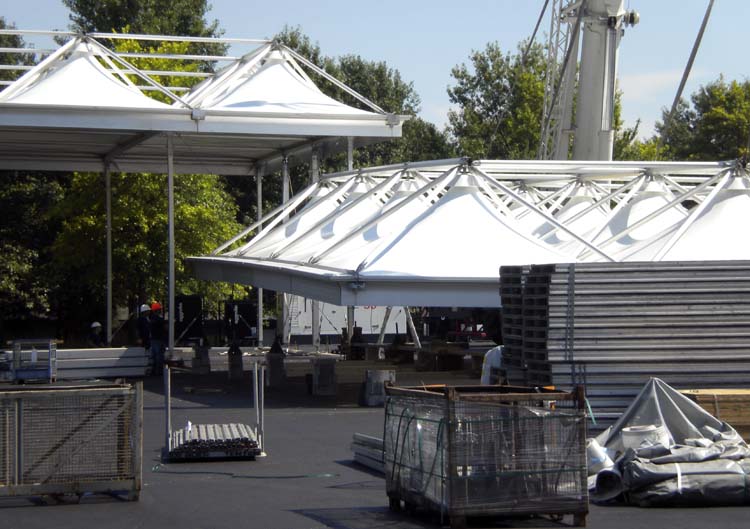
On my way into the office this morning, I drove around the Park a bit and took a few (more) photos of even more tents going up in preparation for WEG.
These first two are next to the outdoor arena, and I have no idea what they’ll be used for.


And this is a portion of the back of one section of grandstand seating at the driving arena:
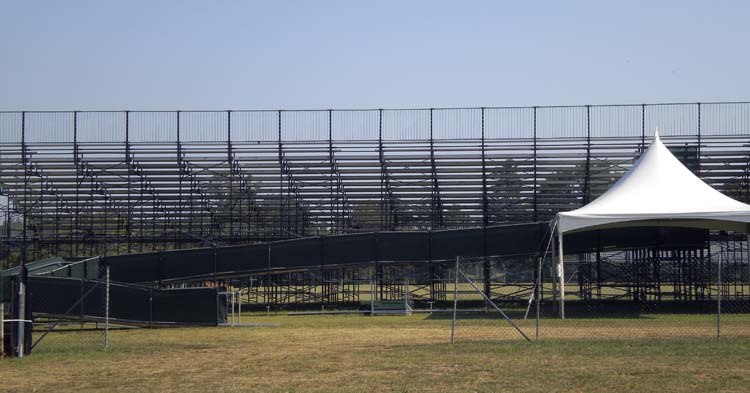
Things are changing around here by the hour, it seems. In the main parking lot, the trade fair is starting to go up, but when I drove by this morning, there wasn’t enough progress to bother with photos. I’m sure there will be plenty there by this afternoon or tomorrow morning, though! So stay tuned.
August 24, 2010
Why, you need walls, of course!
First, from Friday afternoon:
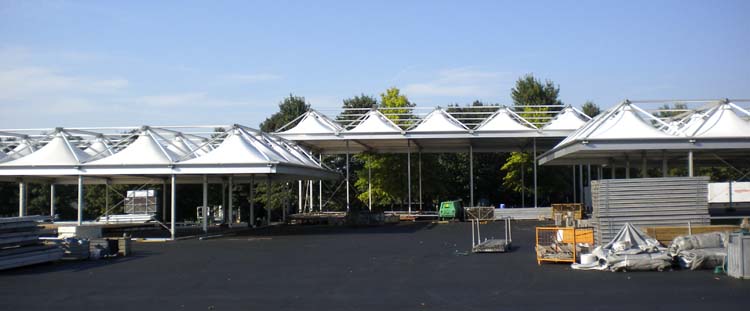
all the roofs are raised up on the three HUGE tents chronicled in the previous post … and, yes, all the rooflines are at different heights
Then, from yesterday (Monday) afternoon:

… suddenly (well, several days later), there were walls on each of the three main tents AND a new central, round-roofed tent

… and, check this out … the tall tent in the back looks like it has two floors!
And finally …

workers (Can you see them??) on the temporary grandstand that faces the main (permanent) grandstand at the outdoor arena
August 20, 2010
… on a pavilion for the upcoming Alltech FEI World Equestrian Games (now just a few weeks away!) … I had thought these might be for the Trade Fair, but they are perhaps the roofs for the Kentucky Experience pavilion … or ?
Over the course of this week, I’ve been taking pictures in the mornings and afternoons to chart the progress of the various (enormous) tent complexes going up in the parking lot. Now you can follow along.

before construction began: piles and piles of supplies were lined up in the parking lot in front of the USDF building

this past Tuesday: the exoskeleton for one of the three tent roofs, under construction

yesterday: several of the large tent roofs, sitting on low supports, before being hoisted up and provided with legs to stand on

around mid-morning today, I went out to check on the progress of the squat roof structures, and saw these enormous cranes in the parking lot; one roof structure had already been raised, and a second was about to go up, so I stayed to get some photos

first, the smaller of the two (huge!) cranes was lowered so the workers could …
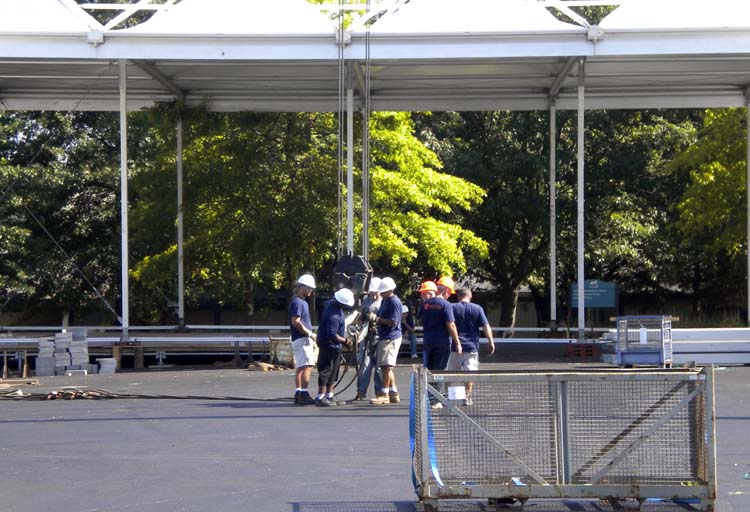
… hang cables on the crane’s hook (you can get an idea of the scale of these tents from the first raised roof, behind the workers)

then the crane lifted the cables and straps back over the roof; the other (larger) crane is already ready with its cables and straps
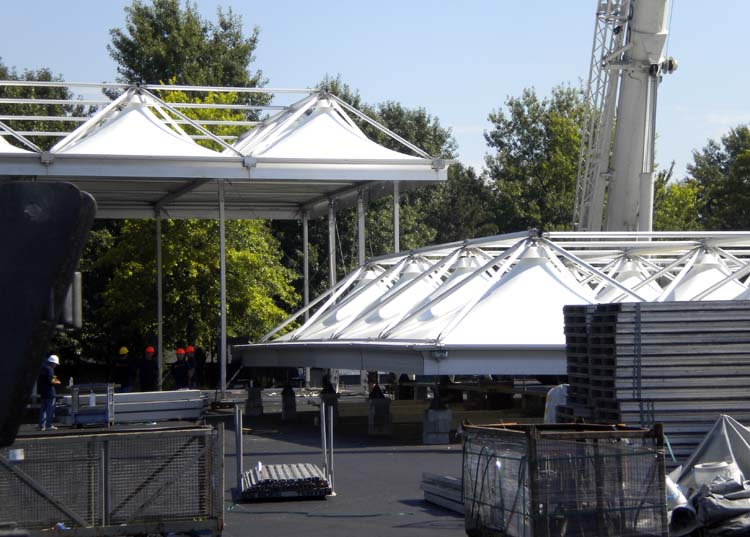
here, a view of the raised roof and the roof about to be raised, resting on its low supports for a little while longer (for scale: those orange dots are hardhats)

yikes! that’s a big crane (there’s a person, up on the roof structure, for comparison)

attaching the straps to the roof structure, four per crane, on either side of the roof

getting ready to go up! … the cranes have pulled the straps and cables taut
starting its ascent … the roof has been (slowly) raised off its initial supports

this entire process was fascinating, but slow … I took this shot on my way back to the office … here: the raised roof, the roof being raised, and a third roof still sitting on the ground (I’m sure that all three will be up when I go back out later this afternoon)
 The Slower Road