competitions


Today’s local newspaper, the Lexington Herald-Leader (www.kentucky.com), had not one but two really interesting articles on how the WEG horses are arriving in the U.S.

Being right up against a magazine deadline, however, I shall give you one of the articles today and one tomorrow.

This first one is titled “Horses Fly to WEG in Wide-bodied, Expensive Comfort” and is by Amy Wilson.

The international equine athletes coming to Kentucky for the Alltech FEI World Equestrian Games are, for the most part, used to traveling, used to comfort and, safe to assume, oblivious to price.

With 500 to 600 horses flying non-stop from as far away as Buenos Aires or Hong Kong in specially built in-plane stalls at a cost of as much as $50,000 per horse, it’s easy to see why some are saying the first appearance of the Games in the United States is making it enormously costly. Yet few are willing to inconvenience their horses in protest.

The logistics are as daunting as the math.

Wide-bodied Fed Ex jets each holding fifty horses from European and Middle Eastern countries will take off from Belgium’s Liege Airport for the Cincinnati/Northern Kentucky International Airport on Thursday. South American horses will go through Miami, and Pan-Asian horses through California first, before moving on to the Bluegrass.

The great migration already has begun. Some horses from Chile and Guatemala have passed their quarantine and are at the Kentucky Horse Park. Many more are arriving, beginning Thursday, in Northern Kentucky to begin their quarantine before being trucked to Lexington for their star turn. At some point, all will go home again.

Each plane employed in their multiple moves is a study in comfort.

Take the plane that brought twenty-one horses from Australia and Japan to Ontario, Calif., on Monday. Twelve people, known as flying grooms, accompanied the horses. Each of the grooms — three with the Japanese team, four from Australia, and five from Peden Bloodstock, the official transport agent for the games — sat next to the horses so they could hydrate, feed, destress, and generally administer to their charges throughout the fourteen-hour flight.

All rode in a fuselage cooled to the mid-50s. “The horses love it,” says Greg Otteson, sales manager for Tex Sutton, the transport agent for the firm that brought the horses to Kentucky after their forty-eight-hour quarantine in Southern California. “Horses put out a lot of body heat, and the coolness keeps the bacterial count down.”

Dawn Strickler, shipping agent for Horse America Inc., said most horses are calm throughout the trip. “They can be sedated. But most don’t need it, and the grooms generally don’t like to do it,” she said.

Each horse, per its owner’s instruction, can be flown first class, business or coach. That determines how much room each horse needs in the stall, determined by his or her size, breed and temperament. A first-class stall would be seven feet wide; a business class stall would be a two-horse stall, allowing each about three feet, eight inches of movement; coach class would be a three-horse stall, with about two-and-a-half feet of room per horse.

Peden reserves the right to refuse to send a horse in a stall that might not be large enough or safe enough.

Each move is also a study in speed, said Martin Atock, managing director of Peden, which has handled equestrian transport for the past four Summer Olympics and all of the World Equestrian Games since their inception in 1990.

“We are expediting the process so that the horses are not waiting to load or unload,” Atock said. “The authorities in Cincinnati have been great. We are set to go from touchdown directly to the ramps to the Bob Hubbard trucks to the parking lots where the horses will be held for quarantine.”

Not every competitor in the Games brought his or her own horse, despite the advertised speed and comfort of the process. The Australian vaulting team opted to come to Tennessee on Sept. 2 and train on the horses they will use for the Games instead of paying to bring their five Percheron/Thoroughbred mixes with them.

Bronwen Lowe, international vaulting coordinator for the Australian vaulting team, said the U.S. games are “enormously expensive, easily four times as expensive as any WEG we’ve been to.” Lowe also said that because her team receives no support from the Australian government, as many European teams do for the pre-Olympic event, the cost of bringing the horses was prohibitive.

Lowe also noted that U.S. vaulters have lost horses who died in transit. Horses, she said, “are psychological beings, too,” and the long trip and the stress put on them was part of the decision not to bring them.

Joanie Morris, director of communications for the United States Equestrian Federation, said vaulting and para-dressage are the only two disciplines that may use horses in competition on which riders did not qualify. “Due to rules of the other disciplines, horse and rider combinations qualify together,” said Morris. “It’s the partnership that earns the certification.”

Peden’s Atock defended the cost of the shipping, saying it is well understood by the competitors for whom, he suspects, this is not their greatest expense. There is insurance on their well-trained horses, there is training, and there are veterinary costs.

“With horses at this level, the money, where does it start?” asks Atock. “Where does it end?”

… here, without further ado …

Isaac’s largemouth bass (destined for a spot on the marathon course), all nicely stained … and with scales (Can you see them?) and shiny black eyes

 … and for good measure …

the aforementioned rainbow trout

So I was leaving the KY Horse Park yesterday evening and ran into Mick Costello (course builder for the eventing and driving cross-country courses), who asked whether I’d seen “Isaac’s latest fish.” I hadn’t.

Mick gave me directions to the shady carving area where Isaac’s been working and sent me off to find Isaac and the fish.

Isaac does all of his sculpting with chainsaws, which I find amazing to contemplate when faced with how lifelike these wooden animals end up looking. Unlike most of his recent sculptures, which will populate the eventing cross-country course, this fish is intended for a spot (I’m not telling which spot) in one of the marathon obstacles. 

this largemouth bass is destined for a home in one of the marathon obstacles

While not quite as large as some of Isaac’s other sculpted animals (a huge kingfisher with a bug in its beak, an enormous goose, and a lifelike but massive rainbow trout, just to name a few), this largemouth bass nonetheless stands more than seven feet tall. Isaac also showed me some of his “before” and “in-process” photos of this fish, and it was quite something to witness this huge fish emerging from a hickory log.


Coincidentally, this story appeared in today’s Lexington Herald-Leader newspaper (www.kentucky.com):

Artist with a chain saw carves for WEG

by Mary Meehan

“It’s a little bit of an odd story,” said Isaac Bingham.

That’s a little bit of an understatement.

Because the tale that finds Bingham revving up a chain saw to carve giant squirrels and fish at the Kentucky Horse Park begins in Vermont, winds through Dartmouth and Berea colleges, and takes a detour to study boat building by indigenous peoples in Asia and South America.

“I never imagined I would do anything like this,” said Bingham, “this” being, among other things, carving a Canada goose the size of an RV out of a tree trunk for the Alltech FEI World Equestrian Games.

Carved animal figures have long been used as jumps or beside jumps at equestrian cross-country events, but it wasn’t until January that Bingham tried his hand at the unusual artistic endeavor.

The thirty-two-year-old has a habit of diverting from a path to try new things.

After growing up in Vermont, he went to Dartmouth College to study engineering. A few years of studying left him restless, and he was off to travel the globe, including spending time in Morocco. Because he wanted to get into the arts, he came to Kentucky and Berea College, graduating in 2005. He was then awarded a $25,000 Thomas F. Watson Fellowship to study native boat builders in places like Bolivia, Peru, Vietnam, and Malaysia. Boat-building skills in those countries have evolved over thousands of years.

“I’m always up for a new adventure,” he said.

Bingham had been making jumps at the Horse Park for about three years when Mick Costello, who oversees their building, realized he needed some new duck heads for this year’s Rolex Kentucky Three-Day Event. His previous carver had moved to Australia, so Costello gave Bingham and two other workers a chance to see what they could do.

Bingham had never created art with a chain saw, but he had created art and he had used a chain saw. So he figured he probably could do it.

It turns out he could.

“Isaac is just wonderful. It was quite a surprise” said Costello, who’s been working at the Horse Park for more than twenty years. “He’s the best ever.”

The [eventing] cross-country course was created by world-renowned designer Mike Etherington-Smith, who is based in London, England. He maps the route that horse and rider will take and what sort of critters should inhabit various jumps.

Etherington-Smith dictates the height, width, and depth of the sculptures and the types of animals, say “fish” or “frog,” and then Bingham takes over.

It all starts with the right piece of wood. Costello said local tree services sometimes provide logs, but he also buys tree trunks or uses wood from trees at the Horse Park that need to come down.

Somehow Bingham can see the animal within the log. A burr oak could be a rainbow trout that is seemingly in motion or an orange and brown northern leopard frog that is both native to Kentucky and brightly colored so as not to blend into the grass and cause the horses to hesitate before they jump. (Bingham also paints the animals.)

“You free the animals from it,” he said.

He sometimes uses the traditional sculpture skills he honed at Berea to make clay models for the wood works. But, he said, all the carving on the animals is done with chain saws of various sizes.

“I am never interested in doing that same thing that everyone else is doing,” he said.

Bingham, whose father was a carpenter, said he grew up with sort of a blue-collar work ethic. “Being an artist,” he said, “was never something I could wrap my mind around.”

He’s still a little amazed by his newfound skill and understands what a rare opportunity he has. It’s not every emerging chain-saw artist who has access to the tools, including heavy equipment to lift and move the logs, needed to turn a tree trunk into a trout. But he thinks he’s found his niche, for now.

“Maybe I really am what I can call an artist,” he said.

That, too, is a little bit of an understatement.

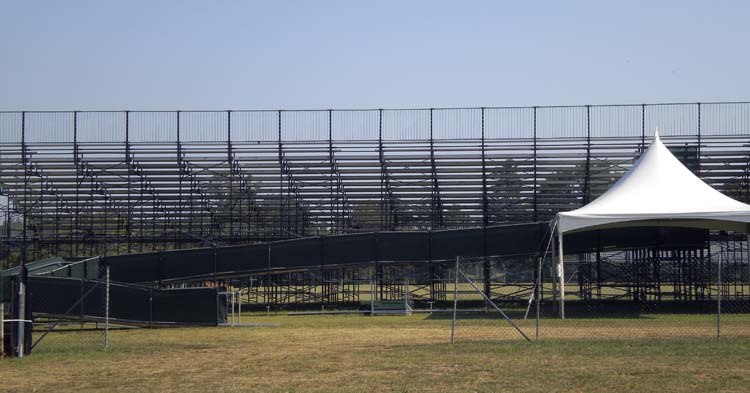
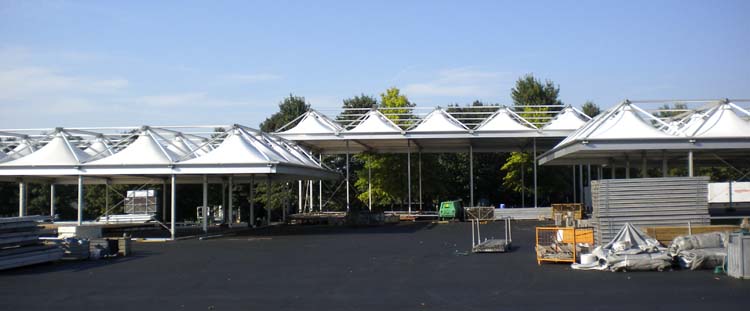
On my way into the office this morning, I drove around the Park a bit and took a few (more) photos of even more tents going up in preparation for WEG.

These first two are next to the outdoor arena, and I have no idea what they’ll be used for.

And this is a portion of the back of one section of grandstand seating at the driving arena:

Things are changing around here by the hour, it seems. In the main parking lot, the trade fair is starting to go up, but when I drove by this morning, there wasn’t enough progress to bother with photos. I’m sure there will be plenty there by this afternoon or tomorrow morning, though! So stay tuned.

Why, you need walls, of course!

First, from Friday afternoon:

all the roofs are raised up on the three HUGE tents chronicled in the previous post … and, yes, all the rooflines are at different heights

Then, from yesterday (Monday) afternoon:

… suddenly (well, several days later), there were walls on each of the three main tents AND a new central, round-roofed tent

… and, check this out … the tall tent in the back looks like it has two floors!

And finally …

workers (Can you see them??) on the temporary grandstand that faces the main (permanent) grandstand at the outdoor arena

« Previous PageNext Page »