competitions


One of my favorite things about the idea of a World Equestrian Games — often called the “Olympics for horses” — is the great mix of horse people. Unlike most “regular” horse shows and events, this isn’t just jumpers, or only dressage horses, or nothing but driving horses, etc.

One of my favorite things about this particular World Equestrian Games, and the fact that I was literally in the middle of it for the duration (and then some) was that I was able to see this wonderful mix — horses, sports, and people — firsthand.

There were jumpers cheering on reiners, drivers enjoying the eventing cross-country, competitors enjoying everything else going on at the venue, and on, and on, and on: two weeks of good-natured camaraderie that revolved around everyone’s mutual love of the horse, no matter what vocation any one person or horse had chosen.

Among all this horsey goodwill, one of my absolute favorite scenes took place late one evening during the first week of the Games.

Many of the Equine Village events aimed at children were stationed outside the CAA office, so we had a good view of children visiting with ponies, troops of spectators walking from the main stadium to the indoor arena for reining and vaulting competition, and the mechanical cutting horse, which invariably drew a large crowd of participants and spectators.

As I was getting ready to close the CAA shop around 7 o’clock one evening, most of the crowds had left our area, but the mechanical cutting horse was still in action. A couple of members of the U.S. reining team and their families were the mechanical horse’s last riders for the day, and they were having a blast. Apparently, the horse’s operator could adjust the difficulty level posed by the cutting horse and its calf (and I think he even controlled the horse’s movements), and most of the people we saw were riding at a basic level. But on this evening, the required skill level was ratcheted up several notches, and the reiners almost looked like they were riding a real cutting horse. I’m not sure a “real” cutting-horse rider would be laughing quite so much, though! It was a treat to see them and their families enjoying the evening and a bit of fun.

Today’s post is the first of six “WEG flashbacks,” in which I’ll share some of my favorite memories, images, and past blog posts from the WEG. These are in honor of the six-month anniversary of the 2010 Alltech FEI World Equestrian Games, which concluded on October 10, 2010.

.

In my opinion, the best aspect of an international sporting event, like the WEG, is the international “flavor” of the event.

People came from around Kentucky, from across the United States, and from all over the world, converging on Lexington and the Kentucky Horse Park for two weeks of top equestrian competition. I saw and met visitors from near and far on my daily bus rides between downtown and the Horse Park, in our CAA gift shop, and all over the WEG venue. Team members and fans decorated their bicycles, their golf carts, and themselves in their national colors and flags and urged their favorite riders and drivers on with cheers and chants and flag waving.

.

people, bicycles ...

.

... and golf carts were all decked out in national colors and flags

.

fans getting themselves ready for show jumping at the 2010 WEG

.

One of my other favorite “international” memories of the event was the lone media event I was able to attend. When we (media) checked in and received our media credentials, we also received a list of daily Alltech-sponsored events we were invited to attend. As lovely as they all sounded (trips, parties, events in the media “chill-zone,” a bourbon tasting, and more), there just wasn’t time to go to most of them. The one I managed to fit in was a special-event Chieftains concert. My husband was (sadly) out of town that night, but it was a treat — after a long day at work — to be able to watch a concert/party with Irish music, bluegrass music, Canadian fiddlers and step dancers, a Scottish singer, bagpipers, Irish dancers, opera singers, and an Alltech-sponsored children’s choir from Haiti.

I read later in our local newspaper that, while they were in town briefly for this special concert, the Chieftains enjoyed a visit and dinner with the Irish WEG team and the president of WEG sponsor Alltech, who is also Irish.

.

Stay tuned for more WEG flashbacks, and please feel free to share your favorite WEG memories in the comments!

On Wednesday, I went to a reception at the KHP’s International Museum of Horse, to welcome Big Lex to his new home.

Who’s Big Lex, you ask?

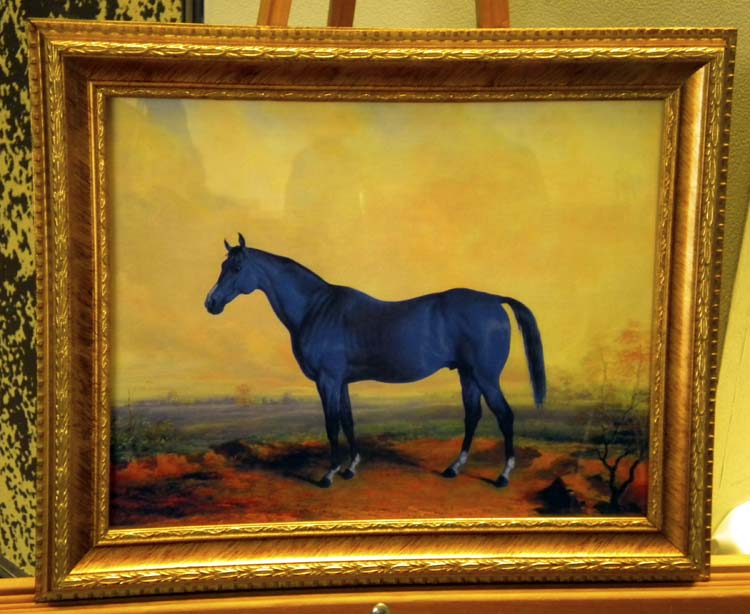
Well, he’s the mascot of our fair city: a bright blue (what we here know as UK blue) horse, based on a painting of the famous nineteenth-century racehorse named Lexington.

.


this is the, um, modified version of Edward Troye's painting of the racehorse named Lexington; in this version, he's Wildcat blue instead of bay


.

Lexington the horse, bred and born near Lexington the city, won six of his seven starts. That doesn’t sound like much today, but many of his races were four miles long!

He went on to a successful stud career and was named Leading Sire in North America sixteen times.

According to Wikipedia: “Lexington was part of the first group of horses inducted into the National Museum of Racing and Hall of Fame in 1955. Not so long ago, Lexington was so forgotten that on a fourth-floor attic catwalk of the Smithsonial Institution’s National Museum of Natural History, [Lexington] was listed simply as Catalog No. 16020. On Tuesday, August 31st, 2010, Lexington’s remains were transferred to the International Museum of the Horse at the Kentucky Horse Park.”

Wednesday, it was Big Lex’s turn to come home. Although he didn’t start out being quite so far away.

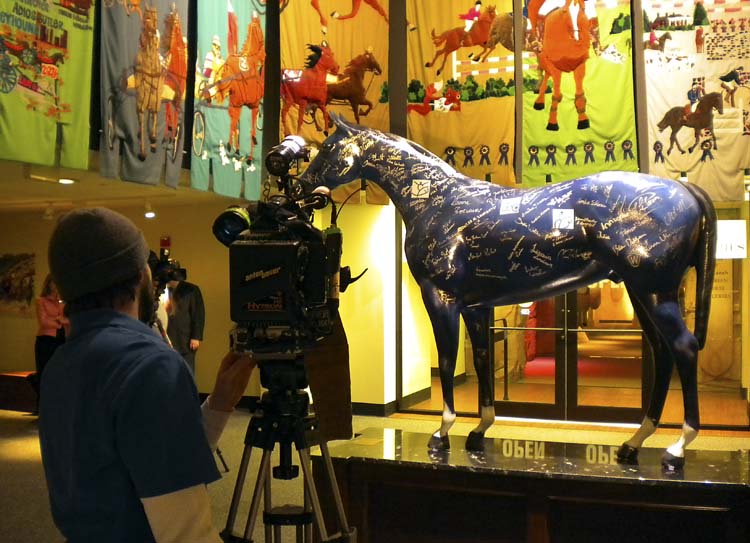
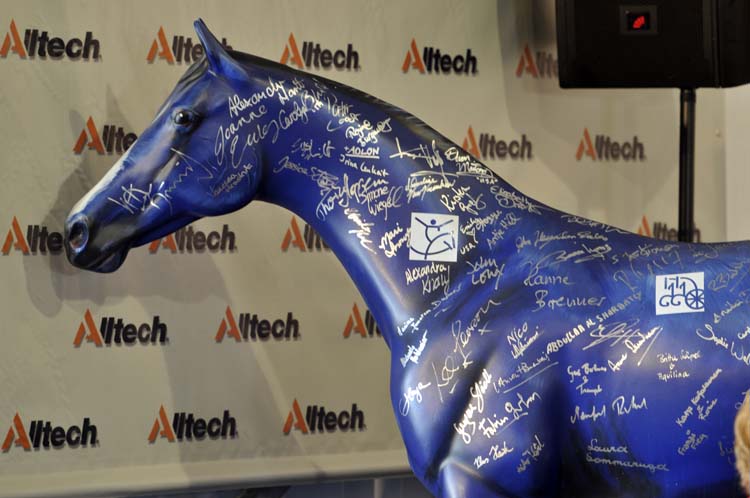
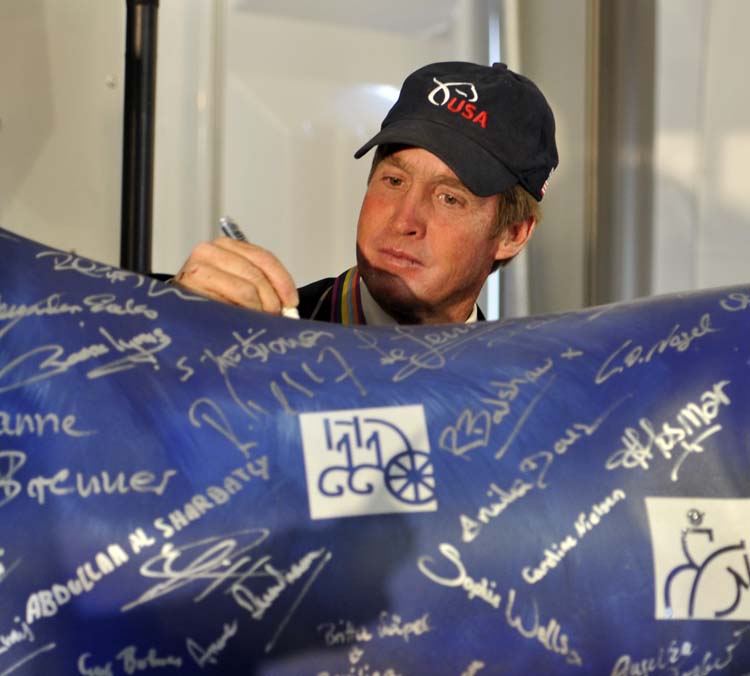
During last fall’s Alltech FEI World Equestrian Games, a fiberglass horse painted to look like the one pictured above stood patiently in the media tent. Here, after every medal press conference, he was signed by medal winners. At Wednesday’s reception, several people said that he was signed only by gold-medal winners (and, truth be told, the number of signatures gracing his blue coat would appear to bear that out), but I know for a fact that the silver-medal-winning drivers signed Big Lex as well.

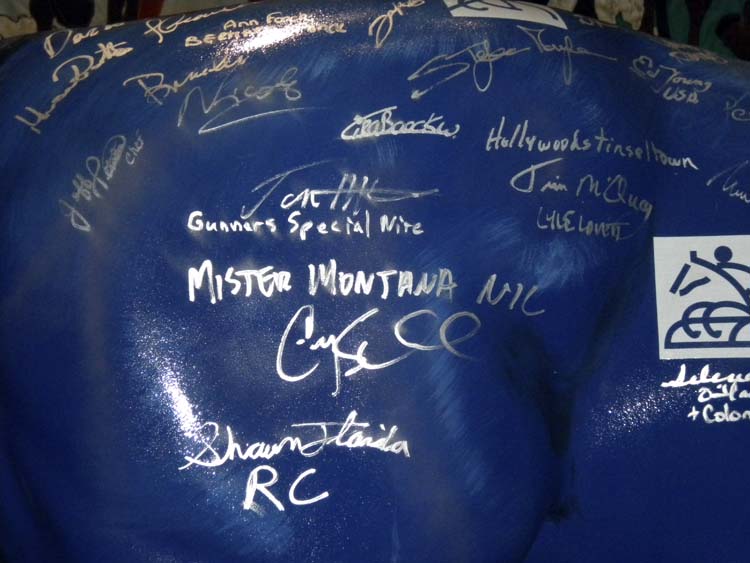
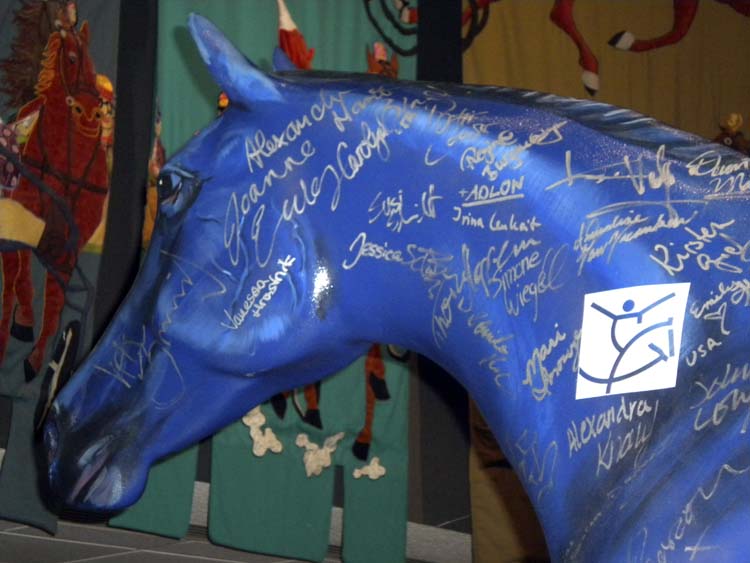
Besides the gold-medalists (and our U.S. driving team), the other signatures on the horse are those of Princess Haya (FEI president), Lyle Lovett (who owns one of the reining horses that competed at the WEG), and William Shatner (who lives near here and performed in the Opening Ceremony).

.

Big Lex, in his new museum home, showing off for the TV news cameramen

.

signatures on Big Lex's offside rump; you can see some reiners' signatures (and their horses' names) and Lyle Lovett's signature on the right

.

more signatures here; that signature to the left of the lower left corner of the vaulting pictogram (on the underside of the neck) is Tucker Johnson's (he won the team silver and individual bronze medals in driving)

My recap of the Driving Championship at the 2010 Alltech FEI World Equestrian Games:

When he came out of the dressage arena, having scored only 30.08 penalty points, Boyd Exell was nearly in tears. Rest assured, though—they were tears of joy.

During his test in the 2010 Alltech FEI World Equestrian Games, Exell could barely stop himself from breaking out into a huge smile—his horses were going so well they were practically “doing it on their own,” he said. The fact that his team was feeling so “on” and self-sufficient was, it turned out, helpful in its own right, as he had broken a bone in his left hand the previous week—while practicing his newest hobby: cross-country jumping.

This was Exell’s fifth world championship in a decade of trying to win it all, and he was certainly off to a good start, with a dressage score that set a new record in world-championship competition.

He admitted later that, on each successive morning, he would tell himself that he had driven badly the day before, in order to push himself to do well on the marathon and cones courses.

This strategy seems to have worked. Following a third-place finish in the marathon phase, Exell stood in the lead after the first two phases and entered Sunday’s cones course with a very slight (1.72-point) lead over the reigning World Champion, Ijsbrand Chardon of The Netherlands.

With one ball down (but no time penalties), Chardon simultaneously secured the team gold medal for himself and his fellow Dutch drivers, and increased Exell’s lead by a few points. Taking advantage of the extra cushion afforded him by Chardon’s mistake, Exell was able to drive somewhat conservatively through Richard Nicoll’s complicated course. In the end, he had no course penalties but 3.52 time penalties. With that, he bested Chardon’s overall score by a mere 1.20 penalty points. Knowing that he had just won the individual gold medal, Exell saluted the nearly sold out crowd as he galloped out of the arena.

When asked what he planned to do after accomplishing his nearly-twenty-year goal of winning a world championship, Exell said that he particularly enjoys building teams of horses that work well together. “So we’ll build a new team and see where they go.”
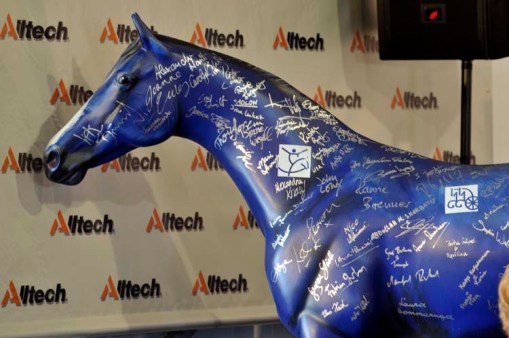


in the spirit of Lexington's "Horse Mania," this blue horse was signed by every WEG medal winner; the horse will remain on display at the KY Horse Park


Medals for the Americans

Following two days of dressage, Chardon was tied for second place with U.S. driver Chester Weber (35.97 points each). Behind them, also tied (with 40.19 points apiece) were Tucker Johnson (USA) and Theo Timmerman of The Netherlands.

And, because each team of three drivers is able to drop one score for each phase and count only the two best scores, the U.S. and Dutch teams were tied for the gold-medal spot after dressage.

The marathon drove well, evidenced by the fact that there were no accidents or serious problems that day. The German team’s chef d’equipe said later that it was a “real championship course.” He wanted to thank Richard Nicoll, he said, “for creating a course that allowed championship drivers to drive like champions and allowed the lesser drivers to finish.”

Among the U.S. team, Johnson had the best drive through the marathon, finishing that phase in seventh place. Throughout the competition, the event announcer had been reminding the spectators and competitors that Johnson planned to retire from competition after this event. So as he exited the final marathon obstacle, he asked his navigator for an update on his time. With a couple of minutes to spare, he stood up and saluted the cheering crowd, which prompted them all to cheer even louder. Johnson said later that he could hear a large cheering section following him on the marathon course. In what must have been a bittersweet moment, he was able to pick out a single voice yelling, “Go, Daddy!” as he entered his final competitive marathon obstacle.

Johnson admitted later that he had found the marathon course to be a difficult one, especially considering the pressure he had placed on himself to have a clean round.

The day was not without problems, though, and the other two American team members didn’t have quite such a good run.

One of Fairclough’s grooms came off the carriage in the third obstacle and, with the resulting ten penalty points, he ended up in fourteenth place in the marathon standings.

In the end, his was not the team’s dropped score for that phase, as Weber accumulated a total of twenty-four penalty points on the course: two for knocking down a collapsible element, ten for a groom dismounting in the fifth obstacle, and then another twelve for a groom dismounting in the seventh obstacle. The result? Weber finished the marathon in nineteenth place out of twenty-five competitors.

Despite the Americans’ bad luck on the marathon, they finished that phase in fourth place among the seven nations vying for team medals.

On Sunday, the drivers faced the lengthy, complicated cones course and a malfunctioning timing clock. The problem with the timer led to several false starts and a delay of about an hour. With the clock fixed, the competition resumed with Weber, who posted the first double-clear round of the day (no balls down and no time penalties). Immediately following Weber, Fairclough tackled the course and claimed the second double-clear round. These two ended up winning first- and second-place ribbons in the cones phase, respectively.

As the competition wound toward its conclusion, the eventual individual medalists each faced the cones course, and each in turn secured their own and their teams’ medals. First of the three to go was Johnson, who had one ball down but no time penalties. Knowing that he had just secured his own individual bronze and the team silver for the U.S., and knowing that he was leaving his final competition, he stood up and saluted the cheering crowd of about five thousand people as he drove out of the arena.

When asked later to describe his feelings on leaving the competition arena for the final time, Johnson said that it “felt good; you don’t always get to end on such a high note.”

before leaving their final WEG press conference, the silver-medal winners in Driving -- the U.S. team -- each signed the blue horse; here: Tucker Johnson, who also won the individual bronze medal ...

.

… Jim Fairclough …

.

… and Chester Weber all added their signatures to the Horse Park’s blue horse as a permanent reminder of their medals won at the 2010 Alltech FEI WEG


ADDENDUM: 

The Dutch won the team gold medal, the U.S. won the team silver and, in a surprise finish, the Germans won the team bronze when the second of two drivers representing Sweden (in third place overall going into the cones phase) went off course and was eliminated.

The drivers representing the U.S. as individuals fared as follows. Josh Rector finished in sixteenth place; Gary Stover finished in eighteenth place; Mike McLennan finished in nineteenth place; Cindy O’Reilly finished in twentieth place; and, sadly, both Bill Long and Casey Zubek were eliminated during the marathon. The tenth and final driver chosen to represent the U.S., David Saunders, had two of his four horses refused in the first horse inspection, and he was unable to start the competition.

World Cup news from www.hoefnet.com:

The Dutch company Chr. Van den Heuvel Carriages will help the drivers who will compete at the first FEI World Cup qualifier this weekend in Hannover, Germany.

The ship’s container with carriages and equipment will arrive in Europe next month, from Kentucky, which means IJsbrand Chardon and Koos de Ronde will not be able to compete with their own carriages.

Van den Heuvel will put De Ronde’s old marathon carriage, which he used during the 2008/2009 season, at his disposal. He will therefore compete with a carriage that he knows well, which is an advantage to him because of the high speed of the indoor events.

IJsbrand Chardon will compete with a new marathon carriage: “Despite the fact that I have had this carriage for two years, I have not competed with it yet. I prefer to compete with my regular carriage because then I know exactly what to expect. As soon as the container arrives, my damaged marathon carriage will go immediately to Van den Heuvel for repair and check-up.”

The double World Cup Champion and World Champion, Boyd Exell from Australia, will borrow Robert Wilkinson’s carriage, which is the same model as his own carriage.

Tomas Eriksson’s carriage was flown from Kentucky, so the Swedish driver will use his own carriage. The competitors list in Hannover on October 30 and 31 is completed with Hungary’s Zoltan Lázar and József Dobrovitz, and wild card driver Christoph Sandmann of Germany.

« Previous PageNext Page »