Carriage Journal magazine


If you have (or had) a copy of the October 2012 issue of The Carriage Journal, do you remember that issue’s “The Road Behind” column? Here’s what it said …

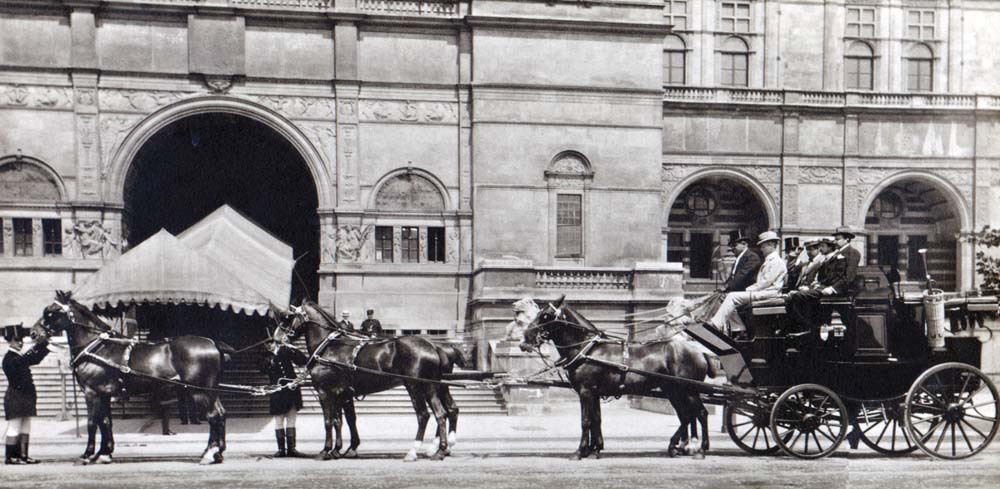
[CAA member] Marc Kelley sent us this photo of his great-great-grandfather, along with a great many newspaper clippings, where we found the following story.

.
.

In the summer of 1900, Albert L. Johnson, a Cleveland-based owner and promoter of electric streetcars, took his Brewster Park Drag and six horses to London. On July 7, New York’s Herald newspaper printed this story, submitted by the paper’s European correspondent.

“Considerable sensation would appear to have been created yesterday afternoon when Mr. Albert L. Johnson, the American coaching expert, drove a team of six horses out of the small yard where he keeps his coach, at Knightsbridge. It had been suggested that he should put on the leaders outside, but this very remarkable driver would have none of that. A large crowd had gathered to see what would happen, and people lined the streets in Hansom Cabs at the curbs, expecting evidently that there would be at least a tangle up.

“Mr. Johnson drove out undisturbed by the amount of attention paid to him and with apparently the same ease as though he were driving a four or even a pair. The team consisted of a shapely lot of bays, three American and three English, with a swing bar connecting the pole and the leaders and running between the swinging team.

“Amid gaping policemen and people, and buses and cabs, stopping to watch Mr. Johnson drive into Hyde Park, there began a series of tests in driving figures of eight and short turns. Then, through the green park he drove through the crowded traffic of Pall Mall, drawing up in fine style at the Carlton Hotel. From there, he turned short round in the street, and through congested traffic, amid the same scene of attention and apparent amazement, drove with fast speed through Knightsbridge, turning in and out, and finally driving through the narrow gate of the Rutland Yard, under an archway in which all on the roof had to bend low, with scarce six inches to spare on either side of the hubs.

“Even with four-in-hands it is customary in the Rutland Yard to put on the leaders in the street, so you may judge how Mr. Johnson astonished them by calmly driving in and out, and all through the journey he never scraped a bit of varnish.”

Check back here tomorrow afternoon to learn more about Mr. Albert Johnson …

It’s been quite a long while since I’ve shared any of the Glimpses of the World photos.

Today’s photo doesn’t have any horses or vehicles in it … at least not that we can see. But, if you happen to have a copy of the January 2011 issue of The Carriage Journal, you may’ve read Andres Furger’s article on Swiss traveling carriages. In that article — and in his 2010 CAA / CWF International Carriage Symposium lecture, in case you were at Colonial Williamsburg and heard it — he talked about this very same St. Gotthard Pass.

.

.

The photo’s caption in Glimpses of the World says, “The king of Alpine routes from Switzerland to Italy is the St. Gotthard. It is impossible to speak too highly of this noble road. Scaling the loftiest cliffs, spanning the wildest torrents, and winding through the deepest gorges, it seems like a gigantic chain, which man, the Victor, has imposed upon the vanquished Alps; the first end guarded by the Lion of Lucerne, the last sunk deep in the Italian lakes, but all the intervening links kept gilded brightly by the hand of trade! It is a splendid instance of the way in which these roads are made to thwart at every turn the sudden fury of the avalanche or mountain torrent. For where experience proves a place to be unusually exposed, a solid roof extends to break the fall of rocks and ice. Still, in these days of steam and telegraph, even this mode of travel in the Alps appears too slow for those who journey here for business purposes, and one of the most important works of this or any age is the tunnel of St. Gotthard. This perforates yonder chain of mountains for a distance of nine and one half miles, yet is sufficiently wide for two railway trains to run abreast. What labor must have been expended here by myriads of men, who most of the time were thousands of feet beneath the mountains, yet who at last, by the perfection of engineering skill, met and shook hands through the narrow aperture which they had pierced from the opposite sides of Switzerland and Italy!”

On Wednesday, I flew to western Michigan to photograph the carriages in this lovely carriage house (on the left); two sweet Morgan mares and a cute pony live in the barn on the right …
.

.

As soon as I’ve downloaded and edited them all, some of the photos I took will appear in an upcoming issue of The Carriage Journal. Others will probably appear here on the blog, so stay tuned.

.

To see a few off-topic-for-this-blog photos from my quick trip, head on over to my other blog: Sunlight on Stuff.

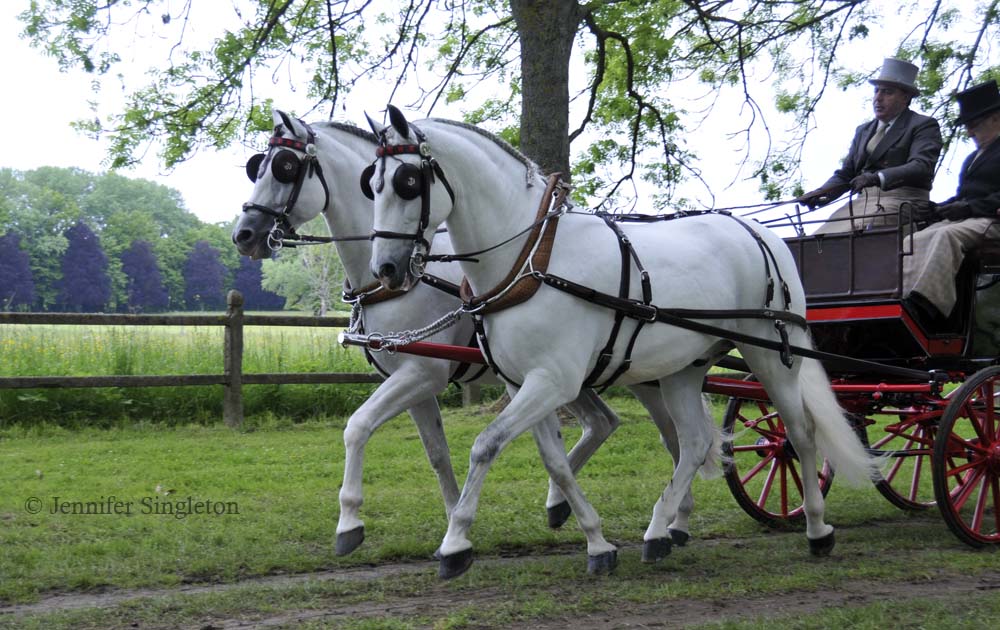
Today and tomorrow, we’re going back to the CIAT Cuts (held in Cuts, France, back in May). The second morning of the competition featured the “country drive” phase …

.

.

.

.

To read more about the entire Cuts competition, see our (A.J.’s and my) article in the August issue of The Carriage Journal. And to see Jacinto Planas Ros (above) and his pair of Spanish horses negotiating one of the exciting driver’s tests during the cross-country drive, check back here tomorrow!

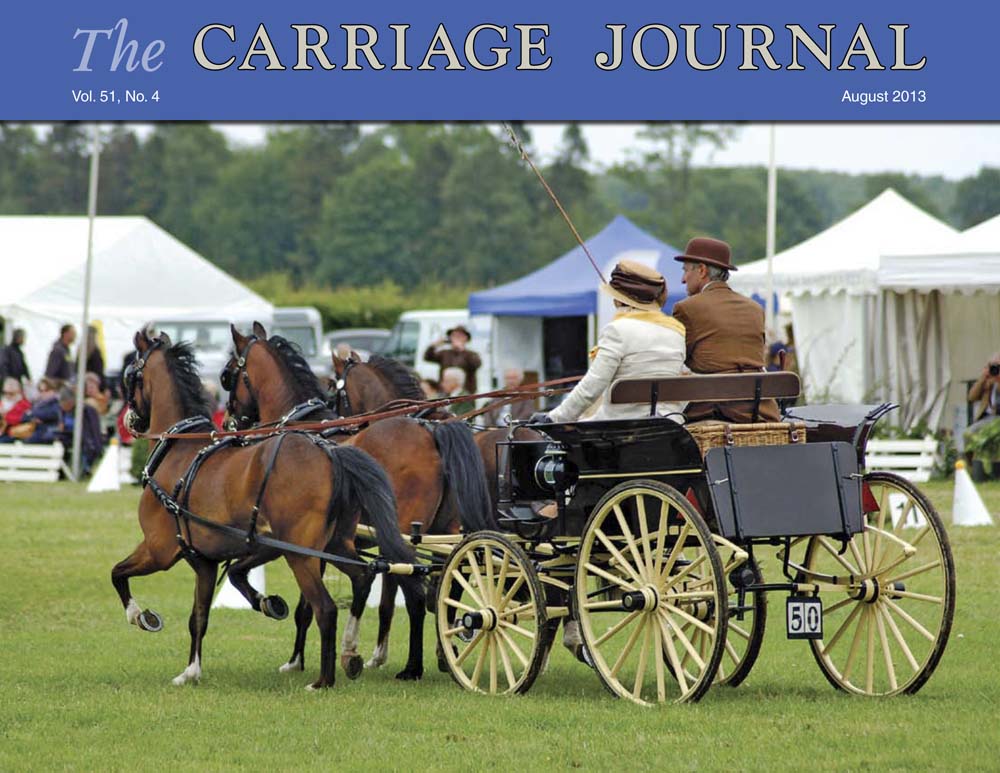
Earlier this morning, we reviewed the proofs for the August issue of The Carriage Journal. It’s going to be a gorgeous issue, if I do say so myself. In it, you’ll find articles on master wagon makers of the nineteenth century, the 2013 CIAT Cuts, steel-spring suspensions in horse-drawn carriages, the winners of the CAA’s 2013 Carriage Showcase, and much more.

Here’s the cover …

.

201308

.

This issue will be mailed on August 1 to all current CAA members and CJ subscribers. If you’re not already one of these but would like to learn more about the CAA and our magazine, and about how to join or subscribe, please do visit the CAA’s website.

« Previous PageNext Page »