This is a quote from one of the European participants in the trip. And he was talking about the day we had. “Awesome,” “amazing,” “fantastic,” or (as our Spanish host, Raimundo, is fond of saying) “marvelous” — none of these seem to do it all justice. To quote the old stereotypical postcard: “Having a wonderful time. Wish you were here.”
We started out the day by going to the offices of the municipal water company for a tour of their building (yes, the water company). It’s just across the street from our hotel and, from the outside, doesn’t look like much. The interior, however, is a beautifully restored monastery, with two cloisters, antique furniture, and a monumental sixteenth-century staircase.

the trip participants in the impressive staircase in the old monastery that now houses the water company
Then we all piled on the bus and stopped briefly by the Plaza of Spain (I think is its name), which is across the street from a huge park and whose massive, tiled building, towers, and bridge have been featured in several movies. On the way there, while several people on the bus were discussing the many (more than a hundred) horse-drawn tourist carriages in Seville, we came upon what appeared to be a Dutch Harness Horse being exercised to a marathon vehicle — down the middle of the street in the middle of all the traffic. It was quite an unusual sight, especially when he objected to stopping for the red light and reared up before settling back down to a smart trot once the light turned green.
After the obligitory tourist stop at the famous square, it was off to the farm of Mr. Ordas. After making our way through the gate, we drove for at least another mile if not more, past eucalyptus groves, farm fields, pasture, and field upon field of olive trees. My description of the gardens, courtyards, and old and newer building probably wouldn’t do them all justice, so here’s a photo of one of the courtyards:
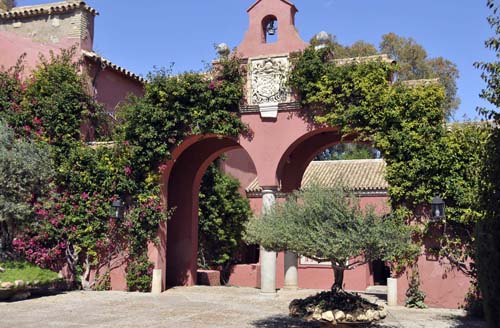
a portion of one of the courtyards at Mr. Ordas’s beautiful farm
From here, we went into one of the stables, filled of course with the most exquisite gray Andalusian horses. Then it was back out into the courtyard and into a lovely carriage house with 26 vehicles. Most of the group enjoyed a long, close look at the collection, while a few went back out into the courtyard to watch the many storks in their huge rooftop nests, flying in and out, standing around, and feeding babies. As I understand it, the storks are considered good luck, and so it is considered bad luck to disturb their nests.
Then it was through the short end of the indoor riding arena on our way to the two-story, round harness room with harness cases around the wall. This room, we were told, had been where the bread was baked in the original buildings on the property. On through yet another little courtyard, and we were out next to the grass riding arena. The setting was impossibly beautiful, with a backdrop of trees, garden, and a large metal and glass greenhouse that looked large enough to hold a fancy party in. Chairs were set up along the short side of the arena, and we were offered homemade lemonade with mint. Eventually, Mr. Ordas arrived, shook everyone’s hand, welcomed us all to his farm, and apologized for his late arrival, but his polo game had just finished. Our group, the polo players, and several other guests were treated to a demonstration of four of Mr. Ordas’s carriages being driven. First, to a background soundtrack of Spanish guitar, came a single, then a pair, then a four-in-hand of Andalusians (at least two of whom were stallions) and, finally, a five-in-hand (three in front and two behind) in the traditional Andalusian-style harness, including all the brightly colored pom-poms and what sounded like hundreds of bells. Each turnout did a bit of a drive around the arena, then at the end they all came in and stood facing us. Mr. Ordas invited our group to go out to take photos or to just look closely at the harness, horses, and carriages. Then he invited anyone who wanted to to climb aboard for a ride.
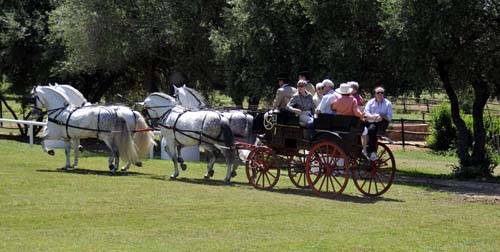
several of our group enjoying a ride in one of Mr. Ordas’s carriages
As we left this farm, everyone seemed to have a happy sort of glow about them.
And then it was on to yet another fabulous destination: the town of Salteras, in the hills above Seville, and the lovely farm of CAA member, carriage collector, and FEI competitor Miguel A. Gutierrez Camarillo.
Here, we met, in Miguel, a gracious host and an incredibly knowledgeable and passionate collector of carriages. It seems odd to call the building we entered a carriage “barn,” as it clearly doubles as display area and living room (with a big dining table, a full bar, plenty of comfy chairs and sofas around the fireplace and TV, and a pool table). But there are also several very nice vehicles here, including an original mail coach, a five-glass landau, and others. Miguel shared stories on each one — how he found it, why he likes it, and why he bought it. And all this while we all drank small glasses of manzanilla.
About 30 minutes after we arrived (enough time to cook the rice), we were treated to a delicious lunch of Spanish paella, fresh bread, and red wine (remember the dining table and all the comfy chairs and sofas??).
Then it was around the back of the property (past the beautifully landscaped dressage arena, the view of the valley from the edge of the hillside, and the view down onto the practice marathon hazards and water) to the “under construction” carriage barn, where the rest his 70 carriages are stored. He had separated them into two groups, with the restored carriages on one side of the big barn, and the original-condition vehicles on the other. Here, again, we were treated to fantastic stories, a demonstration of an old fire pumper, and detailed, close looks at many of the vehicles. Miguel found kindred spirits in many of the die-hard carriage researchers in the group, and they found one as well in him. It’s clear that he knows the subject very well and that he’s passionate about it.
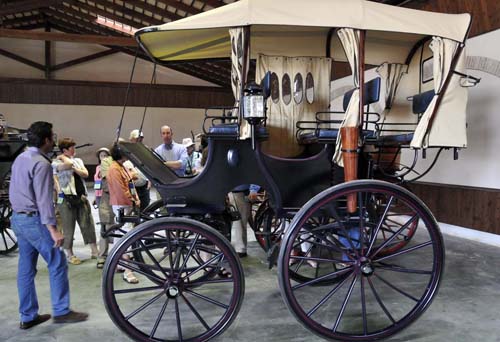
Miguel and several members of the group look at an unusual, recently restored American carriage
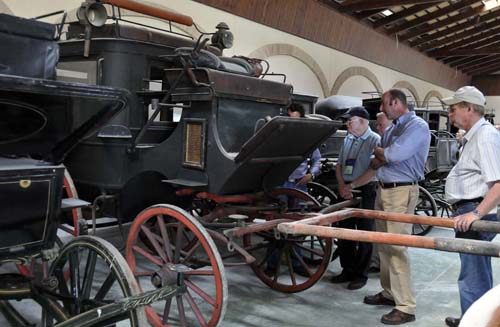
David Freedman and several members of the group discuss one of Miguel’s yet-to-be-restored carriages
Tomorrow, we go see the carriage exhibition (100 carriages) in the bull ring!


 The Slower Road