This is from Volume III of The Carriage Builders and Harness Makers’ Art Journal (published in London and covering the period July 1861 through June 1862):
The First Steam Coach
In 1832, a gentleman, name unknown, flew into a violent state of enthusiastic delight a propos to the first steam coach he, in common with the rest of the world, had seen. We cannot do better than give in the words of the gentleman himself some account of this remarkable forerunner of a new system of traveling. He commences:
“I have just returned from witnessing the triumph of science in mechanics, by traveling along a hilly and crooked road, from Oxford to Birmingham, in a steam carriage. I enclose you a hasty account of our journey, and a sketch [below] of this truly wonderful machine.”
.
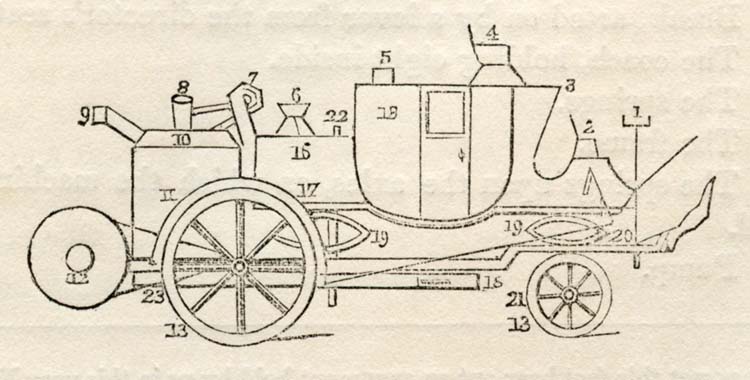
Captain Ogle's 1832 steam carriage, featuring 1: the wheel, or helm; 2: seat for helmsman; 3: boarded seat for four persons; 4: seat for outside passengers; 5: hammer-box for tools; 6: seat for stoker; 7: pipe for surplus steam; 8: jigger through which the furnace is fed; 9: the flue, or chimney; 10: the boiler; 11: the furnace; 12: blower, acted upon by a strap; 13: the wheels, very strong and broad; 14: piston to the pump; 15: the cylinders and machinery carried horizontally; 16: the water tank; 17; brake, acted on by a lever from the director's seat; 18: the coach, holding eight inside; 19: the springs; 20: the frame; 21: the springs upon the axles, on which the machinery is carried; 22: pump; and 23: the cinder-hole, through which the air from the blower goes
.
“It is the invention of Captain Ogle, of the Royal Navy, and Mr. Summers, his partner, and is the first and only one that has accomplished so long a journey over chance roads and without rails.*
“Its rate of going may be called twelve miles an hour; but fifty, or perhaps a hundred, down hill, if not checked by the brake — a contrivance which places the whole of the machinery under complete control.
“The starting from Oxford was a grand spectacle. It was St. Giles’s fair-day; therefore, all the populace, including thousands from the surrounding villages, thronged the streets, reminding the townspeople of the multitudes at a Juggernaut; whilst the wondrous machine, like that idol’s car, appeared ready to crush its votaries. Care was, however, taken to make them understand the danger, and a passage being cleared, away went the splendid vehicle through the beauteous city, at the rate of ten miles an hour, which, when clear of the houses, was accelerated to fourteen. Notice of the intended journey having been carried forward some days before, every town presented an appearance somewhat similar; but it was not till it reached Birmingham that real assistance as well as applause was required, and willingly was it granted. Just as the vehicle was entering the town, the supply of [coal] being exhausted, the steam dropped, and the good people, on learning the cause, flew to the frame and dragged it (the carriage) into the inn-yard of the Hen and Chickens.”
The editors of the Carriage Builders and Harness Makers’ Art Journal continue:
In looking at the above queer statement — and no other term can be applied to it — one almost wonders that so much ingenuity could exist in a man. The idea of a man exultingly saying that such a vehicle could have gone at the rate of 100 miles an hour is laughable, especially when it is considered the roads were in all probability not quite so straight as the crow flies; and, when it is remembered that there were no rails, personally we should not like to have been an inside, much less an outside, passenger. Our candid writer likens the start to that of the triumphal commencement of the ceremonial of the passage of the car of Juggernaut, below the wheels of which it need not be said the [Indians] used to cast themselves to obtain the death of martyrs, till British dominion happily put an end to the practice; but when the hundred miles downhill is considered, we must come to the conclusion that, under the circumstances, the occupants of the carriage ran far more danger of being annihilated than did the good people of Oxford, who made the triumph so complete.
But the best “fun” in the whole of this narrative is the new importation of a term into carriage building and steam-engineering. It will be remarked that the inventor is Captain Ogle, of the Royal Navy; now the captain cannot forget the salt water and all appertaining thereto, even when hard at work upon a manufacture which certainly cannot be expected ever to plough the sea waves. The directing agent of a coach is usually called the driver; this term will not do for Captain Ogle, neither will the appellation of “engineer” suit him, though he himself is a practical engineer, so the captain, having his mental eyes on the “man at the wheel,” calls the director of his steam coach the “helmsman.” Thus we have it at No. 2 [in the sketch above], “seat for helmsman.”
It were curious to ponder on the fate of this steam coach — that it never came into practical operation is very clear; but one would like to know its history, and whether it did really finally make its exit by going over a steep embankment, which surely was its fate if the helmsman took it downhill at the rate of twenty, much less fifty or a hundred, miles an hour.
.
* See tomorrow’s post for an image of a steam carriage being used in and around London in 1827!
 The Slower Road
Join the conversation