… as described and pictured in The Carriage Builders and Harness Makers’ Art Journal, Vol. III (July 1861 through July 1862):
Indian Dress Buggy
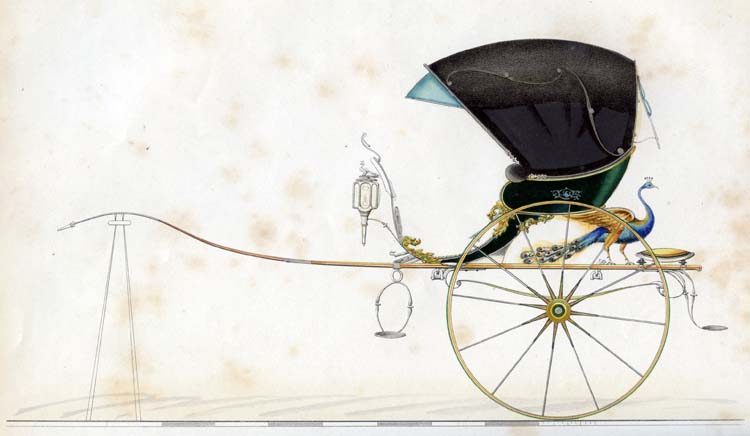
This is a design for a Dress Buggy, to which Messrs. Silk & Sons, of Long Acre [London], have recently built three carriages for Sir Jamsetjee Jejeebhoy, Bart., the millionaire Parsee merchant, of Bombay; one being intended for his own use, and the other two as presents for members of his family.
Of the construction of the carriage we need say little, as our illustration supplies a most faithful design of the original. The body is rounded on all sides; but perhaps the great peculiarity of the design is in the peacocks, which appear to support the hinder part of the body. This is not so in fact, as the support consists in the curved double slips passing from the center of the hind cross-spring to the body.
The peacocks themselves are really works of art. After settling the exact size, form, and proportions required, a pattern bird was carved by a London figure carver. This formed a pattern, or “captain,” as it is called by the herald chasers, from which the real birds are eventually made out of sheet copper, brought up in detail equal to an ordinary chased arm or hammercloth crest. … By this unusual means (at least in coach-building) of making them in copper, great strength was obtained at less weight than in wood, each bird weighing but six pounds. To prevent any sonorous noise, they were filled with wool.
The painting of the body was dark glazed verdigris green, picked a light maize and slightly edged crimson; carriage and wheels a very light maize picked green, and a very small edging line of crimson. The inside lined with light green morocco to all the lower parts; the head being lined throughout with drab silk tabaret, of a small figure, and a sun shade of green silk. The peacocks were painted from life by the herald painter, with the same care, precision, and taste as he would exercise in painting an ordinary crest on a panel. The mountings, such as lamps, wheel-hoops, and headjoints, etc., were of silver, and the armorial bearings were painted in maize relief, showing the peacock crest, with baronet’s helmet and distinctive badge, the whole forming an elegant carriage, and one perfectly unique.
.
 The Slower Road
Join the conversation