As a follow up (or backstory), of sorts, to Wednesday’s post … today’s perusal through more old issues of The Rider and Driver led me to this article, which appeared in the issue that came out one week before the magazine’s Q and A session with Mr. Stevens.
from the April 10, 1897, issue of Rider and Driver:
Up to within a few years little attention has been paid to the systematic production of high-class saddle and harness horses. Breeders and farmers confined their attention to the development of speed, in either the runner or trotter. When this element was lacking in the young animal he was turned into the market as a failure and sold for whatever he would fetch and for any purpose that he might be available. Naturally, such haphazard methods were not conducive to the development of beautiful conformation, stylish carriage, sensational action, and good manners.
Gradually, it began to dawn on the classes using pleasure vehicles that we were behind the Europeans in the quality of our equines, and the sense of pride stimulated the study of the subject with resultant activity on lines which suggested themselves. Horse shows sprang up, wealthy men went abroad to buy fine Hackneys, the parks and avenues became scenes of the livliest rivalry in the matter of equipage. Out of these conditions has been evolved a broader appreciation of the demands of the hour…
Two of the leaders in the new era of horsemanship, to neither of whom, however, applies the remarks concerning antiquated ideas, both of them having been wide-awake and up to date, are now united in their efforts, a condition which not only marks an epoch in the history of the heavy-harness horse, in this country, by the union of bloodlines that will certainly prove advantageous to the horse-breeding industry, but also affords a most worthy example in catholicity of spirit. The event was announced in these columns last week [see tomorrow’s post for a copy of this letter] and caused no mild sensation, as both breeders were supposed, in some misinformed circles, to be so wedded to their especial breeds of horses as not to recognize merit in any other. It is here that their wisdom comes in and it is there that their recognition of one another’s merits places a stinging rebuke on those who have fostered the notion that because a man patronizes one especial kind of horse he becomes a traitor to principle when he favors any other. The gentlemen referred to are exponents of the Hackney (Mr. F. C. Stevens of Maplewood Hackney Stud) and of the French Coacher (Mr. M. W. Dunham, of Oaklawn Stud of French Coachers).
Horses of these respective studs have taken prizes at all the big horse shows and won great admiration for their beauty and style of going. … Anyone with any knowledge of breeding will note at once that the combination of the substance and action of the Hackney with the quality and speed of the French Coacher, both horses having superb conformation, will produce an ideal harness horse.
[Below is] a cut of Cogent, the champion harness horse at New York and Boston, last year, as a sample of what the French Coacher begets. Cogent was bred by the Messrs. Hamlin and has the trotting blood of Mambrino King on the sire side. The crossing of the French Coacher with the native-bred trotter is thus shown to be successful, but Cogent could have more action, which would be present had his dam been of Hackney blood. However, on this point there are various opinions. Aside from any interested motive, we think Messrs. Stevens and Dunham are deserving of the public’s fullest approval for their astuteness and liberality.
.
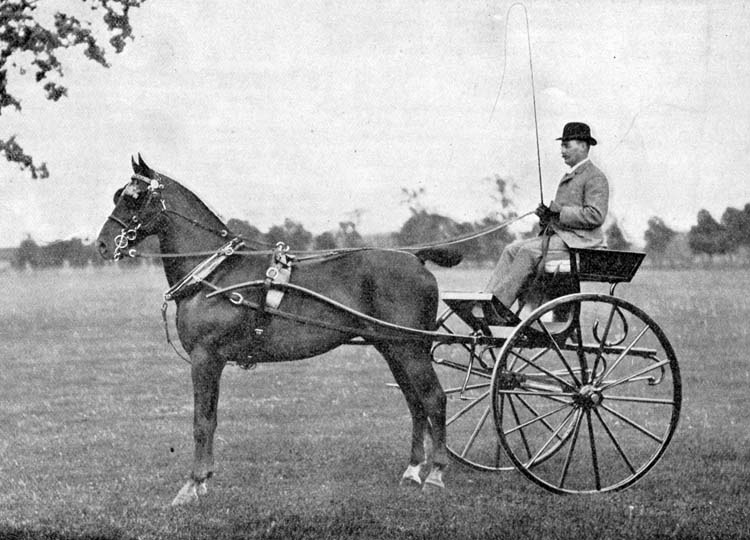
Cogent, half French Coacher, half trotting-bred; winner of first prize at the National Horse Show, New York, 1895 and 1896 (from the April 10, 1897, Rider and Driver)
 The Slower Road
Join the conversation