from the November 26, 1898, issue of The Rider & Driver(published in New York City):
Houses, Stables and Telephones
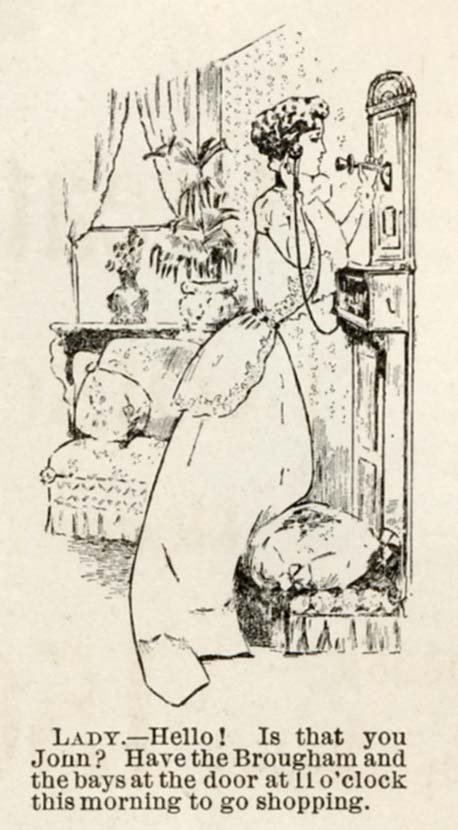
That the telephone service is one of the most useful adjuncts to life in a large city goes without saying. As the New York Telephone Company tersely states the matter, “telephone service in your house puts the whole organization of a large city at your fingers’ ends.” And this is literally true, for in every center of life in New York you find the ubiquitous telephone. Hotels, theaters, clubs, restaurants, stores of all descriptions, livery stables, express companies, railway and steamer ticket offices — in short, every place of any consequence where business is done with the public, or with a section of it, is tapped on to the telephone service and is the next door neighbor, on demand, to everybody else who has telephone service. The enormous convenience of this state of affairs has only gradually become appreciated by private house-holders. The telephone service at one time was considered by many a rather expensive luxury to have in a private house. But the system of charging by the message, adopted some years ago, has changed all that, and a first-class residence in New York is now not considered completely equipped unless it is connected with the telephone service.
.
.
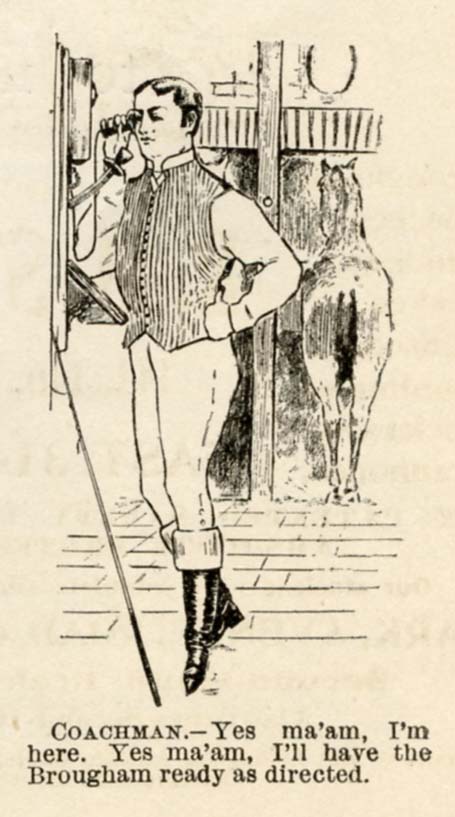
The same applies to a private stable. Private stables in New York are usually separated from the owners’ houses by considerable distances and without the telephone service communication between house and stable is slow and unsatisfactory. If both places have telephone service, not only is the stable as easily available for orders as if it were next door, but it is better supervised, as the moral effect of the presence of the telephone ready to call up at any moment has a decided influence on the stable force.
.
.
The New York telephone system is considered by experts to be the best-equipped and to give the best service in the world. The telephones supplied to subscribers are all long-distance instruments and may be used for talking to any part of the country; the lines are all underground, so that interruptions are very rare, and the service is quick, and available night and day. The actual use of the service, on which the rates are based, is of course much less in a private house or stable than in a business office, so that the cost of the service at such places is proportionately less. The great convenience of the service by reason of its widespread use in all departments of the city life, the ease with which emergencies small and great may be disposed of without friction or delay are what give the telephone service its value in a private house. To many people the feeling of security that results from having at hand a ready means of communicating with the outside world at any moment of the day or night is alone worth all that the service costs.
.
And to think that we now wonder how we ever survived before cell phones and the Internet!
 The Slower Road
Join the conversation