Here’s an unusual “new” sport for a Saturday, which I found in the March 18, 1893, issue of Rider & Driver:
Equestrian Football
In December 1892, five members of Durland’s Riding Academy got together and drew up preliminary rules for equestrian football.
Having no guide and no experience, the rules were necessarily very crude, but since that time they have been materially changed. Two teams of four players each were then organized, and on the 24th of December, 1892, the first game of equestrian football ever undertaken in this city was played.
The first public exhibition game was on December 28, 1892, at Durland’s annual Christmas ride. The teams were [as follows]. Reds: W. S. Elliot, captain; A. F. Brown; D. E. Levey; and H. B. Billings. Whites: M. B. Claussen, captain; W. E. Kotman, J. Meislahn, and F. Staylor. Referee: L. E. Brown. Umpire: B. W. B. Brown. The game resulted in a victory for the Reds by a score of 3 goals to 1. It was a great success and immediately became a recognized sport at Durland’s. Since that time the teams have played at Durland’s on alternate Wednesday evenings; the Reds winning all the games, with one exception.
The game has become very popular, and the teams very proficient. So proficient, in fact, that they would like to try their skill with the Brooklyn Riding and Driving Club team, and have sent a challenge to them through The Rider & Driver.
Summarized, the rules are as follows: The game shall consist of eight men, four on a side, and no horse over 15 hands high shall be used. The ball shall be placed in the center of the field. The game shall be started by one player on each side riding from his goal, dismounting in the center and trying to obtain possession of the ball. The remaining players stay at their own goal until the whistle is blown by the referee. The ball will not be in play until the player who obtains it has his leg across the saddle. Then the whistle shall be blown. A foul shall consist of a player grasping an opponent with two arms around the body or neck, or where the ball is passed forward. The ball can be taken by a player from an opponent if he rides up on the opposite side from that on which the ball is held. A player is not allowed to grasp another player’s bridle, except the bridle of the player holding the ball. In case of a foul, the side making it shall forfeit the ball and five yards. A goal is made by a player carrying the ball to the opponent’s goal, and when the touch is made the player must be mounted. Interference shall consist of a player riding in front of or beside one of his own players who is carrying the ball and warding off the opponents. Interference shall be allowed.
The umpire is the judge for the players, and his decision is final regarding fouls and unfair tactics; the referee is the judge for the ball, and his decision is final on all points not covered by the umpire; both umpire and referree shall use whistles to indicate cessation of play on fouls and expiration of time. The referee shall keep the time. The game shall consist of two ten-minute halves and intermission of five minutes. The goal shall be a piece of canvas twelve feet by eighteen inches, stretched at each end of the field, and shall be covered with chalk. A player shall be disqualified for unnecessary roughness, striking a player, or throwing a man from his horse. A player may throw or pass the ball in any direction except toward his opponent’s goal. A player is not allowed to run with the ball while dismounted, if he does so he forfeits the ball to his opponents. After the goal is made the ball shall be put in play as in the beginning of the game; at the end of the game the side having the most points shall be declared the winner. A player losing his horse after or while obtaining the ball forfeits the ball to his opponents.
.
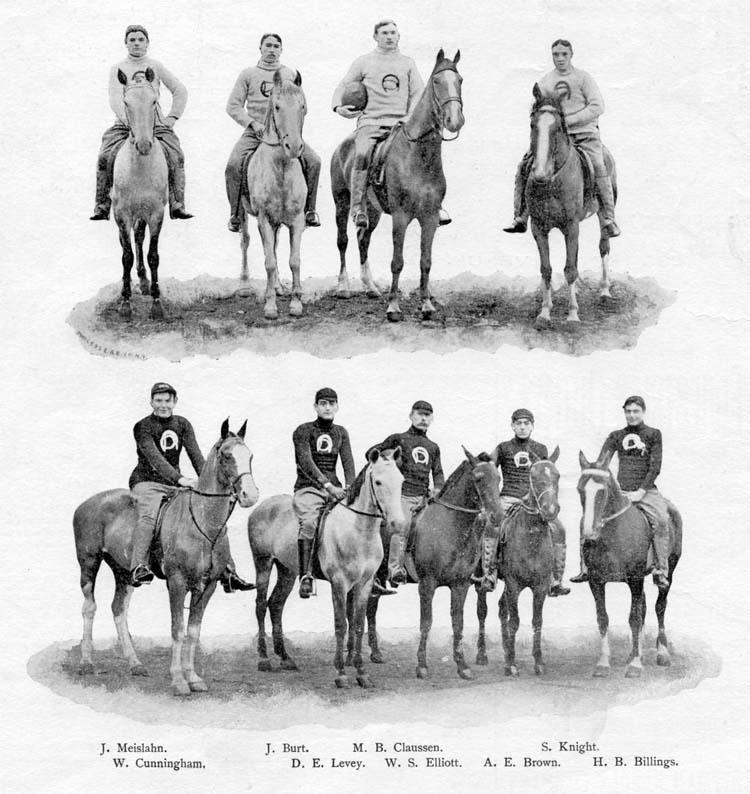
the Whites and the Reds, ready to play a game of equestrian football (from the cover of the March 18, 1893, issue of Rider & Driver)
 The Slower Road
Join the conversation