This past weekend, the CAA Board of Directors met in Stony Brook, New York (on Long Island). They had invited CAA members to join them there as well for a “members’ trip,” which included tours of area attractions. Two of the members on the trip were Tricia Haertlein and her sister, Barbara. Tricia sent us the following fantastic report of Friday evening’s and Saturday’s activities. Tomorrow, we’ll have a link to some of the photos she took during the tour. Enjoy the tour!
We just got back from the CAA meeting at Stony Brook, Long Island. And what a great time! Work responsibilities meant we couldn’t get there until Friday afternoon, but there was still plenty of time to tour the renovated carriage galleries at the Long Island Museum. While we missed the CAA tour of the galleries still under construction, what we did see was wonderful. As you walk into the building, the Grace Darling is there front and center (http://www.obhs.net/Images/GraceDarling1.gif). And here’s an older article about the museum to give you a brief picture before the new galleries: http://www.offbeattravel.com/carriage.html.
Ramps lead from room to room, circling the large vehicle, letting you see her (the GD) from all sides – though I admit I wish I could get a little more up close and personal to see the beautiful paintings she’s covered with.
There’s a room showing various carriages and their uses, and another recreating a “carriage exposition” as it would have looked at one of the late 1800s worlds fairs. There’s even a room preserving a small carriage manufactory from Massachusetts, showing all the belt-driven machinery needed to put carriages together. As we walked through the galleries, there was a Girl Scout troop pinging around like the balls in a lottery machine – it was fun seeing their enthusiasm for the carriages and listening to the little tidbits they picked up off the signs – “Yeah, Tiffany… ALL of these were pulled by HORSES!!!” and “Girls, come here – this is a FIRE Truck.” We totally understood how that was confusing, as they were looking at a completely blinged-out parade hose truck.
It was like this one, only all silver and chrome, and with more bling: http://farm4.static.flickr.com/3530/3715194086_f8cbeb4e55.jpg.
I understand the new galleries will include a carriage house, complete with a lift for moving the sleighs upstairs for the summer and a tack room, along with many more carriages and displays of fittings and accoutrements needed to create a well-turned out vehicle. So you know, their library is a terrific resource to find out more about all these collections from the point of view of a carriage researcher.
There are other art and history displays in additional buildings, but it was time for us to leave to check into the hotel and change for a super dinner at the Three Villages Inn. Dinner was terrific, and we heard quite a few people saying, “No rubber chickens here.” Our table is an example of why these types of meetings are such fun. We just sat down at an empty table and let it fill naturally. Barb ended up next to a lovely lady from New England (a recent CDE/HDT convert), a mother and adult daughter from Ohio were next to me (they ride and drive Welsh ponies), then two couples joined us, one from Utah (Standardbreds, mostly for fun) and the the Ashfords from California, whom we’ve met several times before (pure Landsdale and Wineslander ponies). It didn’t take long before we were all new friends, laughing and enjoying ourselves enough that I know at least one other table was looking at us wondering what was so much fun over here. Add to that, it was a chance to chat and catch up with old friends we haven’t seen the last few years as we’ve been busy with other sides of life.
During the dinner, the museum presented a slide show showing their plans for the galleries in progress (mentioned above) AND we had a door prize. Now there’s a back story to this door prize (isn’t there always?). When we sat down at the table, we all found those fun door bell jinglers Smuckers used to have. Jerry and Rita Trapani, who put this terrific meeting together for the CAA, had acquired enough to have us all jingling away. After we sat down we set to figuring out who had what shapes. Where others had the jingly key chains or horses or maple leaves I had a white amorphous shape we were all guessing might be a cat or “something,” possibly a rabbit. Now, we have several of these jinglers at home, from visits to Smuckers, shows, seminars, etc., so I decided to see if anyone who had “only gotten a keychain” wanted to trade their simple keychain for my “shape. No takers. OK … we’ll take it home for the “collection.” So, was I surprised when Rita announced there was a white rabbit out there and the holder was getting a door prize. Yup … my amorphous shape was that white rabbit and it meant we got to bring home a print of one of Rita’s famous and lovely carousel horses. THANK YOU AGAIN, RITA; he’s very handsome.
Saturday was supposed to be a day of rain, but that didn’t stop fifty of us from signing on for a bus tour of Long Island barns led by Rita and Jerry; in fact, this was the reason Barb and I were at the meeting. We’re always up for a historic barn tour. Lucky for us, it was mostly just cloudy and any rain seemed to hold off until we were indoors.
We started out touring the polo barn at the estate of Marshall Field, now Caumsett Park, on Lloyd’s Neck. The North Shore of Long Island is made up of may “necks” or isthmuses out into Long Island Sound, where many of NY’s wealthy set up summer homes from the mid 1800s through the early 1900s. Caumsett has a lovely brick barn with beautiful windows and lovely old stalls; iron and brass above tongue-and-groove wood bottoms. The yellow herringbone brick floors and stalls were very like those in Gladstone’s Hamilton Farms near our home. The base design works well, with a lovely cross breeze through center doors front and back. In the summer, the warm air rises through high windows and ceiling vents. In the winter, the hay stored above and the brick walls help insulate the barn so the horses’ body heat keeps things from freezing for the most part. See http://www.shorpy.com/node/6051 and http://lh5.ggpht.com/_5VuwJGl83lw/RmittTlztJI/AAAAAAAAABE/nOY3HCD9O6o/DSC_0250_edited-1.jpg.
The barn was renovated in the 1970s just prior to its being used in the film Arthur with Dudley Moore. Lucky for us, it is in use (it’s leased to a concession that boards and trains horses), which helps keep the building in shape. Unluckily, the building shows that keeping up these wonderful buildings is an ongoing struggle. It’s sound, but it could use another facelift since the last one was thirty-plus years ago.
An interesting side show was available at the Caumsett barn. Apparently, the Subaru of one of the local riders was “spooked” by our bus and jumped a telephone-pole parking-lot marker. As we were leaving the barn, folks were working with a tractor to extricate the car, which was caught over the jump!
Our next stop was Ambrose Clark’s Old Westbury, which is now the home of SUNY (State University of New York) Old Westbury. The fourth and fifth photos here show the stable: http://www.oldlongisland.com/2008/07/broad-hollow-house.html.
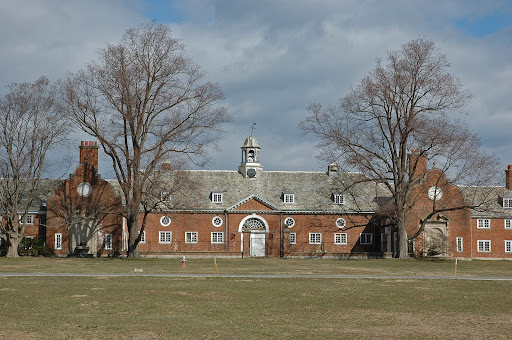
The 340-plus-acre estate was given to the school with the stipulation that it always allow horse use of the land. Mr. Clark was NOT a fan of the car over the horse, and at one time requested that his guests leave their cars at the estate entrance and wait for a carriage to pick them up. We visited his stables, which have been deserted for some time. The main stable is a lovely full courtyard building with stalls along the sides and coach house, tack rooms and, I understand, a veterinary suite along the back. It appeared that the front was housing for those working there. Additional shed-row stables and stone-walled paddocks are still in use by the Meadowbrook Polo Club when they are on Long Island. We were met at the stable by a Paumanauk Driving Club member and members of the SUNY Old Westbury’s chancellor’s staff with hot cider and yummy cookies – a wonderful surprise for a damp morning. We saw “washing carousels” in this barn, something we haven’t run into before. A hot and cold water line are mixed at a faucet leading to a line running up onto the ceiling, where it was connected to a circular track. You put the horse or carriage over a drain, then you pull the hose around the horse/vehicle to clean easily without dragging hoses around. Since it ran on the overhead circle rather than an arm extending from the wall, you had 360-degree coverage. Sadly this building is in need of much love and attention, but hopefully it can be found. The Meadowbrook Polo Club and the university are trying to come up with a plan to incorporate the building and the mandate for horse use of the property into a renovated barn and classroom space that may lead to interesting things for the site in the future.
One more stop before lunch: a Bentley dealer with an antique department which had two Brewster-built body Rolls Royces in the showroom. Apparently, Jerry and Rita are also antique car buffs and Jerry had noticed the cars and asked if we could come see them. Not only did the dealership welcome us in, Jerry’s connection gave us a great talk about early autos and coach-body cars in general and Brewsters in particular. He also made himself universally acclaimed by offering the use of the dealership’s bathrooms as well. It was MUCH appreciated by all and we were all impressed by the marble tiled, mahogany, and frosted-glass stall doors and other luxurious appointments.
The cars were gorgeous with enormous long hoods and every attention to detail throughout. In one car, the Brewsters had developed a door to make accessing the rumble seat a bit easier; not easy – just easier. In the other, we were treated to a passenger compartment that was still in original condition with Bedford cloth seats, door panels, and foot rest; carpeting; even a clock set in the wall between the passengers and driver.
On to lunch on the South Shore of LI via a road that was the end of a coaching run from NY. The road was distinctive for its width, allowing coaching teams to “make time” on their way to the stop.
By the way, I don’t want to forget to mention… Jerry and Rita spent a lot of time putting together a nice booklet of clippings, pictures, and information on the area, the places we were visiting, and more.
After lunch, we drove by W. K. Vanderbilt’s Idle Hour, home of his racing stable. The estate is now Dowling College and the main house, farm buildings, and even carriage house, though still recognizable, are converted to college use. You have to say that carriage house/stable (now student center) is HUGE: http://www.flickr.com/photos/dclibrary/2421934182/in/set-72157604608723051/.
Next, we headed to Bayard Cutting’s Westbrook, an arboretum and summer cottage that was built on land that once was Lorillards Thoroughbred breeding farm. The arboretum is now open to the public and we were able to tour the summer home full of beautiful woodwork and wonderful views from all the windows. The weather was starting to turn at this point, and we were anxious to continue back to the hotel so we didn’t have the time or weather to take the short hike to the carriage house, which was converted to an educational center. This arboretum is very popular for photos après wedding and, sure enough, as we pulled out of the driveway, a white stretch limo was pulling in – drizzle and all. See http://www.bcahs.net/gallery/bca-gallery/.
Onward then to our last stop: the reason the Vanderbilts, Cuttings, Lorillards, and others built large estates on the South Shore of LI, the South Side Sportsmens Club. Started from a stage-stop inn popular for men interested in hunting ducks and deer and in fishing, the club grew into several buildings where men could come and “rough it,” fishing and hunting to their heart’s content. We were met at the club by Gil Bergen, who told us he has worked there in one capacity or another since 1945. Mr. Bergen presented a brief slide show on the history of the area and showed us through the public rooms of the club.
Interesting note here: Lorillard, Cutting, and others were familiar names for us, as those families also had homes in the Far Hills area of New Jersey and many other places. Barb and I decided it must have been tough to keep track of which house you were supposed to be living in THIS week.
After our tour, we mounted the bus one more time to head back to the hotel to then make our individual ways home. Jerry and Rita’s planning for this trip was so complete they even supplied Steve, the bus driver, who could drive with the best of them. He drove us down highways, through small towns and even smaller streets, and into and out of narrow park roads. He backed the bus down impossible driveways and turned around where there didn’t seem to be room to turn. He even negotiated “cones” courses set up at each park entrances and to direct traffic in the park. All without hitting a thing. I was just about to talk to him about running some cones clinics out in NJ when I realized there was one problem. He was used to driving a bus with nothing in front of him and loads of “coach” to pull along behind… How would this translate to driving the horse(s) out front with less to manage behind?
One final note: our old friends Jerry and Rita managed to put together a day trip that did exactly what it meant to do – show us there is a LOT more to Long Island than JFK Airport and the Long Island Expressway. On our way back to the hotel, Rita and Jerry pointed out their home in a neighborhood next to the park. What looked like a suburban built out area was actually chock full of backyard horses who live in “backyards” and flourish in the parks. As was true throughout the island, all was not as it seemed.
Thanks for a great weekend, CAA and Rita & Jerry Trapani!
 The Slower Road


August 4, 2010 at 8:08 am
Thank you for the nice days
I liked again to see Stony Brook
and the nice collection of carriages
also thanks for Rita and Jerry